OBITUARY
Martin Seymour Osman
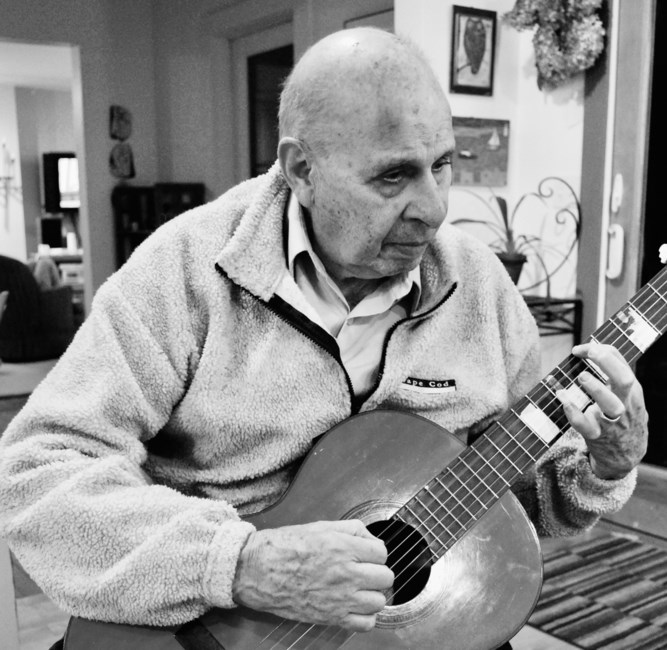
Dr. Martin Osman of Newton Highlands, Massachusetts, an applied physicist, World War II veteran, and blind inventor, died peacefully at home on June 4, in his sleep. He was 101 years old. The cause was old age.
As a blind carpenter, Marty whistled through his teeth as he worked by memory with intense concentration and endless patience. He was a kind man who worried about everyone’s comfort and safety, from his family, to his caregivers, to the workers of the world. He studied guitar as methodically and slowly as he did everything. He was an aficionado of classical music and he was a very funny person.
Marty was born in Brooklyn, New York on March 12, 1925, the youngest of five children of Rebekkah (Zepnick) Osman and Joseph Osman, a shoemaker. Marty’s parents had immigrated through Ellis Island in 1913 with the two oldest children. They spoke only Yiddish, and Marty’s first language was Yiddish. He attended Stuyvesant High School of Science in lower Manhattan. He credits his much older siblings with cultivating his scientific interests.
After high school, Marty served in the U.S. Army, training first as a combat engineer. Fortunately for him, his battalion was not needed and, in 1943, he was sent to New Guinea and the Philippines with an engineer survey company. It was in the army that he first noticed limitations to his vision, and many years later he was diagnosed with retinitis pigmentosa, a degenerative disease that causes increased night blindness and tunnel vision. He retained a little sight until he was in his eighties. Marty was assisted by three beloved guide dogs, Yashee, Nick, and Valor.
Marty met Florence Shir at her friend Sylvia Bashkow’s Brooklyn square dance party soon after he returned from the Pacific. They dated while Florence studied at Smith College and Marty was at MIT. They married in June, 1950 and were together until Florence’s death in 1995. They had four children, Eric Osman (Stephanie) of Amherst, MA; Willy Osman (Rob Kaulfuss) of Waltham, MA; Emily Passman (Bill) of Lexington, MA; and Franny Osman (Bill Freeman) of Acton, MA. Marty is survived by five grandchildren, Roz (Freeman) Mish (Taylor Buehler Mish) of Jamaica Plain, MA, Maddie Freeman (Michael Friedman Freeman) of Acton, MA; Joseph Freeman of Brooklyn, NY; Leo Passman of Lexington, MA; and Aliya Osman of Amherst, MA; and two great-grandchildren, Florence Jo Freeman of Acton, MA and Forrest Akiva Mish of Jamaica Plain, MA. Marty also leaves many close cousins, nieces, and nephews. He was predeceased by his four siblings.
After the army, Marty earned a bachelor’s degree at MIT and a masters at University of Illinois, Urbana-Champaign, both in mechanical engineering; then a doctorate in applied physics at Harvard University. Marty worked at IBM in Kingston, NY, United Carr in Boston, as an instructor at MIT, and, for many years, at Polaroid Corporation. At Polaroid, he worked on a sonar transducer for autofocus and invented the “osmanometer” for detecting defects in Polavision film. The Polavision movie camera was a famous flop, and Marty liked to joke that he helped Polaroid lose $90 million faster.
From the early days of losing his eyesight, Marty cared passionately about safety and independence. He cut a hole in his briefcase and put a car headlight into the side to alert cars as he was crossing the street. Every sharp point in the house was adorned with a protective tennis ball. The swingset was stabilized with cement anchors. Marty taught himself home plumbing, electricity, and carpentry by reading books and became very skilled at this work, using his father’s tools, and power tools that he taught himself to use. As he lost his eyesight, he not only built furniture and dollhouses, he devised safety measures, such as a wooden jig to guide the wood safely toward the blade of the table saw, to protect his fingers. He wore safety glasses until his last year, even for gentler projects, and insisted that everyone should.
Marty devoted many project hours to his family’s interests. He built two coops for son Eric, who raised homing pigeons. He designed a puppet theater for Willy. He taught Emily to use pop rivets for building a trellis, and trained Franny in drilling clearance holes when screwing wooden boards together. He cleared the cellar for noisy rollerskating with metal-wheeled skates on cement. He supported his children as they roamed the nearby swamps with hip boots and collected animals. He appreciated a relative who brought him, when he was young, to a pond in the Bronx to collect plants to put in his fish tank. He built countless bookcases and cabinets for relatives. He designed and built trammels to level paving stones; rock drainage systems; and a helix-shaped brick garden path. Eric remembers him creating Lissajous patterns on the oscilloscope screen.
A lot of Marty’s interest in carpentry concerned accessible designs such as an octagonal holder to help his wife open a bottle when her hand was weak; a laser to shine onto the stove to help someone with low vision hone in on the middle of the pan; and cleverly placed handrails. Marty taught everyone to see disability as a puzzle to be solved, rather than a hurdle.
When Marty was 89 and now completely blind, he was taking a course in using a screen reader at West Haven, CT Veterans Administration Hospital. When he arrived, he walked to the nurse’s station using his white cane with the marshmallow-shaped roller tip. The staff handed him linens to take back to his room as well as a support cane to use in addition to his white search cane, as they noticed he was a little unstable. What to do? He now had three things to hold and only two arms. He pondered the problem for many hours. He ended up affixing a little rubber “bump dot” to the end of the tip of his search cane. Now he could lean the cane up vertically and use it to keep his balance as a walking stick, or hold it at an angle to search. For the next 13 years, he perfected the design. He started with a folding white walking stick with his “dual mode tip”. He spent a few years writing a patent application and was ultimately granted the patent, Dual Mode White Cane. His workshop was a museum of walking sticks and search canes.
Marty pointed out that, while blind walkers are particularly vulnerable to falls, everyone is at risk. He said, “Everyone who falls says the same thing, ‘I didn’t see!’” So his later designs were made of multiple colors. He called these sticks the MOSS (Mobility Optimization Stability Sticks or Marty Osman Stability Sticks). Later, he designed a non-folding stick made from a dowel, and he would spend hours wrapping the handles. Family and caregivers would drill holes in the ends of the dowels and Marty would screw in a rounded tip.
Marty was always right. When he was designing a helical brick walk to ascend a hill on one side of his house, he would send sighted relatives outside to place stakes in the ground and make measurements with string, laser and compass. One day, an argument ensued about exactly which direction a particular stake and string were oriented. As usual, Marty was right. The sighted family member who had placed the stake got it wrong. Marty had a marvelous mind.
Marty was not always right. He had trouble hearing criticism about business and engineering, and became arrogant and delusional when waxing enthusiastic about the size of his company, Valor Dual Mode Canes. Despite the clever design, patent, prototypes, and consultation with helpful professionals in the manufacturing and mobility fields, he was not able to achieve his dream of putting a stick into each and every world citizen’s hands. He did, however, give away hundreds of his canes and distributed samples at Mass. White Cane Day, blind support groups, and senior conferences; users were thrilled to be able to stand up from a chair more easily, stay balanced, and walk upright while using them. Some hikers climbed mountains with the sticks.
To the end, Marty could remember authors’ and actors’ names, details of his army service, world history, politics and, most importantly, names and relationships of everyone in his family. He was the go-to person for the curious.
Shiva will be held at the family home on Tuesday, June 9th, from 4:00 PM- 9:00 PM.
Donations in Marty's memory can be made to Lawyers for Civil Rights, Martha’s Vineyard Land Bank, or the Fidelco Guide Dog Foundation.
Show your support
Add a Memory
Share Obituary
Get Reminders
DONATIONS
Lawyers for Civil Rights61 Batterymarch Street, Floor 5 , Boston, Massachusetts 02110
Martha’s Vineyard Land Bank40 Meetinghouse Way, Post Office Box 2057, Edgartown, Massachusetts 02539
Fidelco Guide Dog Foundation103 Vision Way, Bloomfield, Connecticut 06002
SHARE OBITUARYSHARE
- GET REMINDERS
v.1.18.0