
OBITUARY
Hai Seng Liang 梁海生
May 6, 1934 – December 30, 2021
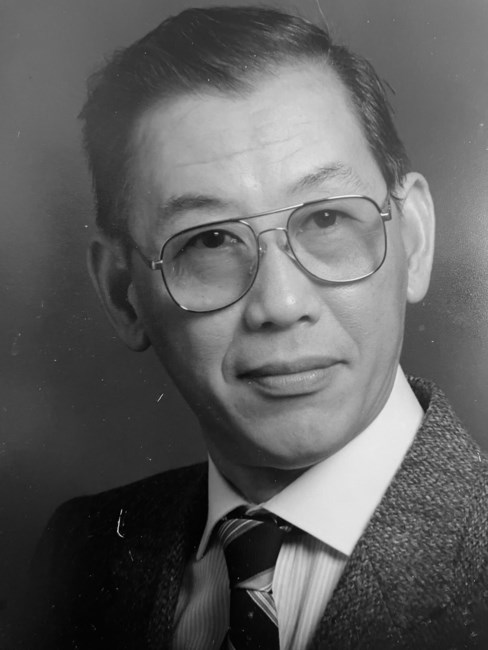
The sun rises from distant shores, peaks high above the Fujian mountains, and sets once more as it has for 梁海生, Hai Seng Liang. Surrounded by mountainous terrain, ocean shores and the changing winds of time, Hai Seng Liang was the eldest, surviving son of a well known author and educator father, 梁士杰, and a loving mother, 莊寶珍, in Xiamen, China. His father’s innovative writings on early child education were taught in universities throughout China. During his youth, Hai Seng experienced much love and joy from his family, but also witnessed strife, discrimination and the suffering of his people as historical events swept through the land of his birth. These experiences profoundly shaped his intellectual, emotional and moral core for the remainder of his life.
As a young boy, he and his family escaped the Japanese invasion, as they sheltered in an ancient toulou building, hidden in the mountains of Fujian province. There, he befriended a young girl named, 曾丽丽 Zheng Li Li . She was from a well-to-do family in the coastal city of Xiamen. This chance encounter set in motion a shared destiny for both families. Their parents knew each other, and soon they too became close friends. In 1949, they parted ways when his father took another Headmaster position in the Philippines, and then Indonesia, to escape the Chinese civil war.
As the civil war ended, and a new China emerged, euphoric political winds swept across the country. In 1951, at the age of 17, young and idealistic, Hai Seng envisioned a new China where his people could rise above the toils of history. He was eager to contribute, and thus sacrificed the comfort and protection afforded by his parents in Indonesia. Instead, he was swept up by unseen, historical forces and by his love for the girl he had met in the mountains of Fujian. In so doing, he left behind the warm and nurturing mother whom he would never again see.
Like the thousands of expats who returned to China, he found himself mired in complex, political structures which forebodingly set the stage for years to come. Soon after his arrival, he once again reconnected with Li Li just before they both set off to study at universities—while he went to Dalian Naval Academy, she attended Hebei Normal University in Tianjin. They remained in contact while both were pursuing their prospective education. Not long after graduating, they reunited and soon after, were married in 1956. Their early lives were fairly unremarkable; they were optimistic and hopeful about their own and their country’s promising future. In a very short period, they had their first-born son 汉中 Han Zhong. Three years later came 汉武 Han Wu , and soon after arrived their youngest son, 汉昌 Han Chang. Eventually, they both taught at the Maritime Academy in Wuhan and settled into a routine academic and family life, on a small college campus, along the southern banks of the Yangtze River. Essentially, like the lives of millions of Chinese people during that era, this remarkable man’s profound, personal journey contributed to the development of a newly modernizing China.
Eventually, the euphoria and hubris of change, ominously gave way to another dark, tumultuous period of Chinese history, known as the Cultural Revolution. During their remaining years in China, his family endured indescribable suffering under the fervent influence during the Great Leap Forward and the Cultural Revolution. This once idealistic young man, who returned to China with hope, optimism and calling, was burnt by the flames of the rampaging Cultural Revolution. He was educated under this new sky, rose to become a much-loved and respected college Professor, but was later purged to labor in the rice fields in Sa Yang, Hubei. He and his generation of idealistic and educated young men and women, made immeasurable personal sacrifices in their efforts to change the course of history. However, under the weight of the political fervor, Hai Seng soon left academics and worked at an electric power plant in Wu Chang, Wuhan. In no small manner, they and their generation succeeded in educating generations of young Chinese—lifting hundreds of millions of people out of illiteracy and poverty. In essence, they sowed the seeds of today’s modern China.
In 1974, with his mother’s health failing, the Chinese government granted permission for Hai Seng and his two oldest sons to visit his parents, who by then resided in Winnipeg, Manitoba, Canada. Unfortunately, because of complicated, bureaucratic procedures, they arrived two months late to Winnipeg. Therefore, his parting good-bye to his mother was instead as a hopeful teenager, on the Tanjung Priok pier in Jakarta, Indonesia , when he departed for China.
It wasn’t until 1976, two years after his arrival in Canada, that his wife and youngest son were allowed to join the family in Winnipeg. There, Hai Seng dutifully settled into a prosaic life in his newly adopted country.
This time the external forces were subtle, yet equally persistent as he adjusted to a foreign land—learning a new language, and navigating through cultural morass, all the while seeking a way to provide for his family. Fortunately, Hai Seng was a learned man who saw education as the golden ticket to a better life and greater opportunities. During the evenings, he studiously hit the books and advanced his own curiosity and professional credentials in the nascent field of computer programming. He knew that with his language limitations, and not so subtle racial discrimination, his employment opportunities were limited. Nonetheless, he understood the necessity to create his own opportunities, so that he could secure better outcomes for his children. Indeed, his early years growing up under the demanding tutelage of his Headmaster father, finally paid dividends. He ceaselessly pursued additional, professional credentials in the technology field, and was soon offered a position at one of Manitoba Hydro’s small, electrical power plants, in Selkirk, Manitoba. As he continued to update his credentials and consistently prove his abilities, he slowly rose through the ranks within the company, and retired as the Staff Officer at the Limestone Generating Station in Gillam, Manitoba, which is the largest power plant in the province.
Upon retiring from the Manitoba Hydro, he and his wife Li Li moved to Port Coquitlam, British Columbia. There, they settled in for the latter part of their remarkable life journey. Once again he found himself flanked by mountains and ocean, and with the girl he met long ago. Yet, this time the sun set gently on the ocean’s horizon, and pointed its way home towards the shores of Fujian, China. Fortunately, the external forces were calm and benevolent, and their lives were full of world travel and visiting their grandchildren. For a long while, they divided their time between the two shores that have bookended their lives, Port Coquitlam, British Columbia and Xiaman, Fujian. Life had been good.
Once his family learned of his health status, his three sons, six grandchildren, and his eldest sister and nephew—scattered across Canada, the USA and China—quickly gathered to pay homage to the Patriarch of our family, and surround their mother / grandmother with loving support. With the warm hands of his beloved Li Li caressing him, and family gathered around him, Hai Seng’s eyes surveyed the fruit of his labor with a prideful contentment. Within months of his diagnosis, Hei Seng Liang quietly passed away at the Cross Road Hospice in Port Moody, British Columbia, Canada.
Hai Seng Liang is survived by his loving wife Li Li, his three sons, John Han Zhong and his wife Sherry, Mark Han Wu and his wife Lucy, Fred Han Chang and his wife Jeanette Juba-Liang, and six grandchildren, Matthew and his wife Kayla, Nicholas and his partner Genevieve Collins, Ling Long, Hong Long, Quin Long and Anjue Long.
He is also survived by his younger sister, Dr. Rozane Rong Seng Tsai 梁榕生 and her husband Yan Tay Tsai, who originally sponsored him and his family to Canada, as well as his scientist brother, David Hui Seng Liang 梁斐生, youngest sister, Suzanty Yan Seng 梁燕生, in Indonesia, and youngest brother, Philip Da Seng Liang 梁达生 in Winnipeg, MB.
Hai Seng Liang lived a noble and dignified life. From his early days as a college Professor, generations of students admired and emulated him. As the news of his failing health spread, tributes poured in from his former students. He leaves an indelible, positive mark upon everyone whom he met. Despite a life of challenge and struggle, he never lost his faith in humanity, and his love for both his birth and adopted countries. From their childhood encounter in the Fujian mountains, two generations of children have made their way into the world—and are eternally graced by his dignity, intellect, and compassion. A life well lived.
Friends and family are invited to view the following videos in tribute to Hai Seng Liang's life:
https://www.dropbox.com/s/hai5fyzowjn96cs/FairwellHSLiang%20-%20720WebShareName.mov?dl=0
https://www.dropbox.com/s/x16pa5gmmnghfkx/HSLiangEulogy%20-%20Large.mov?dl=0
Show your support
Add a Memory
Share Obituary
Get Reminders
SHARE OBITUARYSHARE
- GET REMINDERS
v.1.18.0