
OBITUARY
Leon Leoni
January 28, 1928 – April 20, 2013
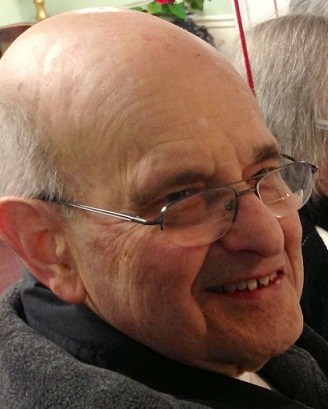
Dear son of the late Eugene and Cecile Leoni. Beloved husband of Ruth (Benkowitz) Leoni. Devoted father of Kenneth Leoni and wife Linda of Canton, Thomas Leoni and wife Kathy of Wilbraham, Susan Penchansky and husband Sandy of Holliston, and Denise Linsky and husband Joseph of Easton. Cherished grandfather of ten grandchildren. Loving brother of the late Robert Leoni.
Funeral service at Stanetsky Memorial Chapel, 475 Washington Street, Canton on Monday, April 22 at 9:00am with interment at Sharon Memorial Park.
Shiva observance at Temple Beth David of the South Shore, 1060 Randolph Street, Canton on Monday from 7:00 to 9:00pm with minyan at 7:30pm and also at the home of Susan and Sandy Penchansky on Monday from 5:30 to 7:30pm.
Charitable contributions in memory of Leon may be made to the Alzheimer’s Association of Massachusetts and New Hampshire, 480 Pleasant Street, Watertown, MA 02472 www.alz.org/manh/ to support dementia research or to the United States Holocaust Memorial Museum, 100 Raoul Wallenberg Place SW, Washington, D.C. 20024 www.ushmm.org.
AN AUTOBIOGRAPHY WRITTEN BY LEON
My ancestors lived in France dating back to the early 1800's. I have been told that they were well treated especially while Napoleon was in power. They were in the rope manufacturing business to supply the French Navy. The only stipulation was that the jews who wanted to participate in commerce had to change their names. The story has it that ours was changed from Levy to Leoni.
My grandfather Eduard was a commercial consul to Germany representing France. In Germany he befriended himself with a mirror glass manufacturer and became his business partner. Sometime after, WWI broke out he found himself on the wrong side of the conflict. As an enemy alien he was at first imprisoned and subsequently held at an internment camp for the remainder of the war.. My Grandmother Theresa in turn was living in Nurnberg where she was restricted to living within a city block and had to report to the local police as if on parole at prescribed intervals. She had to obtain permits for just about everything from necessities to clothing. She had permit limiting her to a quarter of a liter of milk per day. To travel anywhere required a hardship permit. My father even had to have a permit to ride a bicycle to ride within the confined area. My father although born in Fuerth, Bavaria was nevertheless prohibited from attending public school and was taught at home for the duration of the war. After the armistice he entered public high school where Henry Kissinger's father became his teacher. After the war things were very bad in Germany. The currency had been greatly devalued and he lost a fortune. So they turned to my father's uncle in Germany who did get them started in Berlin.
My father married my mother in 1926 . He worked for Reichhold, a manufacturer of paints. My father's job was to establish foreign affiliates for the company. Some of his assignments were in Palestine and in South Africa. Shortly after their marriage his job took him and my mother to live in Athens, Greece; Istanbul, Turkey; Sofia, Bulgaria where I was born then Vienna, Austria; Belgrad, Yugoslavia where my brother was born. There we lived in luxury on a large estate with servants and all.
I attended the first grade in Yugoslavia. I had to learn serbian and the cyrilic alphabet and there is one particular incident that I remember to this day. My mother took me to school on a trolley and when we arrived at the school it was closed. King Alexander had died and King Peter became his successor. When we got home my mother put a black bunting on the national flag and displayed it. I clearly remember this event. I can no longer locate my Serbian report card and may perhaps have given it to the American Jewish Historical Society. But I do remember what it looked like as it was written in Cyrrilic.
From Yugoslavia we moved back to Vienna. I was in the 4th grade of school at the time of the nazi anschluss. One of the first things that happened to me was being transferred to a school attended only by Jewish children. I remember being taunted by little nazi bullies outside the school.
My school notebook with a composition extoling the Nazis and Hitler dated March 12, 1938, the date of the anschluss along with my report card, are now with the Jewish Historical Society as are my parents' nazi passports. The report card shows 41 days of absence because my parents kept me at home much of the time.
Throughout my early childhood we had a live in maid. Her name was Mizi who essentially saved us from the nazis. Here's how. . .The nazi thugs went door to door looking for Jews and came to our apartment. My parents were prepared for this and we hid in the basement of our apartment house. The nazis came to our door asking if there were any Jews living there. Mitzi replied no (so the story goes) and offered them a beer and they left. As to our flight from Austria. my parents had a valid visa to South Africa but decided to opt for the US instead.We way we were able to flee Vienna as follows: My father had a good business associate in Greece. This man travelled to Vienna and both he and my mother went out in public and got the necessary exit papers while my father stayed at home. At the time the nazis still permitted jews to leave. The U.S was a at quota for Jews. We also had a valid visa to South Africa but opted to await out entry to America.
We fled Vienna one night in September of 1938 travelling through Italy and boarded an Italian freighter. After 30 days at sea we arrived in Havana and were kept at a detention camp until my fathers half-sister came to Cuba to guarantee our subsistence. A year later we immigrated into the U.S. at Miami and went by train to New York. My father got a temporary job and we then were sent to Cleveland, Ohio by HIAS and that is where I grew up. During the Korean Conflict I was drafted into the army for 2 years and I served in Germany and France. I married Ruth in 1957 moved to Boston and we have four children and 10 grandchildren.
WE REMEMBER HIM
At the rising of the sun and at its going down,
we remember him.
At the blowing of the wind and the chill of winter,
we remember him.
At the opening of the buds and in the rebirth of spring,
we remember him.
At the blueness of the skies and in the warmth of summer,
we remember him.
At the rustling of the leaves and in the beauty of autumn,
we remember him.
At the beginning of the year and when it ends,
we remember him.
As long as we live, he too will live; for he is now a part of us,
as we remember him.
When we are weary and in need of strength,
we remember him.
When we are lost and sick at heart,
we remember him.
When we have joy we crave to share,
we remember him.
When we have decisions that are difficult to make,
we remember him.
When we have achievements that are based on his,
we remember him.
As long as we live, he too will live; for he is now a part of us.
~ a meditation from Rabbi Sylvan Kamens & Rabbi Jack Reimer
Show your support
Add a Memory
Share Obituary
Get Reminders
Services
SHARE OBITUARYSHARE
- GET REMINDERS
v.1.18.0