
OBITUARY
David Jordan
April 30, 1935 – July 5, 2026
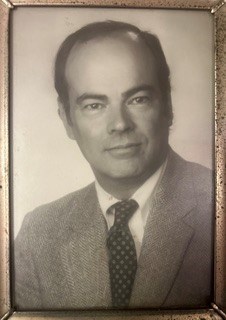
David Crichton Jordan, professor emeritus of government and foreign affairs at the University of Virginia, former United States Ambassador to Peru, and a principal author of the 1980 Committee of Santa Fe report that shaped the Reagan administration's Latin America foreign policy, has died. He was 91.
Born in Chicago in 1935, Jordan was educated at Phillips Exeter Academy and Harvard University before taking his law degree at the University of Virginia and earning his doctorate under Arthur Preston Whitaker at the University of Pennsylvania. Jordan co-authored Nationalism in Contemporary Latin America (1966) with Whitaker, a fitting starting point for a scholar who would spend the next five decades at the intersection of Latin American history, U.S. foreign policy, and political theory.
Jordan joined the faculty of the University of Virginia in 1965 and remained there until his retirement in 2012. He became the youngest chair of the Woodrow Wilson Department of Government and Foreign Affairs in the university's history, serving in that role from 1969 to 1977. In that capacity he recruited a remarkable generation of scholars to Charlottesville, building a department widely regarded as among the finest of its kind in the country.
Known as an expert on democratic institutions, Jordan was invited to teach and provide technical assistance in Argentina in the early 1970s, Spain, upon the death of Franco and the transition to the constitutional monarchy, and Chile, upon the end of Pinochet's tenure, and its transition to representative government.
Deeply concerned about threats to democratic institutions and individual liberty such as Soviet expansion, autocracy, communism, corruption, narcotics trafficking, and terrorism, Jordan was a founding member of the second Committee on the Present Danger in the 1970s. In 1980, Jordan was one of the leading architects of the Santa Fe Report, which served as the intellectual blueprint for the Reagan administration's approach to the Western Hemisphere.
Jordan served as United States Ambassador to Peru from March 1984 to July 1986. During his tenure, Peru had its first democratic transition since 1970.
After returning from Peru, he continued to teach and to write at the University of Virginia until his retirement in 2012. His bibliography spanned more than four decades and ranged across Latin American nationalism, Cold War geopolitics, Cuban foreign policy, Iberian politics, and hemispheric drug economics. In addition to Nationalism in Contemporary Latin America and Drug Politics, his books included World Politics in Our Time (1970), Revolutionary Cuba and the End of the Cold War (1993), and Spain, the Monarchy, and the Atlantic Community (1979), as well as edited monographs on U.S. Latin American policy for the 1980s and 1990s.
David C. Jordan is survived by his wife, Anabella Jordan; his three children, Stephen, Victoria, and Anne, seven grandchildren and four great-grandchildren.
Show your support
Send Flowers
Add a Memory
Share Obituary
Get Reminders
Services
- SEND FLOWERSSEND
FLOWERS SHARE OBITUARYSHARE
- GET REMINDERS
v.1.18.0