
OBITUARY
Dr. Amanullah Khan
March 2, 1940 – August 11, 2026
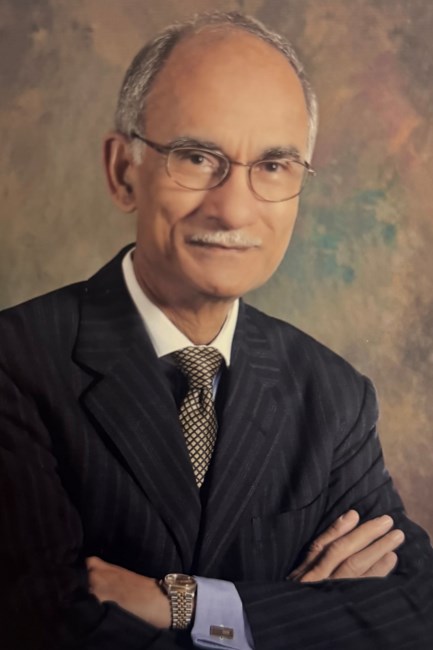
Dr. Amanullah “Aman” Khan was born on March 2, 1940, in Jalandhar, India, to Ahmad Ali Khan and Qamar-un-Nisa Khan. His family moved to Kasur in 1942. It was there that young Aman witnessed the dissolution of British India and the creation of Pakistan.
Aman began his medical education in Pakistan, first studying at West Pakistan Medical School in Bahawalpur before moving to Lahore, where he earned his M.B.B.S. from King Edward Medical College in 1963. After graduating, he joined the West Pakistan Health Services, serving in civil hospitals in Zafarwal, Khangah Dogran, and Campbellpur. It was the beginning of a medical career that would eventually span clinical care, cancer research, immunology and public service on two continents.
In late 1964, Aman left Pakistan with his best friend, Dr. Raja Junaid, for Troy, New York. From January 1, 1965, to January 1, 1966, he served as a rotating intern at Samaritan Hospital. Both young doctors fell in love with the United States and decided to stay.
When it came time to choose where to build his new life, Aman chose Dallas, Texas. He liked to say that Dallas sat on the same longitudinal line as Lahore, making a city halfway around the world feel somehow connected to home. Dallas would remain his home for the rest of his life.
In 1966, Aman joined the Wadley Institute of Molecular Medicine as a fellow in hematology and oncology. He quickly became part of an extraordinary period of discovery in cancer medicine and, in 1970, was promoted to Chief Research Fellow in immunotherapy.
Wadley would shape Aman’s life in another important way. It was there that he met Fran Elise Austin. They married on December 9, 1972, and together built the family and life that would anchor him in the city he had chosen as home.
Aman spent his career asking questions that medicine was only beginning to understand. His early work included clinical research involving L-asparaginase and cisplatin, drugs that would become important treatments for cancer.
His research later explored tumor necrosis factor, interferon, IL-2 and monoclonal antibodies at a time when the idea of harnessing the immune system to fight cancer was still in its infancy. His work with monoclonal antibodies against malignant melanoma ultimately contributed to a U.S. patent issued in his name. By 1991, he had already authored more than 125 scientific papers.
During the emergence of the AIDS epidemic, Aman also cared for some of Dallas’s early patients with compassion and understanding at a time when little was understood about its cause or treatment.
For all of his devotion to research, Aman remained first and foremost a physician. His patients were never simply diseases to be treated, but people to be cared for. He eventually founded Cancer Center Associates in Dallas, where he brought research and clinical care together and continued to provide his patients with access to emerging therapies and deeply personal care. He was also affiliated with St. Paul Medical Center and the Mary Kay Ash Center for Cancer Immunotherapy Research.
Aman’s influence extended well beyond his own practice. He believed strongly in creating institutions that connected physicians and communities. Beginning in the early 1970s, he brought together fellow graduates of King Edward Medical College across North America and helped establish the King Edward Medical College Alumni Association of North America, KEMCAANA, serving as its first president. He later served as President of the Association of Physicians of Pakistani Descent of North America, APPNA, from 1983 to 1984.
His commitment to medicine also extended into public service. Aman served for many years with the Texas State Board of Medical Examiners, later the Texas Medical Board. His work there included physician licensure, disciplinary review, standing orders and telemedicine, and the Board formally recognized him for his commitment to public protection, compassion and professionalism. His service to Texas was also personally recognized by Governor George W. Bush.
In 2002, President George W. Bush appointed Aman to the President’s Advisory Commission on Asian Americans and Pacific Islanders, extending his public service to the national level.
His contributions brought recognition in both the United States and Pakistan. In 1968, only a few years after making Dallas his home, Aman was presented with the Key to the City of Dallas. In 1991, the Pakistan Academy of Medical Sciences selected him to deliver its Academy Oration and honored him as Professor of PAMS. Decades after he helped bring together his fellow King Edward graduates, KEMCAANA honored its founder with its Gold Medal.
Aman’s curiosity was not limited to medicine. He was a lifelong student who never seemed to lose the desire to learn something new. Alongside his medical training, he earned a PhD in Immunology from Baylor University and later an MBA from the University of Texas at Dallas. Even after becoming an accomplished physician, researcher and poet, he continued his education, taking poetry courses through the University of Oxford.
But medicine tells only part of Aman’s story.
He was an artist as well as a man of science. An avid photographer, Aman traveled the world with a camera, documenting landscapes, people and the small moments that caught his eye. His photography was exhibited and recognized with awards. In 1976, he won First Place in Photography at the Texas Medical Association Annual Art Exhibition for his photograph Natural Contours. Decades later, his work appeared in multiple editions and categories of the Smithsonian Magazine Photo Contest.
He was also a prolific poet. Writing in Punjabi, English and Urdu, Aman published seven books of poetry, including Mukar Gaiyaan Nain Shawan, Sifting Shades, Fusion of Words and Colors, and Heaven in the Woods. His work received recognition within the Punjabi and Texas literary communities, and in 2018, after years of involvement in the Texas literary community, he became President of the Poetry Society of Texas. He also developed his own poetic form, which he called the “Ballanelle.”
Whether looking through a microscope, a camera lens or at a blank page, Aman remained intensely curious about the world and the people in it. His scientific work will remain part of his professional legacy. His photographs and poetry preserve something of the way he saw life.
But to those who loved him most, his greatest legacy is much simpler. We don’t think of him as doctor or advisor or poet. We think of him as Honey, Dad, Nana and Uncle Aman.
Aman and Fran spent more than 50 years building a life and a family together. They raised three daughters, Roxanna (son-in-law David Manning), Sabrina (son-in-law Blake Perry) and Amanda (son-in-law Jyotish Chugani), and became the proud grandparents of Liliana and Bray.
Aman was a true girl dad. He was there for every performance, every award presentation and the countless moments in between. He served as a chaperone on countless school trips and sat on school advisory boards, including the Tulane University Parents Council, but just as important was the time he simply spent with his daughters. He taught us how to garden, took us with him on rounds at the hospital and let us play at Wadley while he worked. He photographed us endlessly, supported whatever we chose to pursue and, by our own admission, spoiled us rotten.
Aman also loved to travel. Some of our earliest adventures were distinctly American ones: piling into a conversion van and setting off on long road trips across the country, meeting the Junaids along the way. Together, the families explored the United States, while Aman photographed the landscapes and people they encountered on their journeys. His curiosity eventually carried him much farther. He became an enthusiastic international traveler, returning again
and again to Europe and Asia, always with a camera close at hand.
Away from medicine, Aman loved sports. He was an avid tennis player, cricketer and skier. He learned to ice skate and ski while living in Troy, New York, and took Fran skiing on their honeymoon. Skiing became a family tradition, and every winter the Khans headed for the mountains together. At home in Dallas, Saturday mornings often meant friends gathering on the family tennis court for a match, then enjoying snacks together while they recapped the game.
But the sport he loved most was one he never played: American football. Aman became a devoted Dallas Cowboys fan, and some of our favorite family memories were made cheering for America’s Team together from our season tickets. Even in his final years, he watched every game from home and cheered for the boys.
For a man whose professional life was marked by serious work, Aman possessed a wonderfully silly sense of humor. Nothing made Dad laugh quite like an old-fashioned potty joke. Those closest to him will remember his bright smile, his laughter, his curiosity and the joy he brought into our lives.
Dr. Amanullah Khan spent his life crossing boundaries: between Pakistan and America, science and art, laboratory research and compassionate care. He studied disease and searched for better ways to treat it. He helped build institutions and communities. He photographed the world he traveled, wrote about the world he remembered and cared deeply for the people who shared that world with him.
Our family would also like to express our deepest gratitude to the people who cared for Aman with such devotion. To his physicians and caregivers, thank you for the patience, tenderness and dignity you gave him each day. Your kindness, compassion and devotion brought him comfort and gave all of us the reassurance of knowing that he was surrounded by people who truly cared for him.
Thank you for loving us, Honey, Dad, Nana, Aman. We will love you and miss you every day of our lives
Show your support
Send Flowers
Add a Memory
Share Obituary
Get Reminders
Services
- SEND FLOWERSSEND
FLOWERS SHARE OBITUARYSHARE
- GET REMINDERS
v.1.18.0