
OBITUARY
Evelyn Rebecca Smith
December 1, 1921 – October 30, 2020
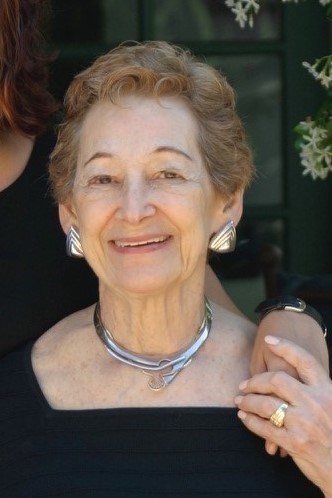
Evelyn Ginsburg Smith was born on December 1, 1921, the child of Harry and Anna Ginsburg, immigrants from western Russia. Evelyn is survived by her three children, Sharon of Dallas, Joel (Terra Brockman) of Chicago, and Adena (Richard Green) of Los Angeles, and by four grandchildren, Benjamin in Seattle, Jarred in Rome, Ian in NYC, and Mae in Los Angeles.
Evelyn was born and raised on the north side of Chicago along with her two siblings, Jacob (Yankel) Ginsburg and Gertrude (Gittel) Ginsburg Kruglik, who both preceded her in death. As a young girl, Evelyn remembered her parents struggling to learn English with a tutor at their kitchen table, which they eventually did with enough success to open multiple businesses in Chicago, including a hotel and laundry service.
Evelyn attended Senn High School where many students were also children of Russian and Eastern European Jews, and where she consequently learned to sing the football fight song in Yiddish. As a teenager, she and her coterie of best friends from Senn organized a tight-knit social gang they called Girls About Town, complete with custom-made jackets with their names and “GAT” emblazoned on the back. GAT’s express purpose was to go out and have fun on loosely organized trips around the city. In the depression era 1930s, fifty cents was enough for a full day of entertainment at the legendary Riverview Amusement Park on Western Avenue in Chicago, a destination Evelyn always regarded as one of the best. Her friendships with many of the Girls About Town gang continued for decades, well into their retirement years.
Evelyn’s father, Yuruchim (Harry) Ginsburg, was born July 4, 1891, in or around Minskegebirnya, a schtetel near the town of Minsk, in what is now Belarus. He arrived in the US around 1910. A few years later, her mother Nechama (Anna) Kotlik arrived through Ellis Island, from the same general area of western Russia. Although their home villages were close to each other in the motherland, they first met and eventually married in Chicago.
Evelyn sometimes talked about how adventurous, even libertine, she was as a young adult, and about how she fought with her parents to exert her independence. Both of her parents had fled Russia around 1900 as teenagers, leaving family far behind. So the idea that Evelyn wanted to leave Chicago to go far away to college (far away being 140 miles south at the University of Illinois Urbana-Champaign) was cause for concern, worry, confusion, and anger. Her older sister Gertie had married while still a teenager, and her brother Jacob stayed close to home to go to the University of Chicago. Why would Evelyn want to leave the security of home and family when she didn’t have to? But Evelyn was determined to fledge the nest, and off she went to the college, graduating with a degree in social work in 1943.
Evelyn was a strong, smart, challenging woman and had high standards when it came to men. When she mentioned to one of her friends, Fran Racusen a charter member of Girls About Town, that she was having trouble finding a decent guy, Fran said, “You should meet my cousin George.” At the time, George was serving as a radar specialist in Italy during WWII, and in the closing days of the war they began a long-distance, war-time correspondence.
After the war, while she and George were dating, Evelyn began working for the Red Cross. Her first job was welcoming British war brides at Chicago’s Union Station and helping them to unite with their American husbands. For Evelyn, the Red Cross represented the opening of many exciting doors. One of those doors led to Korea, during the heat of the cold war Korean Conflict.
This opportunity to serve overseas led to many arguments with her father at their kitchen table. He said that she was foolhardy, immature, reckless, rash, and impulsive. Why voluntarily put herself into a war zone? But for Evelyn, the opportunity represented the pinnacle of independence. She was partly driven by a selfless desire to help others, and partly by a selfish desire for adventure. And besides, George hadn’t yet proposed, a sore point with her.
So after a long cross-country train ride, and a sea voyage across the Pacific, Evelyn was stationed in Kunsan, Korea, from 1947 to 1948. Her first job there was as a home communications liaison for U.S. soldiers. Her unit was eventually absorbed by the U.S. army, wherein she was given the rank of Lieutenant. She facilitated emergency communication for family members, morale boosting for soldiers, and canteen services at embarkation and debarkation points.
During her year in Korea, Evelyn and George continued their correspondence. Both were erudite, funny, and engaging letter-writers. Most of that correspondence survives today, some of it too steamy to include in a family newspaper. The letter-writing bonded them, and when Evelyn returned state-side, George, a scrawny, bald, bespectacled chemist, had the good sense to propose.
Evelyn’s mother Anna did ask her skeptically, “What do you see in him?” And Evelyn’s response was a deeply resonant, “Ohhhhh, mother…..” Although she often said in later years, “I certainly didn’t marry him for his looks,” she knew what she had found—a consummately decent, moral, smart, gentle man with a wicked sense of humor. His only flaw was not being able, or willing, to dance.
But accepting flaws while still embracing those around her was core to her personality. She had keen insights into human nature, and saw what was in each person whether she liked them or not, and in particular what was unique, and special in each of her independent, oddball, nonconformist children and grandchildren.
Evelyn and George married in Chicago in 1949 and then moved to George’s home town of Dallas, Texas. It wasn’t an easy transition for her—coming from exciting, cultured Chicago where she had, after all, seen Frank Sinatra perform in one of the many theaters near her home—to a young Dallas still working to escape its Cowtown history. They welcomed their first child Sharon in 1950, their son Joel in 1953, and their daughter Adena in 1959.
Marriage and motherhood, however, did not diminish Evelyn’s independent streak. She never embraced the post-war 1950s happy homemaker model, and always knew the importance of a woman earning her own paycheck. Nevertheless, she took the role of motherhood seriously, and to each of her three children gave it her all. She led Cub Scout and Brownie troops, joined the PTA, packed school lunches every day for 20 years, and made a hot dinner for the table, exactly four out of seven nights a week.
When her oldest children were finally away at college, and her youngest had turned 13, she entered the work force with gusto, holding a succession of jobs, from social worker for the State of Texas to IRS support representative. Even after her husband retired, she continued working into her mid-60s, enjoying her independence and her paychecks. In retirement, Evelyn lived out the Girls About Town motto to “go out and have fun” on a bigger stage as she and George enjoyed world travel and cruises, attended graduations, visited old friends (including a few of those Girls About Town), and enjoyed the fruits of two productive lives.
Along with her independence and strength, decency, kindness, and morality were at the heart of Evelyn’s character. She lived those values simply, without being overtly conscious of them, every day of her life for just shy of a century. In doing so, she imparted those values to her children and grandchildren, who are eternally grateful.
A private funeral service will be held at the Shearith Israel cemetery on Monday, November 2nd, at 11am. You may attend the funeral virtually via https://www.facebook.com/ShearithLifecycle
Show your support
Send Flowers
Add a Memory
Share Obituary
Get Reminders
Services
- SEND FLOWERSSEND
FLOWERS SHARE OBITUARYSHARE
- GET REMINDERS
v.1.18.0