
OBITUARY
Dean L Rogers
April 21, 1923 – January 26, 2012
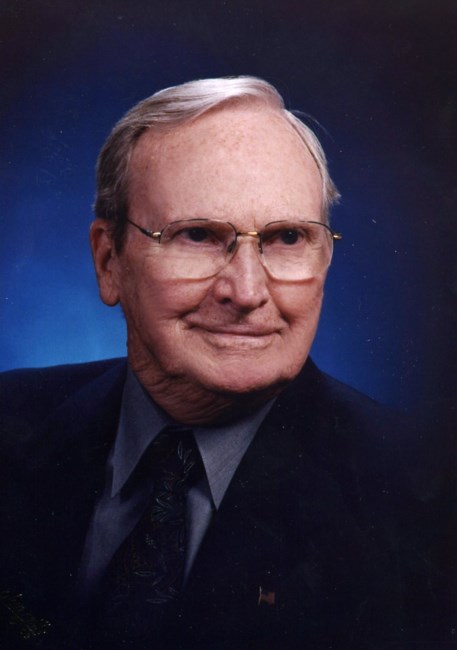
Born April 21, 1923 in Calvert, Kansas, Dean Lincoln Rogers passed away on Thursday, January 26, 2012 in Denver, Colorado. He was preceded in death by his first wife of 54 years, Mary Stapleton Rogers, his parents, Joseph Michael Rogers and Ruby Farlee Rogers, and his two sisters, Shirley Konkel and Bonnie McCravey.
With a Master’s Degree in social work from the University of Nebraska, Dean eventually retired after 30 years of service with the Veteran’s Administration where he served as a social worker and as chief of social work at the Denver VA at the time of his retirement in 1979. Dean was a World War II veteran having served over three years with the U.S. Navy where he was stationed in Kodiak, Alaska as a radio operator.
Dean will be remembered for his integrity and honesty. He was a devoted and loving father, grandfather and husband. He is survived by his loving second wife of nine years, Mildred Kearney Rogers, son David Lincoln Rogers of Oklahoma City, daughter Anne Patterson of Denver, and son Mark Stapleton rogers of Denver. He has three step children, Steve Kearney of Mulberry, Florida, Debbie Schutt of Centennial, and David Kearney of Aurora. He also leaves behind a loving and adoring group of grandchildren and great grandchildren.
The following is the story of Dean Lincoln Rogers in his own words:
I was born on April 21, 1923 in Norton County, Kansas—actually it was near Calvert,
KS, a small town in northwest Kansas consisting of a general store and post office, a
garage, a grain elevator and feed store, and three houses. Warren Harding was president
and Calvin Coolidge was vice president. It was the third straight year that New York
played New York in the World Series, and the Yankees were victorious that year. A
gallon of milk was 54 cents, a loaf of bread was 9 cents, and automobile was around
$500. A gallon of gas cost 11 cents, and the average personal income was less than
$1300.
It wasn’t the best of years, and things didn’t get much better during the ensuing ten or
twelve years. I survived several dust storms and lived through a rather long economic
depression. Somehow I was able to stay in school and graduated from Norton
Community High School in 1941.
My most exciting achievement during those early years was being invited to try out with
the NY Yankees in Kansas City in the spring of 1940. They were looking for a first
baseman to replace Lou Gerhig. Unfortunately I didn’t have the batting power they were
looking for. After the war, I played some semi-pro baseball in Kansas and Nebraska.
After graduating from high school, I came to Denver to be near my high school
sweetheart, Mary Stapleton—the girl I later married after the war.
On December 7, 1942, I joined the Navy and was sent to Idaho for boot camp. Following
that I was sent to radio school at the University of Idaho in Moscow, Idaho. While there,
I came down with scarlet fever and was set back a month in my graduation from the radio
school.
After school, I was assigned to the NAS at Tillamook, Oregon which was known for
being one of the rainiest places in the world. It was so damp and wet that anything
leather would mildew if not kept in a dry area. After a year and a half in Oregon, I was
transferred to the NAS in Kodiak, Alaska where I cooled my heels for two years. I
remember one night going to a movie about two miles away when the temperature was
35 below zero.
After the war I was anxious to return home, however, I soon discovered that I was very
low on the soon-to-be-discharged list. I had no combat duty, had earned no medals, and
was not married. Eventually I was assigned to a liberty ship and returned to San
Francisco and was later discharged at the separation center in Livermore, California. I
had served three years and two months in the Navy.
I returned to Norton, Kansas, and on March 30, 1946, I married my high school
sweetheart. That fall I enrolled at the University of Nebraska using the GI bill. I had no
idea what I wanted to study, and I had less encouragement as to whether I could do
college work. Prior to entering the service I had no expectation of ever going to college.
My high school grades were very average, and I had no prospects of being able to afford
a college education. The GI bill gave me new hope and encouragement and I decided
that with my interest and background in sports, I might do well to enter teacher’s college
to become a teacher and a coach.
After my first year in college, I discovered that I enjoyed biology and social sciences,
making them a major focus in my teacher training. By going to summer school I was
able to receive my degree in Secondary Education and Biological Science in the spring
of 1949. That fall I taught and coached at a small central Nebraska town—I also had the
entire physical education program for grades 1-12. I coached girls volleyball, boys
basketball, and baseball. I also did some officiating for boys basketball.
After my first year of teaching I returned to the University of Nebraska to begin work on
a degree in school administration. Early on I became concerned about personal and
family problems that seemed to interfere with student learning. Finally, my advisor
referred me to the graduate school of social work where I found encouragement in
working with such problems. I changed my course of study in the fall of 1950, and I
received my masters degree in social work in 1952. I took my first professional job with
the Veterans Administration in Knoxville, Iowa. I worked 30 years with the VA. After
Knoxville I transferred to Grand Island, Nebraska, then to North Little Rock, Arkansas,
and finally to Denver in 1968 where I retired in 1979.
I was married to my first wife, Mary, for 54 years. We had three children—two sons and
a daughter. We moved to Cherry Creek Retirement Village in March 1998, and two
years later, Mary died of breast cancer.
With the help of God, I met Mildred Kearney who had recently moved to Cherry Creek
Retirement Village. Although neither of us were looking for a serious relationship, we
soon became good friends, finding many similarities and coincidences in our two
families. Before we knew it, we were falling in love. Millie had been married to her first
husband for 48 years. He died of cancer in 1991. Due to our age levels, we decided we
didn’t have time to have a long courtship, and we agreed that we wanted to live together
as man and wife for our remaining years. We were married on November 9, 2002.
I have been a very fortunate man, and I am very thankful for the family and friends I’ve
had throughout my life.
Show your support
Add a Memory
Share Obituary
Get Reminders
Services
SHARE OBITUARYSHARE
- GET REMINDERS
v.1.18.0