
OBITUARY
Howard Allen Tanner
September 4, 1923 – August 16, 2026
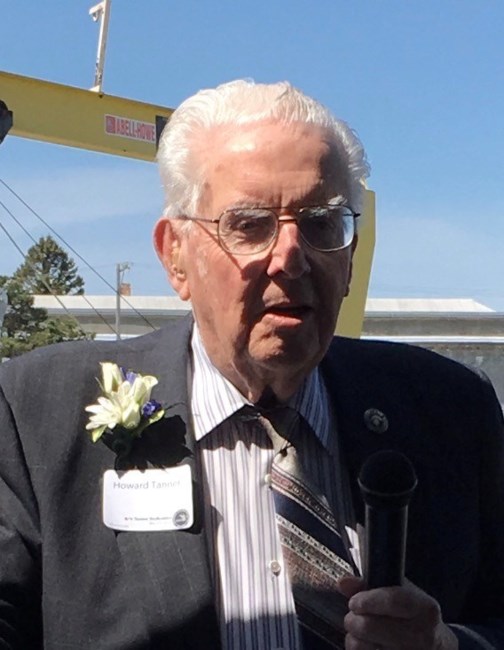
Howard was born September 4, 1923, in Kalamazoo, Michigan, the son of Howard Everett Tanner and Maud Tanner. His appreciation for Michigan's natural resources began early. Growing up in northern Michigan, he fished the Jordan River and surrounding waters with his father from the time he was a young boy, beginning a lifelong connection to the outdoors that would ultimately shape not only his career, but the future of fishing throughout the Great Lakes.
Howard served in the United States Army during World War II before returning home and pursuing his education. He attended Michigan State College, now Michigan State University, and went on to earn his Ph.D. in Fisheries Science from Michigan State University in 1952. His career took him to Colorado, where he worked as a professor at Colorado State University and in fisheries research and management for the Colorado Department of Game, Fish and Parks.
In 1964, Howard returned to Michigan to become chief of the Fisheries Division of the Michigan Department of Conservation, which later became the Michigan Department of Natural Resources. He arrived at a challenging time for the Great Lakes. Lake trout populations had declined dramatically, invasive alewives had multiplied in enormous numbers, and massive fish die-offs were creating serious ecological and recreational problems.
Howard saw possibility where others saw a problem.
Drawing upon his experience in the western United States, he championed the introduction of Pacific salmon to the Great Lakes. In 1966, Michigan began releasing coho salmon into tributaries of Lake Michigan. The program was extraordinarily successful, with the salmon thriving on the abundant alewife population and creating a recreational fishery that attracted anglers from throughout the country.
Howard's vision helped transform the ecology, recreation and economy of the Great Lakes region and earned him recognition as the "father of the Great Lakes salmon fishery." What began as an innovative and, at the time, uncertain experiment became one of the most significant fisheries management achievements in North America.
His career of public service extended well beyond the salmon program. Howard served as Director of Natural Resources at Michigan State University's College of Agriculture and Natural Resources and later returned to state government as Director of the Michigan Department of Natural Resources, serving from 1975 until 1983. Throughout his career, he helped guide generations of fisheries professionals and advocated for thoughtful stewardship of Michigan's lands and waters.
Howard's contributions were recognized with numerous honors throughout his lifetime. He was inducted into the American Fisheries Society's Fisheries Management Hall of Excellence in 2008 and the Michigan Outdoor Hall of Fame in 2019. In 2022, the Michigan Natural Resources Commission honored him with the Thomas L. Washington Lifetime Conservation Award in recognition of his seven decades of leadership, mentorship and dedication to natural resources. Michigan State University also established the Dr. Howard A. Tanner Fisheries Excellence Fellowship, ensuring that his commitment to Great Lakes fisheries research will continue through future generations of scientists.
In 2018, Howard shared the story behind his groundbreaking work in his book, Something Spectacular: My Great Lakes Salmon Story, preserving the history of a program whose effects continue to be seen—and caught—in Michigan's waters today.
For all that Howard accomplished professionally, his life was also defined by the family and relationships that accompanied him through more than a century of life. He was preceded in death by his wife of 73 years, Helen (Freytag) Tanner. He is survived by his children, Howard "Mark" (Sally Marquette) Tanner, Carl David (Jan Jorguson) Tanner, Hugh Adrian (Roberta Dye) Tanner; grandchildren, Eric, Kevin, and Ben Tanner; great-grandchildren, Jude, Maxwell, Rocky, Eleanor, Jaden, Tyler, Karsten, and Asa, along with friends, colleagues, former students and countless members of the conservation and fishing communities who carry forward his legacy.
Howard believed that natural resources belonged to the people rather than any one entity, and his guiding principle was "providing the greatest benefits, for the most people, for the longest time."
His was truly a life of service, science, conservation and something spectacular.
According to Howard's wishes, cremation has taken place. A Celebration of Life will be scheduled in the near future.
Show your support
Add a Memory
Share Obituary
Get Reminders
Services
SHARE OBITUARYSHARE
- GET REMINDERS
v.1.18.0