
OBITUARY
Agnes Carreon Abola
February 28, 1949 – September 16, 2025
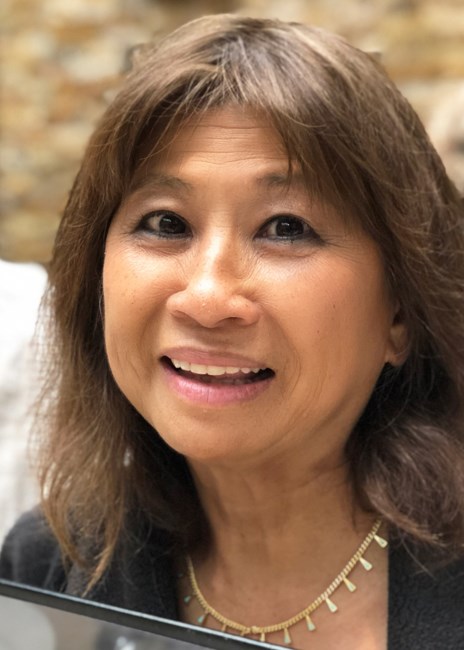
While we are filled with aching and eternal sadness at the death of Agnes Carreon Abola, I write this piece to celebrate her life.
To her husband, children, and grandchildren, Agnes Carreon Abola was wife, Mom, and Lola — a humble supporter, comfort giver, honest opiner, and best friend. A remarkable woman in a domestic sense.
It’s strange to think about what a trailblazer she was. At a time when few women were engineers, she worked alongside other engineers and physicists enabling high-energy particle studies at Brookhaven National Lab. From 1984 - 1999, she was a vital part of the software group in the control room of the Alternating Gradient Synchrotron (AGS) and contributed to the design of the control systems for the Relativistic Heavy Ion Collider (RHIC), the highest energy heavy ion collider in operation, only exceeded in 2010 by the Large Hadron Collider (LHC), at CERN.
When she and Enrique, her husband, moved to Encinitas, California in 1999, she joined Raytheon as a software engineer and architect. Her work supported software systems in US Navy aircraft carriers, and she often gave presentations to admirals and generals.
She very rarely talked about how remarkable her work was or that she was doing this highly technical and high-impact work. It was just what she did. To us, having a math genius Mom was utterly normal.
Her journey to California started in the Philippines. She was the daughter of Francisco Carreon, a lawyer, judge, and Assistant Solicitor General in the Philippines, and Maria Salud Nuguid Carreon, a school teacher.
Agnes’s early education was at Santa Theresa’s, in Quezon City, on the outskirts of Manila, Philippines. While there, she learned a smattering of Flemish from the Belgian nuns who taught her, and made life-long friends who she was still in touch with until her death. She went on to study math at the University of the Philippines (UP), where she earned her bachelor’s degree.
At UP, she became friends with Jaime Abola when they were volunteering as math teachers to children in the poorer neighborhoods of Manila. He set her up on a blind date at a birthday dinner with his twin brother, Enrique, who was too busy playing soccer to teach. The dinner was a big success and, two years later, Agnes and Enrique married on March 25, 1968. Later that year they welcomed their first child, Anna “Pia” Abola. Together, the young family immigrated to the United States in 1970, and lived the quintessential American dream.
It started in Pennsylvania, where Agnes and Enrique attended graduate school at the University of Pittsburgh.
Agnes was unable to finish her masters degree before the family moved to Downers Grove, Illinois, a suburb of Chicago. As with many families on work visas, only one person could earn a
paycheck, so Agnes stayed at home, raising Pia and welcoming Melissa in 1975, and Alan in 1976.
A month after Alan was born, the family moved to Holladay, Utah, while Enrique completed postdoctoral work at the University of Utah in Salt Lake City. This was a hard time for Agnes. Unable to work, unable to drive, and at home with three small kids–only one of which was in school–she felt isolated and alone. In a place full of Mormons, Catholic Filipinos stood out. Especially ones that liked to drink caffeine-filled Coca-Cola. She used to talk about going a little crazy during this time. I can only imagine how bored she must have been.
Fortunately, we lived within walking distance of the Catholic Church and a kind group of Gaelic nuns (thank you Sister Maria Goretti!). There was also a tight-knit Filipino community that picnicked together in the Utah lakes and mountains, and stayed up late playing bridge and poker. As is usual for our soccer-loving family, we made good friends through the local soccer community.
In 1979, we moved to Middle Island, New York, a small town in the middle of Long Island and right next to Brookhaven National Lab. In 1984, after many years as a stay-at-home Mom, Agnes obtained a green card and was able to start working at Brookhaven National lab.
I remember the time before my Mom was able to work as an era where money was tight. In the very early days, in Pittsburgh, we were on food stamps. Eating out at McDonalds was a once-a-year treat. Even after my Mom started working, she was always worried about money and spent a lot of time juggling bills and activities to make sure everything could be afforded.
We lived in a series of apartments, and then a condo, while Mom dreamed of owning a big beautiful house. I am so glad she was able to make her dreams come true, in a gorgeous house she had renovated according to the designs she and my Dad wanted. She loved her house, and especially the backyard. Her mother was an avid gardener and orchid grower (which is much easier in the Philippines), and my Mom filled her house and yard with lovely flowers.
As a person, Agnes was humble, kind, and a little zany (although perhaps not as much as the other Carreons). At four feet ten inches (four feet nine by the time she died) she was, as Melissa likes to say, the strongest weak person many of us had ever met. She liked to scandalize the grandkids, telling my daughters that sometimes, when she was driving, she would get mad at the other drivers and just had to give them the middle finger.
Agnes was a woman with a great many loves.
She was an avid puzzler, especially of the New York Times crossword puzzle, sudoku, and the newer games like Spelling Bee. Our father would start the day’s Spelling Bee puzzle and take it to genius, then hand it to Mom to finish. She was the Queen Bee. Although I think they might have sometimes used hints. Sometimes.
She was a fan of mysteries. Agatha Christie, Ngaio Marsh, and P.D. James to name a few of her favorite authors. Also Star Trek. At Brookhaven Labs, her coworkers gave her a Ferengi lunch box which she was very proud of.
Like the infamous Imelda Marcos, Agnes loved shoes. She had so many shoes that when they relocated to Encinitas, the movers joked that, “oh, it’s another box of Agnes’s shoes!”
She loved to travel with my Dad. They went to Hawaii, Alaska, the Philippines, England, and many countries in Europe. They traveled the southwest and to national parks, hiking and seeing the sights. There’s one story of a hike in Utah where it was so steep that her toes kept hitting the front of her hiking shoes. Later that night, she lost all of her toe nails. She blamed my Dad for making her walk downhill so fast.
Until just a few months before she died, she loved walking at the San Elijo lagoon with my Dad. They enjoyed seeing the birds, especially the cormorants and the burrowing owls.
She loved her kids and her grandkids, watching them grow, watching them play soccer and perform, talking and traveling with them.
Most of all, she loved her husband, Enrique. They shared so much–figuring out how to survive as young parents in the United States, raising a family, and growing into a comfortable life where they could enjoy all the things they had only dreamed of in their early days together.
The beginning of the end of Agnes’s life started in December of 2014, the week before she was set to retire from Raytheon, when she was diagnosed with breast cancer. Her first round of treatments were successful and she went into remission until 2022, when routine follow-ups detected that the cancer had spread. Everywhere. The medicine worked for a short while, then failed. When her doctor found a medicine that worked, her body was unable to tolerate it.
She had kidney problems and had to get a nephrostomy tube, which prevented her from enjoying snorkeling in Hawaii or getting into her swim spa.
In 2023 she was also diagnosed with Parkinson’s disease. She had hand tremors and trouble walking, especially with freezing when going into elevators.
Yet she was very cheerful. She wanted everyone around her to be happy and she was committed to doing what was needed to stay as healthy as she could, including her physical therapy for Parkinson’s. Although she did hate the constant doctor’s visits – she said it felt like a full time job, going from one doctor to another and then fighting with the billing departments to get insurance to pay for what they promised. But she wanted to be the one to take care of all of that. She didn’t want to be a burden.
In July of 2025 she had a heart attack and had to have a stent placed. A few weeks later she had a minor stroke. The medicine that was finally shrinking her cancers was also causing her body to generate clots. While she was recovering in the hospital, the nurses would give her
frequent stroke tests, “What’s your name? Do you know where you are? How many fingers am I holding up?” She didn’t always answer correctly, but I’m not sure if that was on purpose. She had a bit of a rebellious streak and liked messing with people, and she really hated those stroke tests.
We think the cancer medicine also caused her body to attack her muscles. In her last few weeks, she was unable to walk, and then unable to talk in more than a whisper.
I spent the week with her before she died, and would help lift her out of bed and into her wheelchair for personal care needs, then reverse the whole process to get her back to bed. She hated that she couldn’t care for herself. Finally, the Friday before she died, as I was helping her, she looked at me and said, “I can’t do this any more.”
We placed a bed for her in the family room so that she didn’t have to go up and down any stairs. She was in the heart of the home. The last Saturday she was very weak. She would call for my father–it was just breath, no voice, because her vocal chords had likely been paralyzed–and he would try to figure out what he needed to do for her. She just wanted to hold his hand.
That afternoon I said goodbye to her, and I suspected that that would be it. I flew back home to the Bay Area.
On Sunday, my Dad and brother brought her to the emergency room because they were worried about her inability to eat or drink. The bloodwork made it clear that her kidneys and liver were no longer working. We brought her home and transitioned to hospice care.
On Tuesday, I flew back and arrived at 5:30 pm. She stopped breathing at 8:30.
On September 16, I lost my Mom and my first best friend. She was so young when she had me, it felt like we grew up together. She was an amazing person, a fighter (in a low-key way), and an inspiration. I will never get over her death.
Agnes is survived by her husband of 57 years, Enrique Abola, three children and their spouses, seven grandchildren, one granddaughter-in-law, and one great grandchild, Agnes Corazon Gomez Sprouse.
Show your support
Add a Memory
Share Obituary
Get Reminders
Services
SHARE OBITUARYSHARE
- GET REMINDERS
v.1.18.0