
OBITUARY
Kamal Sadjadpour
March 19, 1932 – October 15, 2023
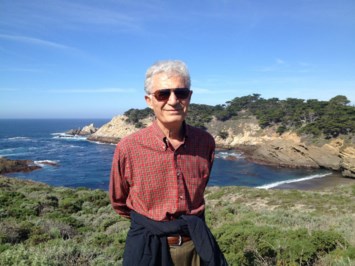
He was born in Tehran, Iran in 1932—the eldest son of seven siblings—and graduated from the Tehran University School of Medicine in 1957. That same summer he boarded a passenger ship from Le Havre, France to New York City, to advance his medical training as a neurologist in the United States. He liked to say that his first glimpse of America was the raised torch of the Statue of Liberty, “a symbol of enlightenment”.
He had fond memories of his early years of medical residency in the United States, including the many friendly colleagues he met in Binghamton, Buffalo, and Chicago. “This initial encounter with America was something like a dream that had become real,” he told his granddaughter decades later, “I was very proud that finally I made it.” Yet he also felt homesick for his tight-knit family and ancient homeland, especially the warmer climate and traditional cuisine (Iranian staples like yogurt were then hard to find in America).
In 1963 he concluded his neurology training at the University of Michigan in Ann Arbor, a city he grew to love, and where three of his children and his granddaughter would later go to school. Although he never learned the rules of American football, he became a lifelong fan of the Maize and Blue. On November 22, 1963, he was in an operating room in Detroit, Michigan when the news broke of President John F. Kennedy’s assassination. “All of the doctors and the nurses in the operating room,” he recalled, “We wept together.”
He returned to Iran from 1964 to 1967—save for a 1966 fellowship in Oslo training under the acclaimed Norwegian medical professor Dr. Alf Broadal—as an Assistant Professor of Neurology at Tehran University Medical School’s Pahlavi Hospital. It was at a party in Tehran during this period that he had the good fortune to meet Shahnaz (“Nazie”) Azari, an Italian-educated design student just back from Rome.
He was set to return to the United States shortly after they met, but they wrote long-distance letters for two years until he made what he called “obviously the best decision” of his life by marrying her in 1969. Nazie’s warm personality helped him emerge from his shy exterior.
Together with Nazie and now a growing brood of children, he spent several years as an Associate Professor of Neurology in Syracuse, New York and Omaha, Nebraska, before opening a private neurology practice in Midland, MI in 1973. He was among an early group of immigrant physicians in Midland and retained a lifelong pride in his Persian cultural heritage as well as a profound appreciation for his new homeland, the United States.
His several decades in Midland were the most fulfilling of his life, both professionally and personally. He was proud to serve as the director of the MidMichigan Medical Center’s Muscular Dystrophy Association and Multiple Sclerosis clinics. He regularly published letters to the editors of the Journal of American Medical Association (JAMA) and Annals of Neurology, sharing his clinical findings. Most importantly he was a physician dedicated to his patients, known for his calm and caring demeanor.
Having grown up in the bustle of Tehran, he enjoyed the verdant tranquility of Midland, especially the oasis of Dow Gardens and the serenity of Grace A. Dow Memorial Library, where he regularly hosted Persian poetry readings. He proudly attended his children’s soccer and basketball games and volleyball and tennis matches. His home in Midland—on James Drive—became a safe harbor for relatives and friends fleeing political turmoil in Iran after the country’s 1979 revolution.
He frequently attended medical conferences—turning them into family vacations—to constantly update his knowledge base. This love of learning inspired his son Reza to pursue a career as a research scientist. He read several newspapers a day, and this love of world events inspired his son Karim to pursue a career in public policy. His compassion and love for his patients inspired his daughter Leila to become a speech therapist.
In total he practiced neurology for over 60 years. His first attempt to retire in 2007, at age 75, proved short-lived. In a 2007 profile in the Midland Daily News, he professed that “I'm missing it so much, I might contemplate a return.” He did so, part time, until finally retiring in 2018 at age 86.
He is survived by his treasured wife of 54 years, Nazie, his four children Nina Sadjadpour (Lee) of Marin County, CA, Reza Sadjadpour (Charlotte) and Leila Alavi (Bahram) of Potomac, MD, and Karim Sadjadpour of Washington DC, as well as his six adored grandchildren Sofi, Omid, Mila, Aida, Cyrus, and Sima, all of whom who have fun memories of their birthdays, holidays, and summer vacations spent alongside him. He also leaves behind his devoted siblings Zari, Majid, Simin, Zohreh, and Saeed, as well as twenty-six nieces and nephews around the world. He was predeceased by his beloved sister Ensieh.
Baba Kamal, as he was affectionately known to his grandchildren, enriched the lives of his family and friends with his kindness and wisdom, and we will always cherish our memories of him. We take comfort in the words of one of his favorite Persian poets, Rumi: “Goodbyes are only for those who love with their eyes, because for those who love with heart and soul there is no such thing as separation.”
Show your support
Add a Memory
Share Obituary
Get Reminders
Services
SHARE OBITUARYSHARE
- GET REMINDERS
26.1.1