OBITUARY
Viviane El-Yachar
April 4, 1941 – February 14, 2026
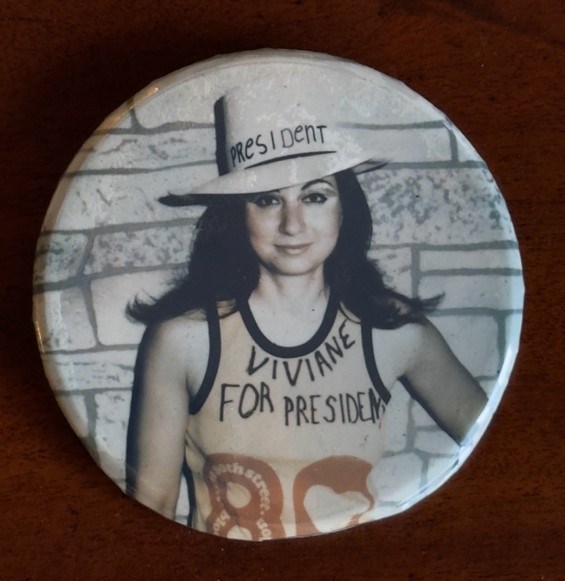
Born on April 4, 1941, in Cairo, Egypt, Viviane was raised in a French-speaking Jewish family in a city that was, at the time, cosmopolitan and complex. After the Suez Crisis of 1956, when Jews were expelled from Egypt, she and her family fled first to France and then to the United States with the assistance of a HIAS travel loan. They arrived in Columbus, Ohio — where Viviane lasted exactly three weeks.
At nineteen, unwilling to let geography dictate her future, she boarded an overnight bus out of Columbus and arrived in New York. By the next day, she had secured work as a “Parisienne model,” a title she bore with irony and pride. She trained under famed model Lucie “Lucky” Daouphars, the French-born icon of 1950s couture photography known for her work with Richard Avedon.
Viviane, unsatisfied with being objectified, wanted to control the camera rather than stand in front of it. That led her into documentary production and finance, where she found her footing behind the scenes, shaping narrative rather than serving as its subject.
Her professional life unfolded in bold chapters. She worked in production finance, later founded her own company, and eventually moved to Brazil, where she helped establish what is widely described as the first cable television company in Rio de Janeiro. She lived there for four years before returning to New York, the city that would remain her anchor. She married twice and divorced, always choosing forward motion over stagnation.
In New York, Viviane built a respected career in real estate, serving for many years at The Corcoran Group and earning a reputation for sharp intelligence, discretion, and impeccable taste.
Her interests were astonishingly wide-ranging: economics and global markets, textiles and design, Jewish history and diaspora studies, photography, art, politics, and culture. She was as comfortable discussing monetary policy as she was examining fabric weave or debating historical nuance.
Having known displacement firsthand, she remained deeply committed to supporting refugees and migrant families. She created an endowment for HIAS, the organization that helped her family reach safety, specifically to preserve her family’s books, documents, and personal objects — tangible threads of a life interrupted and rebuilt. She volunteered at the Metropolitan Museum of Art for 17 years and worked quietly but persistently to support newly arrived families in New York, organizing clothing drives, securing children’s book donations, and helping create welcoming spaces for children far from home. She consistently championed those who needed help, often without fanfare and without waiting to be asked.
In her later years, even as her body began to fail her, Viviane’s mind remained dazzlingly sharp. She remembered dates and names with astonishing precision and followed history, politics, and culture with undiminished intensity. She enrolled in online classes at Juilliard, read deeply about wide-ranging subjects, from cutting-edge economics to the Jewish diaspora, and dispatched friends across the city on highly specific culinary missions — to procure and compare Bulgarian feta versus French versus Greek, for instance; or choosing the most flavorful apricots (Uzbeki!) in the city, sampling and judging with characteristic exactitude. Even when swallowing became difficult, she continued to design distinctive, flavorful dishes, always tasting and refining. Her physical world narrowed, but her intellectual one did not; she lived vividly and expansively in the life of the mind until the very end.
Viviane was always pushing boundaries — her own and those of the people around her. She savored each moment fully, yet was always scanning the horizon for the next extraordinary one. She pushed herself and others to be sharper, more considerate, more thoughtful, more attuned to the needs of those around them. She expected excellence and curiosity — and she modeled both.
Among the many chapters of her adventurous life, one stood above the rest: sailing down the Amazon River, lying back on the small deck of a tiny boat as the jungle darkened around her and the stars wheeled overhead. She described it as the best memory of her life — a moment of vastness, motion, and wonder. It’ a fitting image for a woman who never stopped moving toward the horizon.
She is survived by her nephew, Eric Shammaa; by her many cousins in the United States, France, Israel, Denmark, Brazil, and Australia; and by dozens of friends from dozens of countries, backgrounds, and nationalities — a global circle that reflects the breadth of her life – and all of whom will miss her deeply.
A Funeral service will be held on February 18, 2026 at 1:00 pm at Mount Hebron Cemetery, located at 130-04 Horace Harding Expy, New York, NY 11367, United States. Mourners will meet at the Mount Hebron office.
Afterward, a gathering in Viviane’s honor will be held on February 18, 2026 at 5 pm at Ravagh Persian Grill, 1135 1st Ave, New York, NY 10065.
Donations can be made to the Viviane Bivas Elyachar Endowment Fund at the HIAS Foundation (hiasfoundation.org), 1300 Spring Street, Suite 500, Silver Spring, MD 20910.
Show your support
Add a Memory
Share Obituary
Get Reminders
DONATIONS
Services
SHARE OBITUARYSHARE
- GET REMINDERS
v.1.18.0