
OBITUARY
Gene Meakins
November 12, 1927 – February 19, 2018
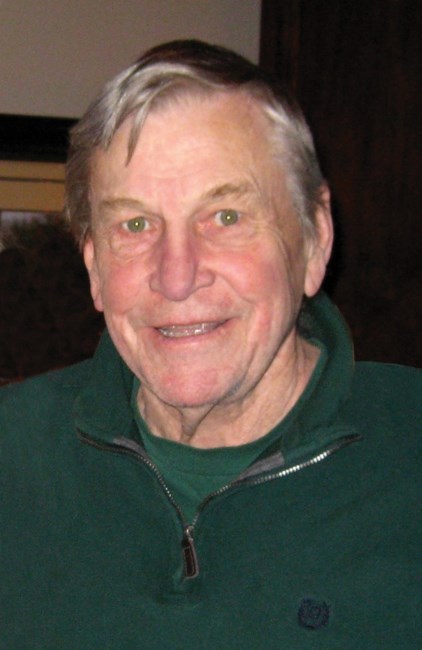
His memorial service and celebration of life will be at 11:30 AM on Thursday, March 8, 2018 at the Evans Community Center Banquet Hall, 1100 37th Street, Evans, CO 80620
Gene Meakins was a small-town boy who had more adventures than most will ever dream of: He worked his way around the world in 1951; he was a reporter who covered a president’s heart attack and a mass murder; organized labor unions in South America and Africa for the U.S. government; worked covertly for the CIA; was a corporate executive and a university professor.
He worked for the American Institute for Free Labor Development, a division of the AFL-CIO, in several countries including Nigeria, Italy, Guyana and Argentina. As a labor organizer in British Guiana (now Guyana) in 1962-3, he was ordered out of the country, threatened, had guards on his house and never let his kids get in the car before it was checked for bombs each day.
This was in the Kennedy years when communism was the major threat to the western world order. USSR and USA were going head-to-head in a tight battle for domination. Cuba had already gone over to communism. Other Latin American countries were ripe for the picking.
“We wanted to give a voice and an alternative economic movement to the (sugar) plantation workers. This was not a new idea,” he said in an interview with his niece. “After World War II with the Marshall Plan, we helped develop the economy and labor unions at the same time when communism threated all of Europe.”
This was an exciting and dangerous life for the middle of three children from the eastern plains of Colorado. He was born to William E. Meakins, Sr., and Cora Wisdom Meakins, in Haxtun in 1927. He joined the Navy at 17 to go overseas and fight. He was on a troop train when we dropped the bomb on Japan.
After the war, he went to Colorado State University (then Colorado A&M) in Fort Collins on the GI Bill where he and former Colorado Governor Roy Romer were fraternity brothers. He was a reporter and editor for the college newspaper and later reported for the Record Stockman, Colorado Springs Gazette and UPI (United Press International wire service).
After graduating from college and a year or so of newspaper reporting, he and a buddy, Willard Walker, worked their way around the world for more than a year in 1951-52, taking on jobs along the way. They left San Francisco with jobs on a Danish freighter. Gene and Willard taught English and coached at the American University in Beirut, Lebanon. He said Beirut was one of the most beautiful cities in the world.
He could not visit Israel until he was ready to leave the Middle East because in those days, one couldn’t go into Israel and then back to an Arab country. Israel had been recognized in 1948, just three years before Meakins was there. He traveled to Rome and on to Antwerp. He had just a few dollars in his pocket when he found a job on a freighter back to the U.S.
Gene liked living close to the edge He was a depression child and he wasn’t scared by much.
When he returned to Colorado, he worked for the Colorado Springs Gazette and then UPI. He covered Eisenhower’s heart attack when the president was visiting his mother-in-law in Denver. Eisenhower was in the hospital for seven weeks and Gene was there reporting for UPI. He said that was before TV, so he was going head-to-head with other newspapers and wire services. He camped out for 24 hours a day in the lobby of Fitzsimons Army Hospital. He remembers that competition among the news services was so strong that they tried all sorts of stunts. Two photographers put on white robes and tried to sneak onto the President’s floor as patients.
Less than two months later, a United Airlines plane exploded over western Weld County in the largest mass murder in U.S. history at that time. John Gilbert Graham put a bomb in his mother’s suitcase in Denver and the explosion shortly after takeoff killed her and 43 other passengers on the plane.
Gene was one of the first on the scene. He arrived in pitch darkness. He saw a farmhouse with lights, and crossed a large field to speak to the witnesses there.
“After I was done at the farm house, they had covered the bodies with sheets. That’s when I realized I’d stepped over bodies in the dark,” he said.
Gene’s natural talent for contract negotiations and union organizing surfaced when he was a member of the American Newspaper Guild. He was so good, they sent him to conduct negotiations in New York City in 1958. He came to the attention of the International Labor Department and was recruited by the AFL-CIO. In 1962 they asked him to go to British Guiana (now Guyana) to develop a labor newspaper and radio broadcasts to offer an alternative to premier Cheddi Jagan’s socialist-communist government and economy.
Jagan’s party called a general strike to destroy the unions. There was a split in the country between the Guianese of East Indian and African heritage. The government used the split to gain more power over the workers. Sugar controlled the economy.
“There were riots and beating and killings,” he said. “My job was to write a labor newspaper and do a radio program We broadcast twice a day with issues important to the sugar workers.”
There was plenty of violence. He went to a wedding of a worker on a plantation when the pro-Jagan crowd threatened everyone there, flattened car tires and beat several men. They let Gene go. Perhaps they worried about being too violent to an American well-known in the country.
When the unions began to win their freedom, the government tried to have Gene declared a “prohibited immigrant” and have him expelled from the country. He took his case to the British Guiana courts and he won. By the time he left, British Guiana President Jagan had been ousted and the Communists never got a foothold in South America.
He established newspaper and radio programs for major trade unions in Nigeria, Guiana, and Argentina as a representative of the American Institute for Free Labor Development.
He went to Buenos Aries, Argentina in the mid ’60s, where he again worked with union organizing. He and his family were there several years. When he returned to the U.S. he was assistant inter-American representative for the AFL/CIO in Washington, D.C., for several months, but decided to come back to Colorado.
In 1968, he went to work for Kenny Monfort, a fraternity brother and old friend, at Monfort of Colorado. There, as Vice President of Industrial Relations, he did union contract negotiations, human resources, community and public relations. He retired in 1996.
He taught at UNC as an adjunct professor of labor collective bargaining and labor history. In 1983-84, he was nominated by his students for “Professor of the Year.”
He was a Harvard University graduate of the Trade Union Program, and Swarthmore College under the WWII Navy V-5 flight program.
Meakins is survived by his wife, Dorothy; children, Jill Meakins (John Dubue) of Centennial, Mark Meakins (Gail) of Utah; grandchildren, Kyle Meakins of Montana, Jennifer Meakins (Jon MacGillis) of California; Dottie’s children, Kelly Richards, Stacy Denman, Camala Denman, Jenny Coghill, Alizabeth Cochrane; her grandchildren, John Blomberg, Michelle Reeves, Jordan Roberts, Hannah Coghill, Tristan and Charley Cochran and great-grandson, Jude Flor. His first wife, Shirley, his parents and siblings, Bill and Jaralee, preceded him in death.
In lieu of flowers, please donate to your favorite charity or to the Shirley Meakins Memorial Award Endowment at UNC. Make checks out to UNC Foundation with Shirley Meakins Fund on memo line and mail to Allnutt Funeral Service 702 13th Street, Greeley, CO 80631.
Inurnment will be at a later date at Roselawn Cemetery in Fort Collins, CO.
Show your support
Add a Memory
Share Obituary
Get Reminders
Services
SHARE OBITUARYSHARE
- GET REMINDERS
v.1.18.0