OBITUARY
Don Packham
November 7, 1920 – April 16, 2020
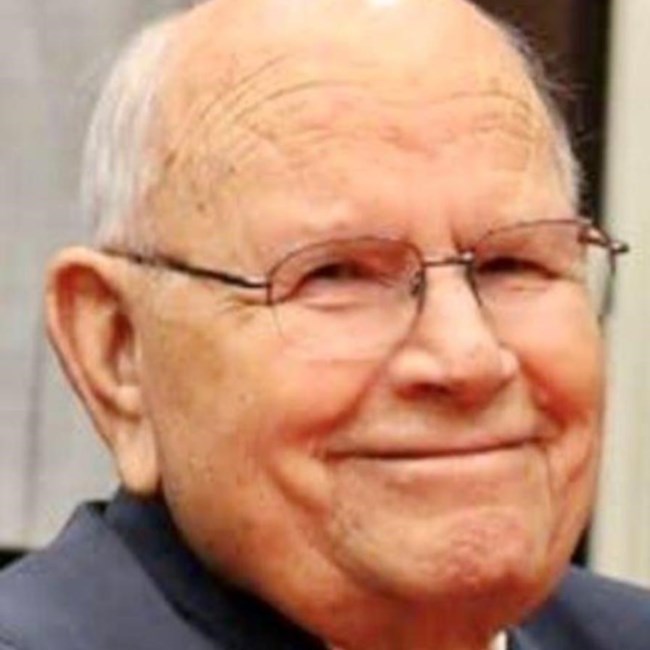
Captain Don Everett Packham (Ret.) completed his final mission on this earth and returned home to base April 16, 2020. He passed peacefully in his home in Hemet, California at the age of 99. Don is survived by his wife of 74 years, Mary, along with his four sons Paul (Nancy), Garry (Terri), John (Ginny), and Ray (Velma), as well as collectively 65 grandchildren, grandchildren’s spouses, great grandchildren, and great great grandchildren.
Born November 7, 1920 in his family’s home on the Camas Prairie near what is now Fairfield, Idaho, Don was the eighth of 12 children to John William Packham and Luella Hickenlooper. Don is also survived by three siblings, Willis, Nolan, and Emily Williams.
Don smiled a real smile on his second day of life. A smile that remained with him and those he met throughout life. He also grew up to work hard at an early age on a rural farm in the 1920s. There was no electricity, cars, or even running water. All of the work was done with horses and wagons. Don’s first chore as a child was to keep the family’s supply of wood in the wood box. As soon as he could reach the udders of a cow, around the age of seven, he became a milker. This would prove one of Don’s favorite chores and foreshadowed what was to come.
Among Don’s fondest memories as a child were family sing-alongs, playing checkers, and a game called ante-I-over that involved throwing a ball over the barn. He also enjoyed hunting, fishing, and trapping. One day, Don borrowed a neighbor’s 22 rifle and attempted to throw a can in the air and shoot it as he had read about in Western books. Unfortunately, he shot himself in the foot. His mother cleaned out the wound with a stick covered in mercurochrome and Don learned a valuable lesson.
Don’s grade school consisted of two rooms and two teachers. One room for grades one to four, the other for grades five through eight. He was an avid reader and especially enjoyed stories about animals. Two of his favorites as a child were The Call of the Wild and Lobo the Wolf.
In high school, Don played football and basketball; he also began to hone his ping pong skills. Don was elected student body president and served as yearbook editor his senior year. He played the drums in the school orchestra where he sat next to a cute girl who played the bells, which he considered a good reason to be in band. He even acted in school plays, including a role in Little Women that “required” him to kiss another cute girl.
While the Great Depression had ended in 1933, money was still tight in those days, and Don was unable to afford college after graduating high school. Instead, he helped pay for his sister’s emergency appendectomy and contributed to a new Allis Chalmers combine for the family to harvest grain. The next fall, Don had saved up enough money to attend Brigham Young University. He enjoyed college and even made the wrestling team. Despite earning straight A’s his second semester, money was tough to come by and Don decided his dream was to work on the farm and not in a chemistry lab.
When war broke out, Don was not drafted because he was needed on the family farm. Nonetheless, in September 1942, he decided to enlist in the Army Air Corps. Before training, he left with two friends for California and attended the 1943 Rose Bowl game where Georgia defeated UCLA in the first time the game was played in Pasadena since the bombing of Pearl Harbor.
Once Don qualified, he was transferred to Ryan Field in Hemet to complete his pilot training. It was there, at a USO dance on Harvard Street, where he met his future wife, Mary Lowrimore. He walked her home and she invited him to enjoy a delicious chicken dinner on Sunday. Mary later attended Don’s graduation dance wearing a black skirt with a white top. He gave her a gardenia corsage surrounded by red roses. They would write to each other in the trying months ahead.
Before Don shipped off to Europe, he received additional training at multiple other bases. When stationed at Hamilton Field near San Francisco his brother Leroy, who was stationed at Camp Ord, came to visit and Don took him for a ride in an AT6. Don did a few aerobatic moves for Leroy, who claims that Don flew him under the Golden Gate Bridge.
D-Day was June 6, 1944 and on the 4th of July Don was sailing on a troop transport ship headed for Europe where he would serve in the 367th Fighter Group. He flew P38s and P47s on 71 combat missions and 135 sorties, including flying on Christmas Day during the “Battle of the Bulge.”
On Don’s first mission, August 13, 1944, hew was sent to bomb barges along a river. His mission took only one hour and 50 minutes. He made his dive, lined up on the target, and pulled up at just the right time. He felt pretty good about everything until later when he noticed he hadn’t dropped his bomb. He quickly dropped the bomb rather than make another pass at that barge. In the debriefing afterward, everyone was curious what that explosion was.
With each completed mission, the Army provided pilots with a ration of alcohol. Don remained true to his religious teachings and abstained from alcohol and certain other practices; so he would save the ration until he had a full bottle and then would give it to his crew chief. He never had to abort a mission because of mechanical problems.
After completing his tour of duty, Don accepted an additional mission on April 25, 1945. On this mission, his plane was shot down over Germany. He was wounded but was able to bail out before his plane crashed. He was taken as a prisoner of war for three days before being liberated by the US Army. Mary was made aware of Don missing in action but, through prayer, felt confident he was okay.
War in Europe ended on May 8, 1945. Don was honorably discharged, having earned a Purple Heart, Distinguished Flying Cross, Air Medal with 10 Oak Leaf Clusters, and European Theater Ribbon with Battle Stars. Don returned home and he and Mary were married on July 8, 1945 in Hemet at the home of Myrtle Branin. They honeymooned at the now historic Riverside Mission Inn.
Following their marriage, Don and Mary moved to Camas Prairie where they partnered in farming with Don’s three older brothers. After Mary had given birth to their first three boys, it became apparent that the Packham Family farm could not support Don’s family along with the families of his older siblings. Don did not complain, he did not argue, he didn’t even ask. In 1952, he chose to sacrifice his dream and return to California. The way he saw it, he was the last in, so he should be the first out.
Back in the Hemet-San Jacinto Valley, Don partnered with Jim Lunsford to own and operate Valley Farms Dairy. The dairy business was not easy. In fact, it was quite hard, with long hours, and often little financial reward. Again, Don did not complain. And, while Don’s family did not accumulate some of the luxuries that some others did during the post-war boom, they were always provided what they needed and more.
After selling their dairy business, Don worked at San Jacinto Valley Cemetery for one year, in 1970, while he earned his California real estate license. Until retiring in 1992, Don practiced in both the real estate and mortgage industry, namely with Myrl Tibbits at Tibbits Realty and Nolan Packham at Charter Mortgage Company.
Don set an example of work ethic and honesty that would never be forgotten by his children, and which they would pass on to their children. He also set an example of faithfulness and fidelity.
Together with his wife Mary, Don devoutly attended the Church of Jesus Christ of Latter Day Saints and served as first counselor to two bishops of his local ward, Myrl Tibbits and Todd Foutz. Don was also active in the Rotary Club and American Legion. He served one term as President of the San Jacinto Rotary Club, which met at the Vosburg Hotel.
Don and Mary consistently prayed for others and gave generously and sacrificially. It’s told that they once took out a loan to fulfill a tithing to their church. Perhaps to Mary’s sometimes chagrin, they would defer or forgive overdue milk accounts when operating the dairy. And, later in life, they would forgo rent payments from downtrodden tenants. Mary once confessed she had to be the first to the mailbox in order to remove the requests from charitable organizations so that Don wouldn’t send them so many checks.
While Don and Mary contributed to many great charities, their favorite cause was their family, and especially their grandchildren. They lived like few others, so that they could eventually live and give like few others. It wasn’t that they had made so much, it was that they had chosen to live with such simplicity and selflessness.
Don’s work on the farm and the dairy had consumed most hours of most days from early morning to night; and that meant that he missed many hours he would have preferred to enjoy with his children. This became apparent when Don received the blessing of grandchildren and then great grandchildren. For every hour he missed with his four boys, Don invested ten-fold the hours in attending every grandchild’s athletic event, awards assembly, or recital that he could get an invitation to. It was not an obligation; it was a passion that he treasured.
In retirement, Don cultivated a renowned garden in his yard and assisted his mother-in-law with her garden. He and Mary fed their family untold numbers of tomatoes, strawberries, raisins, and fruit leather that their taste buds will never forget. He taught his grandchildren to compete in checkers, ping pong, bowling, and life. He also entertained them by wiggling his ears and made them scream with his whisker pies.
As hard as Don worked in the field, he was fortunate to have a spouse who worked just as hard to manage the household all those years, raise his boys, and keep their finances in order. They were partners; they shared in the sacrifice and they sacrificed for each other, for their family, for their community, and for their Lord and Savior who first sacrificed for them.
Throughout 74 years of marriage, Don and Mary remained faithful and demonstrated a true and enduring love. Their relationship not only served as an example to others but provided them strength to share their love with family, friends, and strangers in real and tangible ways.
We will always remember, respect, and appreciate Don answering the call to serve our nation in World War II. However, his real tour of duty did not end when he returned from Europe. It concluded April 16, 2020 when he went home to his Father in Heaven and was told, “well done my good and faithful servant.”
Don will be interred Friday, April 24 at the same San Jacinto Valley Cemetery where he once worked. Due to current public health orders, the graveside service will be limited to nine family members. A memorial service will be planned for a future date. To share a memory of Don or send a condolence to his family, please visit Miller-Jones Mortuary website www.miller-jones.com
In lieu of flowers please make memorial contributions to give.lds.org.missionaryfund
Show your support
Add a Memory
Share Obituary
Get Reminders
Services
SHARE OBITUARYSHARE
- GET REMINDERS
v.1.18.0