
OBITUARY
Mary Alice Hurd
March 13, 1927 – October 4, 2024
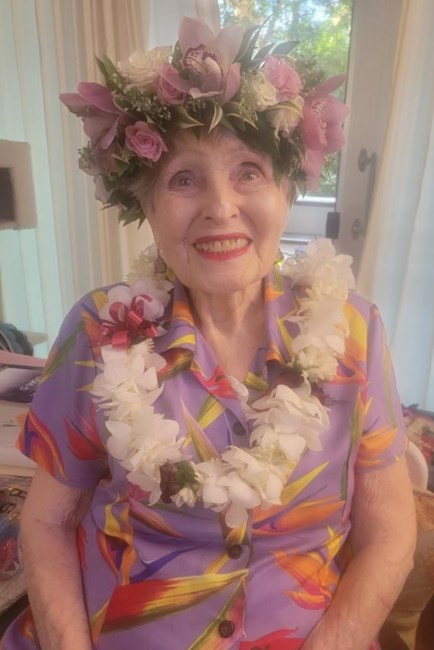
From her early years growing up in Florida and Washington, D.C., to her newlywed days in Virginia, Philadelphia, Harrisburg, and New York, to a long career in Dallas, and then her final days in Hawai’i, she always left an impression on whomever she met.
Born in 1927, she was just a toddler in Florida when her father suddenly died, leaving her widowed mother to raise Mary Alice on her own during the Great Depression. This was a pivotal time in her life at a very early age. It made her realize that it’s very important to get an education to take care of yourself, because men cannot always be there for emotional or financial support, even if they want to be.
She watched her mother, who had a teaching degree, grieve for a short time before starting to earn a few Master’s degrees in order to become a better provider. Mary Alice frequently said, “I learned from my mother that you just have to keep going.” She also noted that her mother greatly influenced her life. “She had a good sense of humor while also encouraging me. A friend said when my mother walked into a room she brightened it. People said the same of me going into my classrooms. It made me proud that I was like my mother in that way.”
Education played a vital role in Mary Alice’s life. When she and her mother moved to Washington, D.C., to live with her great aunt, her mother began taking college classes. Mary Alice tagged along some days because they couldn’t afford a babysitter. She would sit quietly in the back of the classroom and in the afternoons, the Dean of Women would let her mother and Mary Alice take naps in her office.
Mary Alice began typing at an early age. This was so that she could type her mother’s school papers in order for them to be legible! Her mother paid her in swimming lessons to learn this skill.
Mary Alice was excited when she was finally able to attend school. She started first grade in February, a month before her sixth birthday. By starting a half semester before her peers, she quickly realized that this was to her advantage. The sooner she could graduate from public school, and then college, the sooner she could begin working to help make money for her family. As a pre adolescent, her summer vacations were divided between staying with her paternal grandparents in Pennsylvania and trips with her mother. On one of these trips, this time to California, she saw palm trees and felt very happy and warm. Years later, she realized that this was from being around palm trees as a happy toddler in Florida when her father was alive.
When she was only five years old, Mary Alice’s mother made her promise that she would attend and graduate from college. She worked hard to achieve this goal and received a scholarship when she was seventeen to attend George Washington University.
While still in her teens, Mary Alice joined Job’s Daughters, an adolescent branch of The Masons and Eastern Star. “They taught me how to interact with people of my own age, how to be a performer, and how to stand up and say my piece.” The organization also helped her fill the gap left by her father’s untimely death by seeking out the paternal attention of her church friends’ and classmates’ fathers.
By meeting people of different backgrounds, Mary Alice realized that not everyone had to look just like her to be liked by her. An older friend included her in social outings where she learned to interact with older kids, and a Chinese man named Mr. Han, who was a colleague of her great aunt, opened her eyes to an entirely different culture. Over the years, she learned that people’s professionalism and talents should not be judged solely on their appearance. A defining moment in this regard was in 1939 when she and her mother were present at The Lincoln Memorial for Marian Anderson’s historic concert. Along with 75,000 others, she witnessed how a woman could overcome prejudice and triumph over those seeking to dismiss her talents.
The experiences with people of different ages, cultures, and backgrounds helped her focus on her own goals and instilled in her the confidence to passionately pursue them. But she would not be immune to discrimination over the years based on her gender. Holding down summer jobs before heading off to college, she was able to help her family financially during the Great Depression and World War II. She was determined to graduate from high school in two and a half years. She achieved this goal by working in the school library and in the school bank, which gave extra credits to her curriculum total.
Mary Alice first majored in history at George Washington University, due to the influence that her favorite junior high school teacher – who taught history – had on her. But her first semester of her sophomore year she took a general psychology class and it changed the course of her life. “I was immediately hooked. There was nothing else I wanted to study or any other area that I wanted to work in.” She changed her major to psychology and worked hard in the new courses to make sure that she graduated on time.
In her course work, she grappled with her aversion to Sigmund Freud’s theories. “He didn’t do anything for women. But he did make people realize that how children are treated affects their lives.”
Mary Alice was a feminist before feminism was recognized. When she entered George Washington University in 1944, many people believed that she and her female peers were only there to find a husband. But she was open to everything that others had to teach her, along with their advice to better herself. The Dean of Women at George Washington told her that as a leader she must be able to do everything she told others to do, and not tell them to do things she had no experience in. When she worked at the Pentagon, her female supervisor encouraged her to think creatively, outside the pathways most women followed post-WWII.
It was at George Washington University that she met her first love, Randy Gordon. They soon married and moved to Philadelphia where she earned her Master’s degree in psychology. A short time later they moved to Harrisburg for a year and then to Virginia. They eventually moved to New York City where they both worked while Randy earned his Master’s in Business Administration in economics. In their eighth year of marriage they welcomed their only child, Carol Anne.
Mary Alice was also an only child, as were both of her parents, and as was Randy, and she frequently said that being an “only” gives one the luxury and blessing of choosing one’s own siblings and even one’s own “hanai” (surrogate) children. Mary Alice was a “mother” to many children over the years. It was the Gordon house where kids gathered after school and on weekends or holidays because it offered a safe environment. You always knew that the door of the Gordon house was ‘open’, no matter what day or time it was.
Mary Alice was a psychometrist at Macy’s flagship store in Manhattan, administering psychological tests to the store’s employees, until Randy accepted a job in Dallas and they all moved to Texas. Mary Alice applied for – but was denied – a psychometrist position with the Dallas Independent School District because she didn’t know how to administer the Rorschach test. She then volunteered at the Dallas Crippled Children's Center so that she could meet and be mentored by a woman there who could teach her about psychological testing. That woman soon hired Mary Alice to work at her school for developmentally impaired children.
Connections and timing played a major role in her life whether it was business or education. One year a Christmas letter from a family friend included a special note about a scholarship from the American Association of University Women. The organization was seeking women who were interested in furthering their education to become university educators. The day the card arrived was the last day the association was accepting applications for the scholarship. She called to ask if it were too late to apply and when the association found out that she already had her Bachelor’s and Master’s degrees in psychology, they insisted that she immediately submit her application so that they could extend the deadline just for her.
In 1967, Mary Alice earned her Ph.D. in psychology from Texas Christian University. She then taught psychology at the University of Texas at Arlington for a year. In 1968, she began her storied career at Southern Methodist University in the Psychology Department of Dedman College of Humanities and Sciences. As Associate Professor of Psychology, her research interests focused on organizational psychology. She received the prestigious “M” award - SMU’s highest honor - in 1976, along with the Distinguished Psychologist Award from the Dallas Psychological Association (DPA) in 1986. She was also President of the DPA for a year. She retired from SMU in 1997 as Professor Emerita of Psychology. She continued teaching as a virtual life coach until she was 87.
But not all of her time at SMU was gratifying. After teaching there for several years, she sought a promotion and was asked by the all-male panel that was screening applicants if she were seeking this promotion just so she could “get out of the house.” She told them that she wasn’t and was teaching because she knew that you had to be able to support your family and yourself.
She also experienced discrimination from the school newspaper, The Daily Campus. Even though she held a Ph.D., when the paper would write articles about her – or any other female professor with a doctorate - they would not refer to them as “Dr.” but as “Mrs.”, despite their tendency to refer to male professors – even those who held only Bachelor’s degrees - as “Dr.”. She complained to the editors and asked that it be corrected the next time any Ph.D.-holding female faculty members were mentioned in an article, and they complied. She was also part of the suit filed by SMU’s female faculty members to start receiving the same pay for their positions as male faculty members did. The female faculty members won the suit, and not only did they receive raises, but they were given back pay they had previously been denied, as well.
Despite the long-held prejudice towards women in academia, Mary Alice refused to be defined by it. She knew her potential and fought against the forces that were trying to keep her from attaining it. She did not see herself as a victim and continued to be an excellent professor. She led her students by example to fully empower themselves. In 2000, she was interviewed about the history of SMU. You can watch this interview on youtube at this link: https://www.youtube.com/watch?v=7WJoKquSn34&t=5s
In 1981, Randy was diagnosed with salivary gland cancer. He retired from his position with the United States Department of Agriculture. They – along with Carol Anne – then opened a small family business, a wine and cheese shop and catering business in Dallas. Randy died in 1984.
About 13 years later she met the second love of her life, Phil Hurd. They were married for 13 years and he died in 2011. In 2012, Mary Alice moved to Hawai’i to live with her daughter, Carol Anne Gordon. Dr. Mary Alice Gordon Hurd died on October 4, 2024.
Through her marriage to Phil she was blessed to be the hanai mom of his three grown children - Brian Hurd, Jennifer Hurd (and her husband Michael Peterson), and Nina Hurd Jones (and her husband, Ken, and their daughter, Lauren).
In 1985, the horrific tragedy of the crash of Delta Air Lines Flight 191 occurred at Dallas/Fort Worth International Airport (DFW), due to wind shear from a microburst. The crash killed 136 people and injured 25. DFW airport and the surrounding communities were completely unprepared for a catastrophe of this magnitude. A commission was formed shortly after this terrible event, comprised of experts made up of first responders, medical personnel, religious authorities, disaster responders, and other professionals of various expertise. Mary Alice was asked to be a part of this task force, and due to guidance she contributed to this group, not just DFW but other airports around the nation were better prepared when airplane disasters occurred in the future.
This is one of Mary Alice's favorite stories, especially around voting season: she grew up in Washington, DC, when the legal voting age was 21, not 18. BUT - at that time, no resident of Washington, DC, could vote for President. You can look up the draconian "reasoning" behind this yourself, at your leisure. When Mary Alice turned 21, she was unable to vote in the presidential election, because she was a resident of DC.
When she was 25, she was a resident of Virginia - but not for long. She and Randy were moving to New York shortly, and when she arrived in New York, she wouldn't be there long enough to establish residency in order to vote for president. And the man she wanted to vote for was her distant cousin, Dwight D. Eisenhower.
So she made a point of going to stand in line at early voting in Virginia - taking a day off of work - standing in line for SIX HOURS - in high heels (of course) - in order to vote for the first time in her life for the President of the United States, at the age of 25. Hawai'i, Alaska, and Puerto Rico residents could always vote for president, even when they were only territories instead of states. It took a Constitutional Amendment (the 23rd) to give residents of Washington, DC, the right to vote for president, even though they'd literally been the neighbor of all the presidents for over a century.
So whenever someone would complain to Mary Alice about what a hassle voting is, she'd tell this story. And they'd stop complaining. And they'd GO VOTE. Mary Alice once said, “My life has been interesting. If I had the chance to do it over again, I wouldn’t. It’s very good just the way it is. And I don’t want to go through earning my Ph.D. again!”
Though Mary Alice only gave birth to one child, she was a mother to many, many more - dozens, hundreds, seriously probably thousands - from the kids in the neighborhood (affectionately called “The Caruth Commune”) in Dallas where she lived for 54 years; to her students at SMU; to Carol Anne's friends from grade school, junior high, high school (ESPECIALLY the members of the Highlander Band), colleges, and workplaces; to the wonderful grown children - and grandchild - she gained as an added gift when she married her husband Phil Hurd; to the loving relatives she gained by marriage to her first husband, Randy Gordon; and to people she met through her social and professional roles for 97 years.
She never met a stranger. She never judged anyone harshly. She would not allow others around her to speak ill of others. She was a lady from the ground up - always welcoming, hospitable, compassionate - the world's BEST listener and the world's BEST hugger.
A member of The Greatest Generation, she survived the Great Depression, World War II, appendicitis, a Cesarean section, breast cancer, tako tsubo, and the loss of two husbands whom she loved dearly.
She loved wearing fabulous hats, she loved dressing up, she loved the color purple, and she loved helping others.
If she touched you at all, please promise to live your life in such a way that it honors her legacy of kindness and giving. And when you continue her legacy, know that you are “Earning Your Purple”, and that she is smiling down at you as you do what she would have done.
Mahalo nui loa to the amazing caregivers who took care of her in her final years, so that she could remain at home until she went home to Heaven, surrounded by the palm trees she loved. They are truly angels on earth.
Donations to a scholarship at SMU in Mary Alice Gordon Hurd’s name for future psychology students can be made online at: https://link.smu.edu/giving/givenow?scode=DCWCAALLALLALPEL2510&tribute=d911c138-8e11-48bb-91e3-78de3dbd02a5
If you would like to virtually attend Mary Alice’s Celebration of Life, please use this Zoom recording link: https://us02web.zoom.us/j/88203244145?pwd=j7yHsO1NymBrAtfDOSbXoiFZ0h3fUN.1
Show your support
Send Flowers
Add a Memory
Share Obituary
Get Reminders
Services
- SEND FLOWERSSEND
FLOWERS SHARE OBITUARYSHARE
- GET REMINDERS
v.1.18.0