
OBITUARY
Michael Collins
October 31, 1930 – April 28, 2021
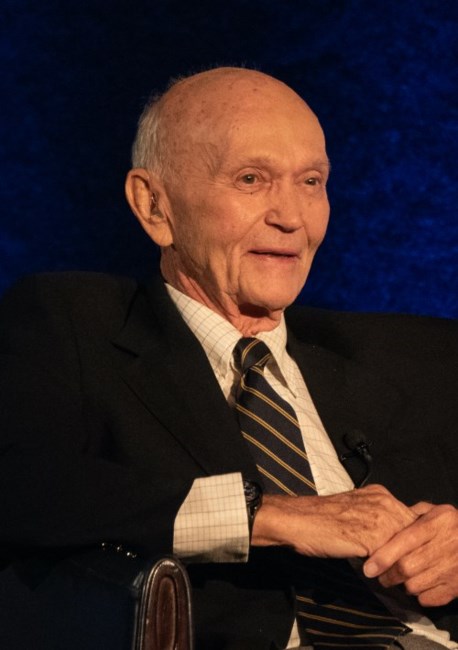
Collins, who spent seven years as an astronaut at NASA, piloted command module Columbia in orbit 60 miles above the moon while Neil Armstrong and Buzz Aldrin became the first humans to walk on the moon on July 20, 1969.
His family released a statement on his passing, announcing that their beloved father and grandfather passed away today, after a valiant battle with cancer.
“He spent his final days peacefully, with his family by his side. Mike always faced the challenges of life with grace and humility, and faced this, his final challenge, in the same way. We will miss him terribly. Yet we also know how lucky Mike felt to have lived the life he did. We will honor his wish for us to celebrate, not mourn, that life. Please join us in fondly and joyfully remembering his sharp wit, his quiet sense of purpose, and his wise perspective, gained both from looking back at Earth from the vantage of space and gazing across calm waters from the deck of his fishing boat. Our family asks for privacy during this difficult time. Details on services will be forthcoming.”
Collins was born Oct. 31, 1930, in Rome, where his father, James L. Collins, was a major general in the U.S. Army. After graduating from the U.S. Military Academy at West Point in 1952, Collins joined the ranks of military test pilots at Edwards Air Force Base in California.
NASA chose him as an astronaut in 1963. Less than three years later, he took his first flight aboard the Gemini 10, the precursor program to Apollo, and orbited Earth. On that mission he became the fourth human to conduct a spacewalk.
Just three years after that, Collins was part of the three-member crew on Apollo 11, the first lunar landing mission that lasted eight days.
Though Collins was in orbit aboard Columbia when Armstrong stepped on the moon and uttered the famous phrase, “Houston, Tranquility Base here, the Eagle has landed,” Collins was just as excited as his colleague, telling the team in Houston he was listening to communications with his comrades, and it was “fantastic.” An estimated 650 million people worldwide watched the moon landing.
While Armstrong and Aldrin spent nearly a full day on the surface, Collins circled the moon. He later said the thing he remembered most was the view of planet Earth from a great distance. “Tiny. Very shiny. Blue and white. Bright. Beautiful. Serene and fragile,” he recalled.
After spending nearly 22 hours on the surface of the moon, Armstrong and Aldrin ascended and docked with Columbia. The trio then started their three-day trip back to Earth. When they splashed down in the Pacific Ocean, the Apollo 11 crew were American heroes.
Apollo 11 was Collins’ final trip to space, leaving NASA in 1970 to join the State Department.
Collins described his time with NASA as “a chapter in my life—the shiniest best chapter in my life—but not the only one.”
In 1971, Collins became the third director of the Smithsonian National Air and Space Museum in Washington, D.C., overseeing the construction of a new facility and its opening in 1976. It quickly became one of the most popular museums in the world. He served in that role until 1978.
Collins’ wife, Patricia, was a social worker. She died in 2014.
Show your support
Add a Memory
Share Obituary
Get Reminders
SHARE OBITUARYSHARE
- GET REMINDERS
v.1.18.0