
OBITUARY
Billy Joe Rice
November 24, 1932 – October 19, 2009
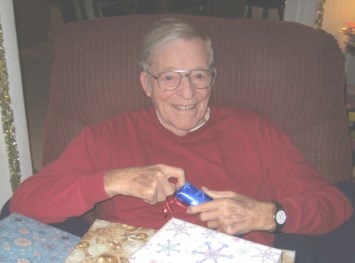
Billy Joe West was born at his family’s home on Thanksgiving, November 24, 1932. He came into this world in Monroe County between Sweetwater and Madisonville, Tennessee, the first and only child of Doshia Elizabeth West and Clinton Ray Fridley. His mother was born on November 10, 1915 in Friendsville, Blount County, Tennessee, and his father was born March 30, 1910 in Monroe County. Clinton was a farmer. Doshia and Billy lived with her family. His full name was supposed to have been William Joseph but the doctor recording the birth listed him as Billy Joe. He never went to court to legally change his name, so Billy Joe it was. His nickname was Cotton top because of his light blond hair.
The family’s log cabin contained one large room and two smaller rooms, a kitchen and a bedroom. The cracks in the logs were stuffed with newspaper and they used a fireplace to heat with in the winter. The mattress on the bed was filled with straw. The straw was changed once in the fall and again in the spring. When the weather was cold the family dogs slept at the foot of the bed to provide some heat. If the temperature outside was just slightly cool, only one dog slept at the end of the bed to keep your feet warm. If it was really cold you might have as many as three dogs at the bottom of the bed. They had coal oil lamps and a wood stove. They washed their face, hands and feet, but probably didn’t have over one bath a week. In the summer, a washtub was filled with water and set outside to wait for the sun to warm it up. Adults bathed first so when the kids turn came it was almost liquid mud. In the winter you washed with a washcloth, usually just your hands and face. There wasn’t too much personal grooming. Teeth were brushed with a twig chewed flat on one end and dipped in baking soda. Their neighborhood was farmland with a house about every quarter of a mile. They bought most of their things from a peddler. The nearest town was about ten miles away, and they hardly ever went to town.
Bill’s maternal grandmother, Mary Mills West was born on February 29, 1876, so she was fifty-six years old when he was born. His grandfather, Lewis West was born on March 24, 1874 and died March 24, 1936 when Bill was only three. One memory he had of his grandfather was that he always let him do what he wanted, even when Bill was already in trouble for something else. He lived with grandma West until he was seven or eight. He also lived with Wanda and Betty, his cousins, who moved in with their grandparents after their mother, Mamie had died. Betty was five years older than Bill and Wanda a year older than Betty. His favorite aunt was Emma and his favorite uncle was Carmack Watson, Emma’s husband. Bill was about a year older than J.L., their son. He remembers being upset by the death of his cousin, Mary Ruth. She was the daughter of his Uncle Joe and Aunt Wincie. She was about seventeen and died from a brain tumor. Her open casket laid in the living room of his grandmother’s house. That was really scary for a little boy.
They always went barefoot when the weather was warm enough, spring, summer and fall. Shoes were saved for special occasions. He had stepped on a lot of different things throughout his life, including hot cans and rocks, when they were burning brush. He had also stepped on glass, bees, barbed wire, nails and tacks.
Bill had several different kinds of swings throughout his youth. There were swings made out of tires and swings with wooden seats. There was even a swing near the creek where the kids could swing out and jump into the water. Bill and a couple of his friends used to bend hickory trees over by climbing on them. The last person up had to be really careful. If the first two jumped off at the same time, the other one could be tossed up like a catapult. The Fourth of July was always a fun time for Bill. He remembers picnicking, swimming and watching fireworks. Most towns had parades and there was usually a carnival or fair with watermelons and apple dipping, etc. When he required punishment as a child, his mother applied a switch to his backside. Bill’s favorite meal was eggs, ham, sausage, biscuits, and gravy for breakfast. He liked mashed potatoes, fried okra, corn bread, beans and chocolate pie for supper. Every fall a couple of fat pigs were killed. Sausage was made and stuffed inside an intestine after it had been cleaned out. Hams were smoked; head cheese, pork roasts and ribs were all prepared. All were smoked and when cured were placed in large boxes and covered with salt. Because of being cured in salt, the ham, bacon, etc. had to be smoked overnight to rid it of some of the salt. Many years later the excessive intake of salt would cause health problems. He was always very skillful with his hands but remembers smashing the heck out of his finger while holding a nail and trying to hit it with a hammer. It’s not surprising years later his favorite subject in school would be woodshop. Bill had a lot of chores as a child with most of them being outside. He carried wood, water, worked in the garden and yard, etc.
Billy West, as he was known, started school in a one-room schoolhouse. He never really did like school. He would much rather have been outside. His cousin, Betty, used to keep a close eye on him and was quick to tell of his mischief. Valentine’s Day at school (in the earlier grades) usually meant a little party with cookies. The teacher was a very wise woman. She had them draw names for Valentines to insure that all children would get at least one. The teacher passed them out. Kids at the time usually did not visit back and forth very much because most lived on farms and there was always work to be done. Valentines usually were never sent through the mail. When Bill was young he liked to play cowboys and Indians. If he got to choose, he would pick to be a cowboy. Hide and seek was another favorite game and the best place to hide was the barn. He always wanted to be a hunter and a farmer. He had strong ties to the land! He learned how to swim when his cousins threw him into the creek. It was scary but he learned quite fast! He did drink a lot of water though. They used to go skinny-dipping and did a lot of swimming in the creek. No one ever had a bathing suit. Summers were wonderful when you were young! You could go fishing, play ball, swim or camp out. Nothing could be better. Looking back on his childhood, he wishes he paid more attention to stories told to him by his relatives about his ancestors. The biggest surprise in his childhood was a twenty-two rifle he received for Christmas. They didn’t have horses on the farm but they had mules. On one occasion he did ride a horse through the riding stables. They started out but the horse he was riding always wanted to stop and eat. Every time Bill kicked him in the ribs to try to make him move, the horse bent his head back and tried to bite him and a horse has teeth like a shark. He couldn’t do anything with him and finally got off of him and walked him back to the barn. You can bet that he held the horse up close to the side of his head with his hand on the bridle, so he couldn’t bite. Bill was extremely happy when he got back to the stable.
As Bill got a little older his least favorite subjects in school were English and science. His biggest problems in grade, junior, and later high school stemmed from the fact that he did not ever really want to go to school. He would do almost anything to keep from going. He had trouble writing essay and term papers because he did not like school and just did not want to study or do homework. He and his cousins were playing with matches once and set fire to the woods. He received a really good spanking for that! They raised tobacco on the farm and he spent many hours working in the fields. The first smoke he ever had was rabbit tobacco (a type of weed) rolled up in a piece of brown paper. He got dizzy. Later, the kids used to smoke while waiting for the school bus. J.L., his favorite cousin, and probably his best friend went hunting with him. They used slingshots. They also liked to play Fox and Hound. They made kites out of paper bags or newspapers. He never had a store bought kite. He and his friends got together on windy days and flew their kites. Bill was alone a lot when he was growing up. He loved to walk through the woods along a stream and see how many different animals he could spot. These were some of the happiest times of his life. Bill went fishing quite a bit. He always liked to hunt and made traps and caught rabbits, opossums and squirrels. Bill and his family had all kinds of pets when they were growing up, including dogs, cats, chickens and hamsters. The dogs were by far the most loved. He also had a variety of wild animals as pets such as birds, rabbits, turtles, fish and squirrels. Speaking of animals, at one time or the other he had been chased by a bull, a goat, a Shetland pony, a dog, a goose, a skunk, and probably a cat. They never really had family reunions when Bill was a child. His aunts, cousins, etc. did get together in the fall for canning season to make sauerkraut, hominy, etc. Bill had the normal childhood illnesses such as mumps, chicken pox, measles and whooping cough. He was happy when he could be sick and not go to school. Bill pretended to be sick so many times in school that they called him “The Great Pretender”. He never went to many doctors. His grandmother usually did the doctoring for the family. She used mustard plasters for colds, along with coal oil and sugar. She put snuff on a bee sting and spider webs were used to stop bleeding. He had a lot of friends in school and they enjoyed playing pranks on people. On Halloween they would move people’s outhouses back a few feet. They also would put a “Kick Me” sign on people. He never had any exceptional birthday parties. His mother always baked a cake and he would have some friends over and maybe receive a toy. There was nothing like the amount of things children get today. Bill always thought he would be a farmer when he grew up but that never happened. World War II started in 1941. All schools, cities, etc. did a lot to help the war effort. There were drives to collect metal, paper and all kinds of other materials. There were special Memorial Day celebrations in Bill’s youth, including parades and speeches. Everyone honored the men who had given there all. There was a lot of patriotism in the country during that time.
Bill’s mother, Doshia (Bobbie) Elizabeth West married Thomas Richard Rice in Chattanooga, Tennessee in 1941. Faye, Bill’s sister, thinks Doshia and Thomas were married in Rossville, Georgia in late 1941 or early 1942. He was a sergeant in the United States Army. He was in the army during the Second World War and also the Korean War. He adopted Bill and Bill’s younger sister, Elise Faye, born October 26, 1937 on June 16, 1943. Doshia and Thomas later went on to have four children of their own, Ronald David, born September 9, 1942, Paul Richard, born August 26, 1944, Thomas Carmack, born July 17, 1946, and Judith Ann, born June 30, 1948. Billy didn’t really have any favorite memories of his stepfather. He was usually working most of the time holding down two jobs. The best advice he probably ever gave Bill was to give an honest days work for a days pay. He also told him to be loyal to the person paying your salary.
From April 1942 to May 1946 Bill lived at 511 Jones Street in East Point, Georgia with his family. People in the country believe in a lot of superstitions. Bill would not walk under a ladder or let a black cat cross his path. He also was very careful on Friday the 13th. Most people in the country also believed in ghosts. They were called haints. When he was living in Georgia he would go to the movies and come home well after dark. He had to walk through about a half a mile of trees and there was a creek at the bottom cutting across the road. He used to sing to keep his courage up and he always imagined the worst things coming out of the woods. Speaking of singing, his family used to sing a lot of Christmas songs and some country songs such as “She’ll Be Coming Around The Mountain”. Bill liked listening to the radio. His favorite programs were “The Lone Ranger”, “Fibber McGee and Molly”, and “Lil’ Abner”. Back then ice cream cones cost a nickel for a double scoop. Billy never had a tree house but he did have a couple of platforms in trees. He didn’t’ remember his mom making any special gifts for him but she did make him special pies and cakes. His memories of his mother were all special to him. She cared very much for her children and sacrificed a lot for them. She was a wonderful mother. She always seemed to give him good advice. They used to always buy her a card for Mother’s Day and sometimes a flower or a gift with their dad’s help. They made her breakfast in bed and tried to be on their best behavior for the day. They learned to two step in school and Bill wore a suit to the first dance he attended. It was probably during eighth grade. He was really bashful and could never ask a girl to dance.
He and his friends used to like to go to the drug store that had a soda bar for ice cream and hamburgers. Bill always liked the outdoors and everything in nature. His favorite movie as a youth was probably “The Yearling”. It was a story about a boy and a deer. This was a very teary movie though because the boy’s father killed the deer. He shot the deer because it kept getting into their garden and eating all the food they were growing to hold them over the winter. He remembered going to every carnival and amusement park that came close enough to town. A couple of times he helped to put up and take down the tents. That got him in for free and he maybe got about fifty cents to spend. There were games where you broke balloons with a dart and knocked over bottles with a ball. There were shooting galleries that usually cost from a dime to a quarter. There was a ferris wheel, a merry-go-round and some swings. His family didn’t go to the circus as often as they went to the fair. He really liked the circus with its cotton candy, elephants, tigers, sawdust and big tents. His favorite candy bar was a peanut bar made by Planters Peanuts. It cost five cents. He liked fried ham on a biscuit or a peanut butter sandwich for a snack. They didn’t often go on picnics but when they did, fried chicken, potato salad and potato chips were on the menu. His mom was a good cook. If it was an organized picnic, there were three legged races, sack races, bobbing for apples, and ball games. There were heat waves every summer. Most of the time you just sweat. You had paper and palm fans, and if you were really lucky you had electricity, maybe even an electric fan. There was no such thing as water coolers or air conditioning. They always tried to go swimming as much as possible. Bill hitch hiked many times both as a boy and later as a man, when he didn’t own a car. When he finally got a vehicle, it was almost a standard rule to pick up a hitchhiker if you had room. It was not until the 80’s and 90’s that people became afraid to do so. His favorite time of the year was summer, because he and his friends could go swimming, fishing, hiking, camping, play with each other, and stay out later, etc. He had to watch his younger siblings and he found changing diapers to be most distasteful.
They moved to Edgewood, Maryland in May 1946 and lived there through September 1949. Their next door neighbors, the Greenbergs, had a large house and an even larger yard. They had a lot of things the Rice family didn’t, including bicycles, sleds, badminton, polo, etc. There two sons were about Bill’s age (12-13). Their names were Henry and Charles. They also had a daughter named Jennifer, who was a little younger than Bill was. They were going bowling one day and Jennifer didn’t want to bowl. He asked her if she would like to go to a movie (some kind of musical comedy) instead and she said yes. Her parents said it was okay, but he hadn’t asked his mom yet. He was afraid she would say no but she said okay, and gave him the money for the movie, 25 cents for the movie and 20 cents for the popcorn). During those days the movie almost always was a double feature. It had already started when they got there. They got their popcorn and got a seat in the balcony section. They watched the movie eating their popcorn. The movie played through and when it got to the part where they had entered they were holding hands and talking about different things. They were looking at each other and just learned over and kissed. It was a harmless kiss but they went to the movies a lot after that. They enjoyed each other’s company and shared many kisses. Before it had time to blossom into something more serious, Bill’s dad was transferred to Utah and they moved. Bill and Jennifer sent letters back and forth for some time, but then his dad was shipped out again and they lost touch. In the spring, Bill used to go hunting and fishing with an older lady who was also the Rice’s neighbor. He always had a wonderful time when he was out of doors. There were quite a lot of woods near his home and he enjoyed exploring them. A favorite hang out for him and his friends was a cave in the side of a bank in the woods. They had a metal cable stretched high in a tree attached to a lower tree. There was a metal pipe around the cable and they could hold onto the pipe and slide down the cable. Once, his mom found cigarettes hidden in his room. She told him if he was going to smoke, he shouldn’t be sneaky about it.
The family went to Sunday school and church on Sundays. After church, he usually had the opportunity to visit with others his own age. Social activities at church included a Christmas play and sometimes a pot luck dinner. People wore green on St. Patrick’s Day. It was wide spread even though his family was not Irish. Everybody participated. There usually was a parade sometime during that period and it was normal to eat corned beef and cabbage. Billy and his family went to Easter services and there was an Easter egg hunt afterwards. Ham was on the menu for dinner. Richard Greenberg, Bill’s friend took his car out to let Bill try to drive. They were on a country road and Bill was really scared. He had a difficult time learning to shift gears, but after awhile felt comfortable. He once took a tube of lipstick from the dime store. He didn’t need it and really didn’t know why he took it. His mother found out and made him take it back to the store and tell the manger what he had done. He was very embarrassed and felt ashamed. He never stole anything ever again. At a school that Bill attended while living in Maryland, there were outside stairs that went down into the woodshop. There was an iron railing that ran along the top of the stairs. He found one day that the iron railing had a slight charge of electricity running through it. If you grabbed it tightly, it did not shock you, but if you reached over and touched someone on the ear, it made his or her eyes light up. It was a lot of fun until everyone caught on. The worst consequence Bill ever received for mischief during school was an occasional paddling. He did sometimes have to stay in for recess and write on the blackboard that he would not talk in school. It was during this period that Billy got his first paying job. He was a stock boy in a country grocery store. He thinks he got paid about fifty cents a day. He also had a job delivering newspapers but a lot of the customers never had the money to pay him when he went to collect. It was a constant hassle. As a youth and many times during his teen years, he slept under the stars. He and his buddies used to go duck hunting on a military reservation. It was of course illegal, but they would sneak in before sundown and find a place to camp. They had a blanket, a couple of cans of pork and beans and some hot dogs. They would roast the hot dogs over the fire before they went to sleep. He would pack up his bicycle with a tent and some food and sometimes be gone for two or three days. There was always someone with him and they made sure they camped near a stream so they had plenty of water. He loved rivers, lakes and beaches and spent many pleasurable hours fishing and hunting. He remembered when he and a couple of friends went hunting in Chesapeake Bay. They had gotten water for the coffeepot from the bay. After they made the coffee, they had to strain it through their teeth to get the bugs out of it. It was wonderful tasting coffee though. Bill was a Boy Scout for years too and went on numerous campouts where they toasted both hot dogs and marshmallows. He also went snipe hunting in his youth. Catching a snipe is like having someone give you a left-handed hammer or a left-handed screwdriver. There is no such thing as a snipe. The object is to get a novice and at night take him out into the woods. He’s given a burlap bag and told that everybody else will drive the snipe towards him. He is to catch it in the bag. All of you would then go back and laugh a lot.
There were a couple of strange people that lived in town. Cross Eyed Goat Head Willie was probably the strangest. His claim to fame was that he could crush or break all sorts of things on his head. He could break sticks, crush cans, break boards, etc. Probably the reason he was cross-eyed was because he was constantly hitting himself on the head. He would bet money that a person could not knock him down by hitting him in the head with their fist. Bill saw a couple of people try it, and maybe someone eventually succeeded, but while the Rices were living there, no one did. Rabbit Foot Gus was another strange person who lived in town. He was very heavy set, had a big belly and huge feet. His shoes were usually worn out and the soles would flop when he walked.
The Rice family moved to Tolella, Utah in September 1949 and stayed there through April 1950. This was about thirty-five miles outside of Salt Lake. They lived in base housing. Military life always kept you on the move. The worst storm that Bill could remember as a child was in Utah. The snow drifted over their one story cinder block house. Numerous times after a heavy snowfall, the school was unable to pick up the kids. This was fantastic because the kids could go sledding (down the hill on a cardboard box or a garbage can lid), build snow caves, have snowball fights and other fun things. He would create snowmen out of pieces of coal, buttons, his dad’s pipe, a carrot, a hat, a scarf and a broom or a stick. His favorite television show was “Championship Wrestling”. He and his brothers took every move very seriously and thought the wrestlers were really hurting each other. Some of the hit songs of the day were: “I’ll Be Seein You”, “Don’t’ Sit Under The Apple Tree”, “Long Ago And Far Away”, “My Buddy”, Danny Boy”, Chattanooga Shoe Shine Boy”, and “Easter Parade”. Benny Goodman, Tommy Dorsy, Glen Miller and Louie Armstrong were some of the popular bands of the day. Bill enjoyed listening to Patti Page, Kate Smith, Gene Autry, Roy Rogers and Sons Of Pioneers, Mario Lonza. He felt that he was too clumsy to play a musical instrument, but liked all kinds of music. He especially enjoyed listening to the radio. He also like to sing and was in the Glee Club at one point. He was in both school and church plays. He remembered a principal that had been in World War II. He was mean but highly respected. Bill says that the man spoke softly but with a mere look could cause a green leaf to shrivel up. As mentioned earlier, he loved wood shop. He completed many projects and once sliced off the side of his thumb with an electric planer. He had his mouth washed out with soap for cussing once and was much more careful about what he said in front of his mother after that. Saturday morning was a work morning. There were lots of chores to do, including mowing grass, raking leaves, filling coal bins, etc. Saturday afternoon though was heaven. It usually included a double feature movie with a brown bag full of popcorn. Bill and his friends watched the films twice. They would go to the show at 12:00 and not get back home until around 8:00.
Bill’s dad was assigned to Germany in 1949. They lived in Hochst, Germany where Bill met his wife to be, Marianne Lechner. While they lived there, Marianne’s sister, Hannelore (Lora), worked for their family as a maid.
Even though they lived in Hochst, he attended high school in Frankfurt. Bill once told a big fib about spending the night with a buddy, and instead ended up spending the night with a girl. Bill liked the ladies! His first serious girlfriend was Erika Poliskie (a girl from Poland) who was residing in Hochst. Bill was a junior in high school and she was attending a German school. They met at a stand that sold cigarettes, magazines, soft drinks, etc. It was a hot and heavy relationship but her sister and her husband returned to the states and she went with them.
Bill wore a suit to his high school prom. He took a neighbor girl to the dance. When they got there some people danced and other people stood around and talked. He was one of the talkers. He never really liked to be around too many people at one time.
They practiced a couple of times for their high school graduation, both with and without their gowns. There were fifty-four seniors in his graduating class. There were two hundred and twenty-one students at that time in the freshman, sophomore and junior classes. Billy Joe Rice graduated from high school in June 1952.
The State Department needed help and his school class was offered the opportunity to take the civil service test and those who passed the test and wanted to, were than offered a job. It was cheaper for them to hire there than for them to bring people from the United States. He went to work for the State Department and was hired as a FS16 (Foreign Service 16). The State Department, unlike civil service starts off at an 18 and the number 1 is Ambassador. I worked my way up in the mail room from a 16 to a 12 after the first couple of years. At the time Germany had the East and West Zones and the capital was in Bonn, Germany. While working in Bonn, I would hitch a ride with the daily Embassy transport to Frankfurt and when I had a couple of days off I would go back to Hoechst and visit with Marianne. My driver, Charlie would take me from Frankfurt to Hoechst and pick me up to catch the Embassy shuttle back to Bonn. I was working in Frankfurt at the Embassy. Since we worked at the Embassy we had civil service passports. We were allowed to ride all transportation (public) free. With a State Department passport we could use the Civilian Club, the NCO Club (Non Commissioned Officers) and Officers Club and had no curfew. All military had to be off the streets no later than midnight. While working at the State Department we had our own housing. Two men were assigned to a house and each had their own bedrooms and they shared a bath, dinning, living room and kitchen. I was assigned my own driver and he would pick me up in the morning. At this time I was making about $500 a month. This was a lot because a Five Star General at the end of the war was making only $500 a month. I was assigned as a courier and we transported classified material from Frankfurt to Berlin. When traveling by train everyone had to get off the train at the border between West and East Germany. All passengers were searched for unlawful items such as coffee, cigarettes and most anything of value while visiting the East Zone. After building the Berlin Wall single people could not go the West and married couples had to leave someone behind to make sure they returned.
Marianne’s family owned their own house before the war. Her father, Oscar Lechner was a colonel in the German Army but he was not a member of the Nazi party. After the war, they rented an apartment in Hochst. He died some years after the war and Marianne’s family used to go out and collect chairs and other furniture to break up and use as firewood. During the war, to keep Marianne and her sister safe, they were sent out to work on farms to protect them. The work consisted of picking potatoes and other chores to help. Marianne’s sister, Lora was in the German Ragan Zeit (German youth organization) that wanted to be Nazi’s.
Marianne and I were in love and wanted to get married. This was after signing the Peace Treaty. If you married a German national you had to resign from the Embassy and leave Germany within 90 days. We were married in Hoechst on August 5th 1953 by a Justice of the Peace. My father had been assigned to McChord Air Force Base, just outside Seattle, Washington. My parents bought a home in Lakewood, Washington.
After our marriage, we had a big party and received lots of gifts. Shortly after I returned to the states, the three month requirement was lifted and you could be married to a German citizen and still keep your job. We left Germany and flew for eighteen hours to get to New York. After departing New York for Seattle, they flew on a DC-3 (Gooney Bird). They stopped at each airport every couple of hours and it took another eighteen hours to fly 3,000 miles. We went to live with my parents so I could find a job and make a living. I worked around at odd jobs and got a job with a flooring company. They liked my work. I was making good money (not as good as I had been) and they wanted to keep me but since I was not in the union (and I could not get in the union because of my inexperience) and there were union members at other places they had to let me go. After doing odd jobs and with a wife to support I decided to join the Air Force. In February 1954 I enlisted and was sent to Lackland Air Force Base, Texas for basic training. My month’s salary was $77.00 and my wife was given an allotment of $30.00. I was now making $107.00 a month. This was quite a step down from what I had been making just a few months earlier.
While I was in basic training our daughter, Patricia Ann Rice, was born on April 9, 1954 in Tacoma, Washington. After basic my first assignment in the Air Force was at Travis A.F.B. (Air Force Base) in Fairfield, California. While stationed at Travis A.F.B., I had my wife fly down from Washington to join me in Fairfield. We could not afford much of anything so I rented a small house from Mr. Page. It was about 3 miles from the base. The house had a small living room, small bedroom and small kitchen. There was a hay field growing almost up to the house and a tractor working in the field backfired and started a fire which burned the house down. I was at work and Marianne had taken Patty to the base for some ailment. All that was left were the clothes we had on. We stayed with Mrs. Bertha Carnegie who had a farm next to our house. We had been close friends with her and she had a small trailer which she allowed us to live in without paying rent. The trailer was very tiny. The bedroom would only hold ½ of a bunk bed and a small crib. The kitchen was so small we had a table that was only 2 feet wide with hanging down sides that were the same. We had to fold down one side and push the table up against the trailer wall and it would sit only 3 people.
We had bought a 1949 Hudson Hornet. It had cost about $300.00 and was in really bad shape. The driver’s side floor had rusted through and there was a piece of tin covering the hole. The tires were likely to pop so we always had a couple of spares in the trunk. It really was a fantastic car though but it was so low to the ground that you had a hard time getting a jack under it when you had a flat and we couldn’t afford good tires. I sold the car for a couple of hundred dollars.
We had lost everything in the fire, all our wedding gifts, Marianne’s passport (we had to report to the American Embassy yearly as to where we were living and Marianne had not become a ward of the United States). When I talked to the Embassy about Marianne’s passport, they said that since we had been married and that I was in the Air Force, if we wanted we could apply for her citizenship. We studied hard for Marianne’s citizenship. We studied civics, about all branches of the government, learned the constitution, etc. Naturally you had to speak English, read and write English and appear before a judge in the Embassy to prove that you could do it. It’s not like today. Today all you have to do is live here. You do not even have to speak English. They even have Spanish as a second language on every phone call and they ask you whether you want to hear English or Spanish. Before Marianne had to appear before a judge, I had volunteered and had been given a date to report. Granny (Mrs. Carnegie) drove Marianne and Patty to San Francisco for her citizenship test. When she appeared before the judge, it was learned that Granny had been born in Canada. She had lived her entire life in the United States but could not prove that she was a citizen. She could not be a witness and they had to return to Fairfield without Marianne becoming a citizen. Later, Mrs. Carnegie’s daughter, Lois, took Marianne to San Francisco and she could prove that she was a citizen and Marianne got her citizenship. Later Mrs. Carnegie also got her citizenship.
I was assigned to the 1501st Air Transport Wing at Travis A.F.B., Fairfield, California in May of 1954. Knowing that Marianne wanted to go back and see her family, I volunteered for England in March. I was transferred to Camp Kilmer, New Jersey to go by ship. The Simon B. Buckner was a troop carrier ship. The first couple of days out were fairly smooth. However, many of the men were seasick and the sleeping conditions were terrible. Since there were three shifts on board, we had to take turns sleeping in bunks. The bunks were made of pipe on the outside edges and were hooked to a middle section so they could be raised out of the way when not in use. They were made of canvas and the canvas was not suspended with springs. We were below the deck that contained the engines and were told that if they were damaged, they would simply shut them off and we would drown. There were vents that protruded above deck and turned downwards and we sat under them to absorb the heat. After the first few days the ship was rolling so badly that we could not go out on deck. You ate standing up and you had to hold your tray to keep it from sliding away from you. People were getting sick and throwing up while eating and it was a mess. They did have movies on the ship and entertainment. When we arrived on the North Sea the weather was the worst of all. We arrived at Southampton on the 15th of April 1955. From Southampton we went by rail to where I was assigned, the 20th Fighter Bomber Wing in Wethersfield, England.
When the war was over, Germany was in a rush to rebuild most of its destroyed parts. They worked 24 hours a day, even using lights at night. England though with their tea breaks (3 a day) was not nearly as close to repairing their cities. All the workers though wore ties, no matter what kind of clothes they had on.
After getting settled down, as soon as I could, I sent for Marianne and Patty. The Air Force flew her over and I had to go to London to pick her up. We took a train from London to Wethersfield and then took a double decker bus to the base. It was quite a shock to see traffic driving on the left hand of the street. After Marianne and Patty arrived, we bought a house on Mushroom Farms. It was about 2 miles from the base. I had been working after work as a bartender at the Non Commisioned Officers Club. We paid nothing down on the house and spent almost 3 years paying it off. I later sold it the same way.
The base had a commissary and Marianne either went shopping with a friend or took a cab. The cab driver lived at Mushroom Farms and was well liked by all. When we were in England, they had the first Asian flu outbreak. It was so bad that all sick persons were told to stay home and the basketball court was filled with all the beds of the sick. I was in bed for a week with the flu and every year afterwards I was the first in line to get my flu shot. I have never had the flu since and I am now 73 years old.
Marianne and Patty went to Germany to see her mother and relatives in July 1955. They went by boat across the English Channel and then by train to Frankfurt. I went by plane to pick them up.
I met and worked with some famous people in my life. There was Glen Davis, an Army football player and Felix Doc Blanchard, who was the most famous football player West Point ever had.
As I previously stated, I was assigned to Wing Operations and part of my duties were to go and record aircraft accidents. I had gone on one to Gibraltar and had flown from there to Germany. We had alerts in the middle of the night and had to go to the Snake Pit. There, we were in tents, and had to use our mess kits and it would upset everything. Marianne, her mother, Anna, Patty and me traveled to the English coast by train and crossed the Channel. Marianne had three times as many suitcases as we needed and I was kept busy running back and forth from the train to the ferry to collect them. Marianne’s mother traveled by herself back across the Channel and said she would never get on a boat again and she never did. I extended my enlistment by two months in July 1957. I was an Airman First Class at the time and you had to have over three years of service before they would ship your household goods for free. Prior to my discharge, I had to get a physical. During the physical, they found that I had a goiter on my thyroid and I had to get it removed because it was bothering my breathing. They sent me to London to have the operation preformed. It snowed heavily and Marianne wanted to come to the hospital to see me. She took a cab and traveled for hours to see me and had to turn around and go back right away. They sent me back to Wethersfield after the surgery and I still had the dressing on. We traveled to Glowscol, Ireland for a return flight back to the U.S.A. It was snowing so hard, and the weather was so bad that at times a person had to walk in front of the bus to direct it.
We left there and flew to Manhattan Beach, New York. I had taken the money from selling the house and made a down payment on a 1958 Chevrolet. We were traveling across the states when the bandage on my neck split open and I had nothing but a line of boils around the incision. We fought snow and once had to be pulled out by a tow truck. We went through all kinds of weather, rain, hail and part of a sandstorm before we made it back to California. While traveling, we usually ate breakfast at a rest stop and Marianne bought groceries from a grocery store to make lunch and sometimes dinner out of. We arrived back in Fairfield and lived with Granny until we could build an extension onto the trailer. On March 6, 1959 our son, Thomas Richard Rice was born at Travis A.F.B, California. When her water broke and she woke me, I told her she’d have to wait for me to take her to the hospital. I had diarrhea and had to go to the bathroom. We left Patty with Granny and I rushed her to the hospital. By the time I got her in the door and got the car parked, I rushed up to the waiting room and there was Marianne on a hospital gurney. I asked her what she was doing there. I said you are supposed to be inside having a baby. She told me, I already had it and it’s a boy! She had been in labor almost 48 hours with Patty. After bringing Tom home, she could not breast feed and he was on formula. We discovered that he was allergic to cow’s milk and we had to put him on pabulum. It was also found that he did not have sweat glands under his arms and all of a sudden, he would be burning up with fever. The doctors could do nothing about it and we were told to put him in the bathtub with alcohol and ice. There was once in a grocery store that they let us put him in a vegetable bin while they moved the vegetables to one side. There were many times we had to put him in the bathtub but he gradually got over it.
In December 1959, I was promoted to S/Sgt and assigned to Lackland A.F.B. as a Military Training Instructor. Prior to reporting to Lackland A.F.B. we wanted to take the kids to Seattle, Washington to see their grandmother. I had worked all day and was tired before starting out. Marianne had packed clothes between the back seat and front seat to make a bed for the kids. When crossing the mountains between California and Washington I got so tired that I told Marianne I had to stop and get some sleep. We pulled off and stopped. All evening Marianne had seen how close the road was to the edge of the mountains and she was scared of the height. After I had gotten to sleep, Marianne turned my watch ahead by three hours and woke me up. She said “Bill, you have been asleep for three hours and it is time for us to go on”. I told her that “It seems like I just went to sleep”. Later, I had a chance to get my revenge. We were traveling from Travis A.F.B. to San Antonio, Texas. Out in the desert, with cars streaming by she said “Bill, you have to pull off the road before I pee my pants”. I pulled over to the side of the road and she pulled down her pants. I let her get started and then I pulled the car forward leaving her there with her butt exposed.
My favorite holiday without a doubt has always been Christmas. I really liked it when I was a boy, but I loved it when I had children of my own to share it with. The looks and anticipation of the holiday, the carols, the snow, the decorations and the food were all wonderful.
At Lackland we trained Flights (around 50 to 60 recruits) in Air Force Reserves. By going into the Reserves instead of the National Guard they were committed to a weekend of service a month and six weeks in the summer. Most of those going into the Reserves were college graduates, football players and celebrities such as Ricky Pettibon (defensive coach for the Chicago Bears), Bob Lilly (Dallas Cowboys) and Gene Pitney (singer of “Man Who Shot Liberty Wallace"). The squadron had a scrapbook probably six inches thick of celebrities. I was probably in hundreds of parades during this time. While, an instructor, I normally had two parades a week. This meant going to work, changing into a clean uniform, going to the parade for a half hour to an hour and then going back to the squadron to continue my job. Work hours were long the first couple of weeks. You got them up at 5 AM and did not quit until lights out at 9 PM.
One time we had taken a trip from Texas to California to visit with mother and the family. On our return trip home, it began to rain. It rained harder and harder and we were driving on roads that were pretty flat. After a while, we noticed there were fewer and fewer cars on the highway. It was almost impossible to see the road. There was a semi truck in front of us and because of the amount of water on the road, we followed very closely behind the truck and hoped that the truck knew where the road was. The rain finally stopped and later the next day, we read in the newspaper, that there were flash floods all over, and many people were washed off the road and drowned. It was a very scary time for us.
Marianne had wanted to go home for a long time and in November 1964 I had a chance to volunteer to go to Germany. My volunteering was accepted and on February 1, 1965 I was directed to report to Charlestown A.F.B., South Carolina for air travel to Germany. We landed at Rhein Main airport in Germany and stayed only a few days with Marianne’s relatives until we could rent a house in Wiesbaden. It took only a few days to rent a furnished house but it took quite a while to get our household goods and even longer for our car to arrive. We visited often with Marianne’s family and when we moved from rental housing to base housing, Oma (Anna) came for extended visits. Marianne’s relatives had never had an American style Thanksgiving and were quite happy to experience one. We also enjoyed Christmas’ together. We tried to get Oma to come and live with us when we returned to the States but she was afraid of flying. She died in mid 1975, after having a heart attack. Marianne’s older sister, Lora also died after having stomach problems.
We were assigned to Shaw Air Force Base in Sumter, South Carolina. While living there I went fishing with a friend. We were out on a boat on the lake when the wind came up suddenly and it started raining in sheets. The waves built up and the boat rocked from side to side. I said a couple of prayers. I thought for sure we were going to tip over but we didn’t and I was ecstatic when we made land.
In October 1970 I went on temporary duty to Gulfport, Mississippi to attend a three week Postal Training School. I graduated there as an honor student in my class. During the time I was there, Marianne slipped on a rug, fell and broke her leg. After returning to Shaw A.F.B., I had orders assigning me to Osan, Korea, which was an isolated tour. My family could not go with me. I packed them up and moved them to Nevada City, California, a town next to where my mother lived. Sometime later, they moved from Nevada City to Sacramento.
I arrived at Osan A.F.B. on my birthday in 1971. I was in charge of the U. S. Post Office there. All post offices in overseas areas are manned by U.S.A.F. personnel. I was the ranking person in Korea. We got our housing and medical facilities but Postal Headquarters are located at Langly A.F. B. in New Jersey. We received all our supplies from Langly including when we desired to take leave, etc. In Osan, I reported to a general in charge of the base. We went to him for holiday personnel to help us handle Christmas mail rush. Not only was I in charge of the Post Office, I was the Customs Officer. We were supposed to open at least 2% of all incoming mail and packages to see if there were contraband or unauthorized items in them. We had American GI’s marry Korean women solely for the purpose of them getting Base Exchange and Commissary privileges. The woman bought items from the BX and Commissary to sell on the black market to other Koreans. Starting around the 30th of November, I worked 180 days without a day off. We were closed on weekends and holidays and I did get to go on tours, etc.
My brother, Ronald, was a Ford model and they would pick him up from Grass Valley and fly him to Hollywood for modeling jobs. He also had parts in movies. He died from an overdose of drugs. He was married to an influential man’s daughter and we always thought it may have been murder but no one was ever able to prove that it was not suicide. When he died, I came home on emergency leave but by the time I got there, he had already been cremated. I was given space available on an aircraft that took me to Osaka, Japan and from there I took an American aircraft and landed in San Francisco. While in Osaka when I went to the bathroom, I noticed that they did not have seats on the toilets. The Japanese and Koreans do not use seats but stand with their feet on the rim of the commode. I spent a week with my wife and family and left again for Osaka and got a hop on a military aircraft to fly back to Osan.
One of the women who worked there had bad teeth and a toothache. She had been to a Korean dentist many times but when they pulled teeth they did not use anything to numb the pain and just yanked them out. Since I had good relations with all the officers on the base, I talked one of our dentists into pulling a tooth for her. She was the happiest person alive. I was invited to her house to have dinner. They cook their meals on a brazer (a cone shaped metal pyramid oven) sitting on the table. She had meat and had a dessert and for me and had bought a beer for me to drink. Now, I have never liked beer and didn’t like the taste but not to dishonor her I drank the beer. In a Korean toilet, they just have a hole cut through the floor and they just stood and used the bathroom. At places like palaces, men had their entrance on one end and women on the other. When you got inside there was no wall separating the men from the women just about a 6” projection sticking out from the wall and nothing for the women. I’m sure all this has been changed by now. They also had soldiers stationed on tall buildings with rifles and machine guns looking down on the people. I spent 13 months in Korea.
When I returned to the States, I was stationed at the 80th Flying Training Wing located in Sheppard A.F.B., Wichita Falls, Texas. On the way from California to Texas we took a side trip to Las Vegas, Nevada to see our friends, Leo and Betty Milles. It was icy and snowing but after a couple of days we went to see Hoover Dam. We kept dropping south to try to get out of the snow but could not do it. We arrived in Wichita Falls and rented a house and our household goods got there just before Christmas.
Patty had gotten Joshua (a cocker poodle mix) while I was still in Korea. She had wanted a dog for a long time but because of living on the base I never let her have one. On the way to Texas many motels would not allow pets and Patty had to sneak him in under her coat. Josh was the most wonderful dog in the world! He never really knew he was a dog and thought he was a human. He loved Christmas and as we always had a tree up, he would sniff the presents every day. He never got in them but we would get him toys, such as squeaky toys and balls. He loved to play with them and even though they say dogs only see colors in black and white he had half a dozen balls of different colors. I could tell him to go get the different color ball and he would always bring the right one back. His favorite food in the world was chicken but when we were having a snack he would go to Tom first, me second, Patty third and Marianne last. His other love was riding in a car. When Patty was backing the car out of the garage to go to work he would always want to go with her on this short trip. When we were traveling by car he would lay in the back window until he got hot and if we had the air conditioner on he would stand on the edge of the backseat and hang his head over the seat to get air conditioner air. He would always go out in the morning to use the bathroom and check things out. When it was raining or dew was on the ground he would come inside, roll over on his back and wait to have his feet wiped off (we had a towel at the sliding door). When we had food for him outside he would want it on a saucer or napkin. If Marianne was out he would sit on the step stool at the kitchen window and wait for her to return. When she was in the hospital he would sit on the step stool waiting for her until we closed the curtain. By this time, he was getting all the ailments of getting older, bad teeth, rheumatism, etc. Marianne died November 15, 1983. Patty married Ken Habegger and moved to Naperville, Illinois in June 1984. After Patty married there was no one to be with him either day or night because I was working nights and Patty had been working days, so I had him put to sleep. I cried like a baby. I made a container out of cinder blocks, wrapped him in his favorite blanket and placed his favorite toy (squeaky hot dog) with him and buried him in the back yard. I have since been offered and told that I should have a dog to keep me company but they get to be too much a part of the family.
While I was stationed at Sheppard A.F.B., Patty had been working in the Base Exchange, and had met and fallen in love with James Russell Ervin. Marianne and I were not thrilled by her choice but they were married on March 2, 1973 and were shortly after assigned to Mt. Vergine, Italy (he was also in the Air Force). After serving in Italy they went to Aurora, Colorado. Patty came back to California in 1976 and later got divorced from Russ.
I was assigned as Sergeant Major of the 80th Fighter Training Wing. This was an air control unit that parachuted in as observers and called back information to forces during wars of the Army, Navy and Air Force, such as targets in Viet Nam, etc. I was selected again for an assignment in the Far East and decided that instead of going from one overseas assignment to another, I would retire. I retired March 1, 1974 and bought a home in Fair Oaks, California. I was really too young to retire and could not find a job. I think that I was getting $60 a week for unemployment and I was getting $404 from my Air Force retirement. I could not live on $648 a month with Tom still in school.
After having disliked school so much as a child, I went to American River College for three semesters on the GI bill. I did this because I needed the money and as a veteran, I was paid to attend school. My grade point average was a 3.65 and there was only one time I didn’t make the dean’s list. I was invited to join different fraternities but felt I was too old. I didn’t have a major or a minor but was leaning toward business management. During this period, I paid $150 for help in finding a job. I was hired as a furniture repairman (I had worked with wood all my life) and did hand carving and was making less than a janitor. I worked there for about a year and a half and then got a job at J.C. Penny’s in June 1977 at a starting salary of $5.00 an hour. I later took a job with the United States Post Office in May 1978 at $2.65 an hour. Even though this was far less then I was making at Penny’s, I knew that the benefits would eventually be far better because it was a federal position. I ended up retiring from the Post Office in 1990 while I was making $19.00 an hour. I had gotten tired of working with and seeing people not doing a thing and being on welfare or being paid for being drunks, or getting Social Security when they came from another country and had never paid in a dime.
After Tom graduated from high school he went to work as an auto mechanic for Carmichael Auto. He met, fell in love and married Lisa Paulette Smith Jose on April 3, 1982. She had two children from a previous marriage, Crystal, age five and Nicholas, age three. Later Marianne and I were blessed with our first grandchild on January 12, 1983, a boy, named Brian William Rice.
I had enrolled in Kaiser Health Group when I started my employment with the Post Office. Marianne had last been treated by the Air Force Hospital in May 1979. They would have continued to care for her but since I now had a family policy with Kaiser, I started taking her there. She had been in the hospital for allergies and also for tuberculosis. She had contacted TB while we were in England and was getting worse. She started seeing a TB specialist. Once I had to call 911 because she was having so much trouble breathing and they took her to Mercy San Juan Hospital (a closer hospital) and then she was transferred to Kaiser. They decided that it was time to operate on her and they took out half of her damaged lung. She stayed in the hospital for quite some time. While she was in the hospital for her operation, I had triple by pass surgery on my heart at Sutter Hospital, paid for by Kaiser. After Marianne came home, she was much improved. She did not have her strength back yet and we had to rent an oxygen tank and a respirator. She stayed on oxygen for some time and had a portable tank so she could move around. I helped to care for her during the day while Patty was at work and she was there with her at night while I was working at the Post Office. In August I had to take her to the emergency room because the oxygen tank and respirator were no longer enough and she was having trouble breathing. When arriving at the hospital, the first thing they did was perform a tracheotomy. After they had her stabilized, I went back home. She was given chalk and a chalkboard to communicate with us because she could no longer speak with the tracheotomy. After about a week of this, she was so sick so couldn’t write on her tablet. For sixty-eight days she was in intensive care. I went to see her every night and also during the day on the weekends. Patty also visited her frequently. Tom came when he had time. He was busy with his job and new family. On November 15, 1983 I got a call that Marianne was dying. By the time Patty and I got to the hospital she was dead. I made arrangements with Mount Vernon Cemetery (a few miles from our home) for the burial. I had tried to talk to her about her last wishes but she would not discuss it. Her only stipulations were that she did not want to be buried underground or cremated. I did as she wished and she was placed to rest in a crypt, where I will join her when my time comes. I often go to see and talk to her.
Shortly after Marianne’s death, Patty married Kenneth Leon Habegger in Chicago on June 12, 1984. They had been dating long distance since December 1982. He was working towards his Masters Degree in Electrical Engineering at the University of Michigan in Ann Arbor. They would fly back and forth about every eight weeks. Patty moved to Naperville, Illinois in the spring where Ken was working for AT&T, and I was all alone. Their son, John Andrew Habegger was born on January 7, 1985 and I was a proud grandfather again. Later I was blessed to have two granddaughters. Christine Anne was born on March 12, 1987 and Laura Michelle was born September 20, 1988.
I went fishing with a friend to Klamath, California. We rented a cabin and early in the morning took off to fish. The river was in a deep gorge and we tied a hundred foot rope to the bumper of the van to help us descend. After fishing for some time, we became separated and I decided to climb out from where I was instead of going back to the rope. It should be noted that this was shortly after I had my second bypass surgery. I had climbed fifty to seventy-five feet when I came upon loose shale rock. Behind me, it was almost straight down because I had climbed over a lot of rock. I was in a position where I couldn’t go up or down. I called for my buddy but couldn’t be heard due to the wind and the noise of the river. I very, cautiously crawled on my knees and stomach until I finally was able to get over the loose shale. Shaking, worrying and lots of prayers helped me get to the top.
Since they have gotten older, my grandchildren have been out to visit me several times by themselves. I have also been to see them numerous times and was there for John’s high school graduation; although it was raining so hard we couldn’t observe the ceremony. I attempted to see another grandchild graduate but ended up in the Edward Hospital cardiac ward instead of at Christy’s graduation. We have enjoyed our times together and when they have been in California, I have taken them to Six Flags, Mare Island and San Francisco where we have loved watching the street people and having our caricatures drawn. We have been to Reno and rode the ski lift to the top to look at Lake Tahoe and visited assorted other places and eaten at many different restaurants, my favorite being any kind of Chinese buffet. Laura says she is going to come out to visit in the spring. Patty was out in April and then again in October. She acts like an old mother hen. I am going to Naperville for Christmas this year, 2005, to enjoy being with them and I hope to see Tom in the spring.
I had a lot of proud moments in my childhood, but was especially proud of the fact that I could do a lot of work that the grownups did. As an adult, I’m proud of the job I did as a husband and a father. I always put my family first. If I have any advice to offer, it would be to always be on time, make your word be your bond, and save your bullets because the South will rise again.
I have had my share of medical problems including diabetes, two by pass surgeries on my heart, a stent, aneurysms in my aorta and abdomen, high blood pressure and failing kidneys. I should be suffering from depression but most of the time I try to keep a positive attitude. I know that when it is time for me to leave this earth I will be willing do so. If I don’t go down below, I know I will be with MY LOVING WIFE, MARIANNE again.
I wrote this poem about myself.
Old Bill’s a good wood carver you can see
He carves for joy and is cool as can be
People marvel at what he can do
He carves for himself as well as for you
When time comes and he goes to his rest
Everyone will say that he did his best
He will live happily in his home in the sky
Talking with carvers in the sweet by and by.
This history of Billy J. Rice’s life was written in two parts. The first part was put together by Patty from questions she had asked her dad and the responses he gave her about six or seven years ago. The second part was written by Bill himself so it is written in first person tense in December 2005.
Show your support
Add a Memory
Share Obituary
Get Reminders
Services
SHARE OBITUARYSHARE
- GET REMINDERS
v.1.17.0