
OBITUARY
Gene Paul Lyng
March 8, 1927 – September 16, 2026
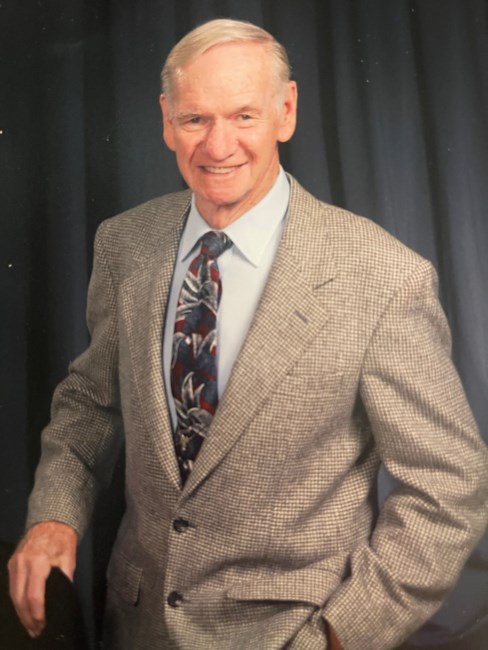
Gene Lyng was born in the High Plains town of Shamrock, Texas on March 8, 1927 and died in Marble Falls, Texas on September 16, 2026. During his early childhood, he and his four younger sisters lived with their parents, Patrick and Myrtle Lyng, in Lefores, Texas on an oil lease managed by his father. Following his father’s retirement from the oil business in 1939, the family moved to a small farm outside of Norman, Oklahoma. Like other members of America’s “Greatest Generation”, Gene’s childhood and early adulthood was marked by two of the signature events of the twentieth century—the Great Depression and the Second World War. Being a child of the Depression and a member of a farm family, Gene developed an enduring capacity for self-sufficiency that would serve him well throughout his life. It was an attribute that enriched the quality of his own family’s life and won him great admiration from all who knew him.
After graduating from Norman High School at age 17, he resolved to do his part for the War effort but was not old enough to join the military. Consequently, he decided to join the Merchant Marines, entering the U.S. Maritime Academy in August, 1944. The most important personal consequence of this transformative period of his life was that he met and won the heart of a beautiful young English woman while docked in Newcastle-on-Tyne, England. After the War, she would travel from Newcastle to join him in New Mexico where he was working on construction projects at Los Alamos National Laboratory. Gene and Victoria Porteous became husband and wife in Santa Rosa, New Mexico in 1949.
Like many WWII veterans returning to civilian life after the War, Gene faced difficult economic circumstances, so he and Vicki struggled to make ends meet during the early years of their marriage. Vicki shared Gene’s childhood experience of deep poverty during the Depression years and, like him, developed capacity for resilience and self-sufficiency. Consequently, the two of them were able to make great strides in improving their family’s economic circumstances over the course of their lives together. After leaving the construction business in the early 1950s, Gene went to work in the expanding oil refinery industry as a production worker at Shell Oil Company in Pasadena, Texas. In 1962, he moved his family to Alvin, Texas to take a job at Monsanto Company, Chocolate Bayou where he began his steady rise from production worker, to draftsman, and eventually to a design engineering position. However, once the plant management became aware of the depth and range of his intelligence and skills, they began assigning him tasks beyond the purview of his official job description. Thus, his work responsibilities increasingly shifted to a “Special Projects” focus, which included such things as introducing the CAD system into drafting services, identifying and incorporating appropriate computing technology into plant operations in the early years of the digital revolution, helping to introduce “strain gauge” technology into refinery processes at the Chocolate Bayou plant, and many other special projects. The intellectual stimulation of this kind of work and the travel opportunities and professional affiliations it provided excited and fulfilled him. It was obvious
to all who knew him in these years that he had reached a level of job satisfaction that few people ever achieve in their lives.
In addition to his official duties at Monsanto, he was a major contributor to the work culture of the plant. Not just a gifted designer and renderer of pipes, he was also able to employ his artistic skills and keen sense of humor in creating a regular comic strip that appeared in weekly issues of the plant publication, Bayou Briefs. He also became a “content creator” in other ways, such as designing and drawing display materials for important plant events and public relations projects. His unique and wide-ranging talents endeared him to his fellow plant workers, from the top to the bottom of the employee hierarchy. So it was no surprise that when Gene reached the mandatory retirement age for Monsanto employees, management encouraged him remain in his position as a contract employee. He was thrilled to continue doing all the “fun stuff” included in his open-ended job description.
While Gene’s intellect, special talents, and strong work ethic were appreciated and respected by many who knew him, the qualities that his coworkers and friends valued the most was his genial temperament. He was a person of significant ability and accomplishment, but also a very modest man. He was incredibly easy-going and treated everyone with respect and deference, irrespective of their particular station in life. Perhaps the thing that people appreciated most about him was his amazing sense of humor. He loved to make people laugh and he put significant effort into achieving this goal. As his wife, Vicki, liked to say about him, “he remembers every joke he ever heard,” which made him a great source of amusement for anyone who spent time with him. Indeed, he managed to find audiences for his humor in many different environments—at home with family and friends, with his colleagues in the drafting department, with other Monsanto employees who followed his cartoons in the Bayou Briefs, and eventually members of the entire Alvin community! This latter fan base emerged when Gene retired (a second time) from Monsanto and began publishing weekly cartoons in the city newspaper, The Alvin Sun. His humorous observations of city politics and good-natured ribbing of city authorities won him many fans among Alvin citizens.
For those closest to him, Gene’s principal legacy will be the inspiring template he gave us for how to achieve “a life well-lived.” He possessed an infinite curiosity about the workings of the world and would never let his lack of knowledge or skill in a particular area deter him from taking up a challenge or exploring a new interest. So, while he was a music lover who enjoyed listening to music, he went a step further and taught himself how to play the guitar and became a reasonably accomplished guitarist. His artistic interests and skills broadened beyond cartoons and other kinds of drawing to eventually include painting large canvasses. Later in life, he decided to take up writing and he succeeded in publishing several books, including his autobiography. Because so much of his work life revolved around engineering and technology, he was an especially accomplished home repairman and shade-tree mechanic who could fix almost anything. Thus, by way of example, he demonstrated how one can live a rich life of achievement and fulfillment, by relying on your intelligence and creative imagination to solve difficult problems, expand your competencies, and explore new ways of experiencing the world.
As talented and capable as Gene was, one attribute stands above all the rest of his abilities and accomplishments, one that may be connected in certain ways to his life-long calling as a fixer of broken things. What everyone who was close to him experienced at one time or another was his overwhelming desire to help them when they needed his assistance, to alleviate their pain or find a solution to their problems. His highest priority in life was to be available to people in need, to use his attention, knowledge, or skills to make things better for them. Even in the last days of his life, when the basic tasks of daily living became a major challenge for him, his standard response to anyone who told him about their current problems or future plans was “What can I do to help you?” For all of us who loved him, no other thing makes us more proud of him and more grateful for his presence in our lives.
Gene was preceded in death by his wife, Vicki. He is survived by his daughter, Beverly Frais, son, Stephen Lyng; four grandchildren, Abigail, Ryan, Richard, and Laura; and five great grandchildren, Taylor, Bernadette, Deidre, Jaxon, and Lilah.
Show your support
Add a Memory
Share Obituary
Get Reminders
Services
Celebration of Life
Share
Service
SHARE OBITUARYSHARE
- GET REMINDERS
v.1.18.0