OBITUARY
John Nicholas Basic
December 16, 1923 – August 18, 2023
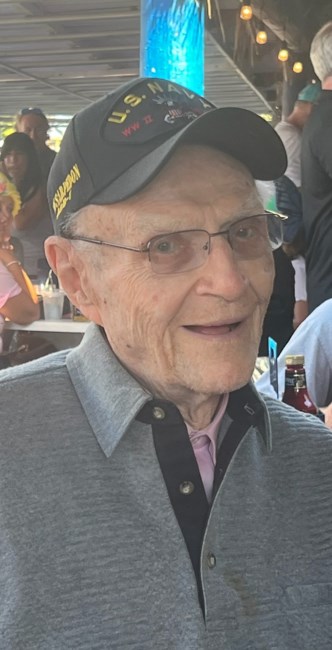
John was born December 16th, 1923 in Chicago, Illinois to the late Marin and Mary (Lucin) Basic. He grew up at 240 W. 33rd Street across from Armour Square Park and close to Comiskey Park on Chicago’s South Side during the worst of the great Depression. He attended St. Jerome elementary school and attended Croatian language lessons every Friday for two hours. He made it a point to attend the annual Velika Gospa celebration at St. Jerome Church.
His Dad passed in 1938 when John was 16. He became “the man of the house” and found ways to help his family survive. His jobs included working on a vegetable cart on Saturdays, a perk being that every weekend he was able to take vegetables home for his mother to make soups since the vegetables could not be kept fresh over the weekend. He was an Andy Frain usher at both White Sox and Cubs ballparks as a teenager. He had a great story about the ballpark hotdogs. While in high school, he worked at Mack Truck as a mechanic’s apprentice.
High School was at Tilden Tech. Upon graduation in June, 1941 he continued to work full time at Mack Trucks while attending engineering classes at night at the Illinois Institute of Technology. Thanks to his younger sisters Katherine (Kittie) and Antoinette (Toni), who both started working, he was able to begin attending classes full time. During this period, he worked under Professors Herbert Anderson and Enrico Fermi as part of the team that constructed Chicago Pile-1, the world’s first nuclear reactor, built under Stagg Field at the University of Chicago. Pile-1 generated the first nuclear chain reaction in 1942. Both Anderson and Fermi subsequently worked on the Manhattan Project that developed the first atomic bombs.
John enlisted in the Navy in April, 1944, and because of his engineering background, he underwent special training as a radio/radar technician at Navy Pier in Chicago and Michigan City, Indiana. After training, he went by train to San Bruno, CA, and then by transport ship to Pearl Harbor and finally to Okinawa, which was to be the jumping-off point for the invasion of Japan. He was assigned as a Radio Technician to the USS Sarpedon (ARB-7), one of twelve Aristaeus-class battle damage repair ships built for the Navy during World War II. The Sarpedon served to repair the many ships damaged by Japanese kamikaze attacks. John told harrowing tales of the kamikaze attacks in the last days of the war. While he was at Okinawa, the atomic bombs that he had an early hand in developing were used to end the war. As if this were not enough adventure, the Sarpedon survived three huge cyclones in September, 1945. John told of riding 100 foot waves during these storms, and how he saved the ship from running into mine fields by repairing the radar system when it quit working during the middle of one of these storms. The Sarpedon was next posted to Shanghai, China, and it was from here John was discharged from active service and began the long journey back to Chicago. One of his fondest memories of his service in the war were the daily letters he received written by his sister Toni from the time he left Chicago until he returned.
He finished his studies under the G.I. Bill at the Illinois Institute of Technology, graduating with a degree in Mechanical Engineering in 1947. He did post-graduate studies in 1947-48, continuing his work with Anderson, this time on building the 2500-ton Syncro-Cyclotron project at the University of Chicago. This huge “atom-smasher” was used by physicists all over world to conduct experiments to study sub-atomic particles. He worked 5 years as a junior engineer with Professor Hermann Blietberg on power plant design and performance.
He was active at the national level in the Veterans of Foreign Wars and American Legion organizations after World War II, and it was through these activities that he met his future bride, Marijo Coleman. He married Marijo in 1950.
In 1953, he left academia for private industry, and began working as Department Head of Mechanical Maintenance at Joanna Western Mills in Chicago. He spent three years as Consultant and Chief Engineer at Mt. Hope Machinery Company in North Deighton, Massachusetts. In 1959, he returned to Chicago and Joanna Western Mills as Director of Engineering for multi-plant operations.
In 1964, he designed and built a beautiful home on a lake outside of St. Charles, Illinois, where he and Marijo raised their family.
In 1969, he left Joanna Western to start his own company, Basic Environmental Engineering. He designed incinerators to convert municipal, industrial and medical waste into electrical energy. Over a 40 year period, he built over 100 projects and licensed an additional 25 projects beyond the USA, including Canada, Mexico, England, Ireland, Saudi Arabia, Japan, Taiwan, and China, among others. He held multiple US and international patents on the waste-to-energy technologies he invented. He received many awards, included the American Society of Mechanical Engineers Thomas A. Edison 2003 Inventor Award, and the Illinois Institute of Technology Professional Achievement Award in 2003.
John and Marijo traveled extensively in the United States and abroad. For example, they were in Berlin when the Berlin Wall fell in 1989.
On the home front they started a family tradition starting ~40 years ago of hosting a “Half-Way to St. Patrick’s Day Party” because March 17 was too cold for Marijo to celebrate her Irish heritage properly. This event was attended by hundreds of family and friends and including live music, roasted corn, and a pig roast.
John and Marijo retired to Marco Island in 1997. He regularly attended San Marco Catholic Church and served as an usher for many years. John was an active member of the Knights of Columbus (4th degree), and he helped with refreshments at half-time at weekly Bingo at San Marco Church sponsored by the Knights. He was an active member of the Veterans of Foreign Wars, and of the American Legion. He was a founding member of the Marco Island Yacht Club. He was an active participant in the social life on Marco Island, and especially enjoyed live music and dancing up until the very end. He enjoyed many area restaurants, and friendships with the owners, bartenders, wait & kitchen staff, and he was a fixture every Sunday at Stans and the Sand Bar.
John is survived by five of his children: Catherine Ostrowski (Mike), John Basic Jr. (Cathy), Sally Cruger, Margaret Basic (The late Jerry Noti), and Kerry Butler (Kevin) and his sister Antoinette Driscoll. He has 9 grandchildren and 13 great-grandchildren. He was preceded in death by his wife Marijo and two children, Manda Basic and Laura Willing.
A Catholic Mass, interment of ashes, and a Celebration of Life will take place at San Marco Catholic church on February 3, 2024 at 10:00 am. Friends may visit www.hodgesjosberger.com to extend condolences to the family and to leave a memory of you and John and any photos you’d like to share.
In lieu of flowers, please consider donating to St. Jerome Croatian Catholic Church in Chicago in John’s name https://giving.parishsoft.com/app/giving/stjeromecroatian
Condolence cards can be sent to:
Catherine Ostrowski
170 Cypress View Drive
Naples, FL 34113
Show your support
Add a Memory
Share Obituary
Get Reminders
DONATIONS
St. Jerome Croatian Catholic Church2823 S. Princeton, Chicago, Illinois 60616
Services
SHARE OBITUARYSHARE
- GET REMINDERS
v.1.18.0