OBITUARY
Marc Andries Smit
October 7, 1954 – January 22, 2017
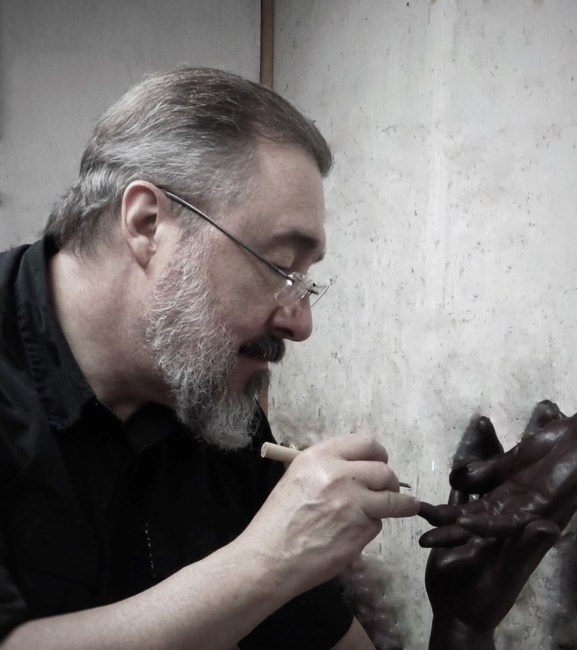
Marc Andries Smit, 62, passed away Sunday, January 22, 2017, at Jackson Memorial Hospital in Miami, Florida, following a recent undetected cardiac event. Marc was born in La Habana, Cuba, to Dirk and Maria del Carmen Smit. He married his wife, greatest friend and constant companion, Astrid Castedo Smit in 1979. He is survived by his sister, Regina Smit-Sio (Carlos Sio), and Regina’s children, Natasha, Yvonne, Katrina & Leilani; and his brother, Richard Smit (Marylin), and Rick’s children, Derek & Lauren. Marc is also survived by many extended family members—including the Pinilla, Trespalacios, Saun, Ferrer and Quade families—and by friends from all walks of life.
In 1961, Marc exiled to the United States with his family. At a very young age, Marc developed a deep and ultimately life-long passion for art, especially sculpture. At the age of 12, his sculptural talents were recognized by the University of Miami, which accepted him for participation in its Adult Center for Cuban Arts and Culture, where he apprenticed with celebrated Cuban sculptors and artists.
Art and culture remained a signature passion for him throughout his life, leading him to study Art History along with Political and Behavioral Science at Florida Atlantic University, where he graduated in 1978. He travelled widely in pursuit of these cultural interests, studying Mesoamerican archeology and European art and culture extensively. His house in Coral Gables, Florida—overrun with artifacts, fossils and relics from around the world and across the ages—displays the broad scope of his travels and interests. The same intense curiosity is reflected by the innumerable books on art, history, culture and other topics, which can be found stacked neatly in any and every available space of his cozy home and even in the cargo space of his SUV.
After a successful career in business, Marc renewed his full-time devotion to sculpture, rendering pieces that can be found in collections in the United States and Europe, including Corpus Christi sculpted for the late Pope St. John Paul II and Orange Blossom for Queen Beatrix of the Netherlands. His public artworks include the Padre Félix Varela Monument in Miami, Diaspora bas-relief at San Carlos Institute in Key West, the José Martí Monument in Orlando, FL, the Professor Richard Hausler Memorial bronze for the University of Miami School of Law, the Father Felix Varela bronze bust at the National Shrine, the Basilica of our Lady of Charity – Martyrs Monument, a bronze at the Church of the Immaculate Conception and Freedom Plaza – a park dedicated to José Martí, commemorating the centennial of the Republic of Cuba. He also created many other gallery pieces, such as Angel Fetish, exhibited at MOLAA, and a memorable series of nativity scene ornaments each Christmas season between 1995 and 2015.
Marc worked primarily in clay and stone, as he put it, “because we are made of earth and we must stand on the firmness of Stone.” His work has been described as classical and powerful with strong emotional and psychological subjects—a range of characterizations that nearly (but not quite) captures the breadth and depth of his dynamic personality.
Marc was an intellectual—who also enjoyed mortifying great aunts and grandmothers with “dirty” jokes and outrageous stories at family gatherings. He was a permanent member of the “kids table” at holiday celebrations, where he held court with magic tricks and games over spellbound nieces and nephews hanging on his every word and movement. Marc could speak thoughtfully about current events, history, politics and the arts, and also do a spot-on Groucho Marx impression. He could (and did) publish insightful scholarly articles or give guided tours at museums, and also trade jokes with “Cubanazos” over coladas outside of Versailles in La Pequeña Habana, U.S.A. He was a walking contradiction in many ways—and a non-conformist.
Throughout his life, Marc pursued knowledge and real experiences despite significant challenges. Although he relied on a prosthetic leg, he was an avid long distance cyclist. Similarly, he mastered classical sculptural technique despite having a developmental deformity in his left hand. He survived Non-Hodgkin Lymphoma but continued travelling around the country and the world together with Astrid.
Marc was always interesting and interested—an engaging personality who was deeply curious and held impassioned opinions. He was fiercely patriotic of his adopted American homeland, while at the same time reverent of his Cuban and Dutch roots. He was intelligent and educated, witty and funny. He was a firebrand in his political beliefs (conservative), but not beholden to partisan dogma. He was devoted to those he loved, and generous with his time and talents. He was at all times an interesting conversation waiting to happen.
In all of this, one sees the unbroken thread of Marc pursuing the essence of the sculptor’s quest: to leave behind an expression of the artist’s existence. In his own words: “Sculpture for me is the ability to take a transient though of energy and produce an object as a vehicle of one’s power in life, and as a legacy and reflection of . . . our time and space.” Through his life—his energy, his ideas, works and actions—Marc rendered for himself and for those he touched a singular and remarkable expression of life in a certain space and time.
A Celebration of Marc’s Life and Work will take place on March 5, 2017. Anyone interested in participating should email [email protected] for information
Show your support
Add a Memory
Share Obituary
Get Reminders
Services
SHARE OBITUARYSHARE
- GET REMINDERS
v.1.18.0