
OBITUARY
Wayne Chris Spelius
July 13, 1942 – October 1, 2017
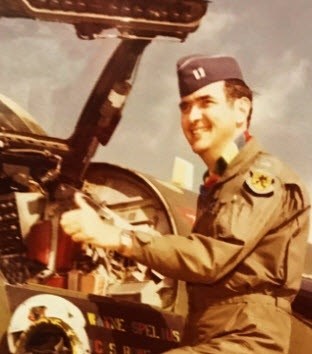
July 13, 1942 – October 1, 2017 (died of natural causes).
Wayne always wanted to be a pilot. He never knew his biological father, a pilot in the Army Air Corp, whose plane went missing in the jungles of Burma during World War II, and was MIA for many years. Finally, his remains along with those of his two comrades in their downed B-24 (“Liberator”) were found in their wrecked plane. They were buried together, with honors, in Arlington National Cemetery.
Wayne was adopted by William J. after his mother, Carol Spelius remarried. At age 7 Wayne remembers giving his permission for his adoption to the judge. At age 15, Wayne was the captain of a 1000 plus mile trip in the family’s small boat “Momisso”, down the length of the Missouri River to the confluence of the Mississippi and then down the Mississippi to the confluence of the Ohio River, and then up the Ohio River to Cincinnati. As Captain, he was in charge safety for his mother, brother and sisters, the youngest of whom was 2 years old. They had many wonderful adventures on that trip and his mother wrote them up for the Cincinnati Enquirer. Wayne graduated from Highland Park High School in Chicago, and then was accepted into the Air Force Academy.
Wayne graduated from the Air Force Academy in 1964, and completed pilot training in 1965. He was first in his class in flying and second in his class in Academics. He was assigned for combat crew training in the F-105 at Nellis Air Force Base, Las Vegas, Nevada. He was part of the first group of lieutenants to go directly from pilot training to F-105’s. He had six months of combat crew training. After that time in 1966, he was deployed to Southeast Asia to the Air Force Base at Korat, Thailand. Wayne was shot down in Vietnam and he ejected from his plane. He had the fastest rescue of the Vietnam War, which he directed. Details of his rescue, follow.
Vietnam: RESCUE OF 1st Lt. WAYNE C. SPELIUS
NOTICE Wayne Spelius: Republic F-105, serial number 58-1165, lost to
anti-aircraft fire, over RP-1, rescued from Gulf of Tonkin.
EVENT
That fateful day for him and his THUD (F-105) occurred on his 37th combat mission, July 17th 1966, just four days after his 24th birthday. He was the second of a two-ship mission that was acting like a four-ship because weather had grounded the F-105’s (“Wild Weasels”) that were supposed to fly with them. To act like a four-ship, he flew behind and out of sight of his lead, as planned. Their mission was armed reconnaissance, deep into North Vietnam, along a road far north of the DMZ. Their mission was considered very dangerous as that region was occupied by Viet Cong and North Vietnamese troops. Rescue was very difficult because fishing boats with radios were usually everywhere and both Viet Cong and North Vietnamese would kill pilots and their rescuers whether on ground or in water.
That day their F-105 ordinance consisted of radar-seeking Shrike missiles (homing missiles on radar) and Sidewinders (air to air missiles). Each of the two pilots tried to attract enemy radar so they could fire their Shrikes. They reached the designated road, and wove back and forth across it, flying “slow” (over 450 knots*) and low (500 ft. above the ground) when Wayne’s plane was hit, causing an engine fire and damage to the electronics which knocked out radio communication. Unable to call his lead and aware of the danger, Wayne turned his fighter toward the water to get as far away from shore as he could, lighting his afterburner to climb as fast and high as possible. At 14,000 to 16,000 feet, flying close to the speed of sound (600 knots), six miles out over the Gulf of Tonkin, his hydraulics failed, causing his plane to start rolling. Although his airspeed was much faster than recommended guidelines for ejecting, he had no choice but to eject. He raised the handles on his seat, pulling off the plane’s canopy, then squeezed the trigger (now exposed) on the seat which fired that seat, launching him out, up and away from his burning plane. The emergency locator beacon on the parachute, designed to activate automatically when the parachute deploys from the backpack, had been purposely turned off by the pilots because Viet Cong used the locator beacon with its frequency to lure rescuers to their deaths. After ejecting, Wayne watched his plane roll over and plummet out of the sky. His parachute started to deploy, then collapsed, somewhat slowing his speed which protected the parachute from ripping out, an event that would have caused serious injury upon landing. Then his parachute deployed again fully, swinging him in his harness. He reached down to pull his survival radio out from the leg pocket of his flight suit, but he yanked the antenna up with such force that it ripped right out of the radio. He stuffed it back in and called his lead; “Pistol One, this is Pistol Two….” but the other F-105 had flown out of his communication range. He then looked down and recognizing the silhouette of a USAF rescue sea plane, the SA-16, Albatross, he called it on the emergency frequency: “Crown, this is Pistol Two.”. He watched the sea plane fly toward the shore in the opposite direction so he called again, “Crown, go to the left, I’m about seven miles off shore (in the Gulf of Tonkin) …” When the Albatross turned away from shore he knew he would be rescued. The Albatross was looking for him in the water, so he called again; “Crown, I’m above you”. He saw the plane rock (tip) its wings to find him, miles above, and Wayne watched as it circled around him, remaining close to the water, while he floated down. Ten minutes later, he landed in the warm water of the Gulf and was soon met by a parachute jumper from the Albatross, which itself had landed nearby, on the water. He was guided away from the cords of his chute and pulled into the rescue plane, thus completing the fastest rescue of the War. He was in the water less than five minutes, and Wayne remembers that he didn’t even get his head wet. In this way he successfully initiated, directed and participated in his own rescue.
The episode was filmed by a camera news crew and appeared on national TV, “The CBS Evening News”, narrated by Walter Cronkite. Right before the newscast, CBS called Wayne’s mother in Chicago asking her how she felt having a hero son who was shot down. Thinking he was dead, killed in the war like her first husband, she started to cry. After assuring her that Wayne was alive and well, a few minutes later, along with the rest of the nation, she watched her son’s rescue on TV.
Wayne, himself, was flown to Da Nang in South Vietnam in the Albatross to be examined and cleared by a flight surgeon. That night he remembered sleeping in an air-conditioned tent room belonging to a Marine. The next morning, he needed help to get out of bed because he was so stiff. Two days later he was back in Korat and resumed flying in less than a week. He successfully completed his first Vietnam tour, and was awarded a Purple Heart as well as a 100 Mission Patch.
After that event, he had to have his parachute put in the plane for him, and he had to lift his leg with his hands to move it from the floorboard to the rudder pedals tor braking after landing on the runway. Little did anyone know at that time that Wayne had fragmented a disc in his spine into five pieces during that high-speed ejection. The injury to that disc necessitated back surgery some years later during his second tour in Vietnam, while flying F-111’s.
Before he went to Vietnam, he married Nancy Powers, and they had a son, Chris Spelius. The marriage did not last. He had another brief marriage after that. Wayne remained in the Air Force as a career officer for another 20 years. He was an excellent instructor pilot, and accident investigator and he made certain that he continued to remain a “flyboy”:
During this time, he studied Judaism and then converted. Through the match-making efforts of his mother, he met the woman who was to become the love of his life. He and Susan Mirow PhD MD, married and together raised their child, Ari.Joseph Spelius. After he retired from the Air Force, he started a computer business selling Medical computer software and hardware, with ongoing support to physicians. His associate, Harry Heightman, and his secretary Margaret McKnight were dear to him.
Wayne and Susan made Salt Lake City their home. Wayne was a wonderful father for Ari, and he was always there for his wife and family, whom he loved deeply. He helped his wife, Susan with billing, and later with her military medical research. He took care of his father Bill Spelius (William J.) and his mother, Carol (a writer, adventurer and poet) during the last years of their lives. He was always there for his nieces and nephews, guiding them with humor and wisdom.
He was an extraordinarily kind person, yet strong and forceful when that was necessary. He is survived by his sons, Chris and Ari, sister, Christine Spelius, DVM, a veterinarian, his brother, Chris Spelius (Rosie Olave) an Olympic Kayaker, and sister, professional pianist Susan Spelius Gannon (Steve Gannon, DDS), nephews and nieces: Chiloe Spelius, Harley Spelius, Heidi Spelius, Andrew and Michael Dunning, Mei-ling and Jin Li Mirow, Heidi and Torrey Mirow, and Laura Lim.
He moved gracefully through life in all its forms. He was a natural athlete, an accomplished skier and sail and motorboat pilot/captain. When his movement became inhibited due to COPD (Chronic Obstructive Pulmonary Disease), he managed to still fly, this time, using a drone that takes pictures.
He left this earth without suffering, on the holiest day of the Jewish Year, Yom Kippur, a day of fasting and atonement for one’s sins. Death on this day means that he is absolved of all wrongdoings and misdeeds. Fittingly he died a righteous man. We will miss him greatly and will carry him in our hearts.
Graveside services will be held on October 4, 2017 at 11:00 AM at Montefiore Cemetery (Salt Lake City Cemetery, Montefiore Cemetery at 1061-1083 4th Avenue, SLC) to be followed by lunch at 73 G Street.
In lieu of flowers contributions may be made to Wounded Warriors or Synagogue Kol Ami.
May his soul be bound up in eternal life.”
Show your support
Add a Memory
Share Obituary
Get Reminders
Services
SHARE OBITUARYSHARE
- GET REMINDERS
v.1.18.0