
OBITUARY
Francis "Gim" Graham Hollister Jr.
May 7, 1940 – August 16, 2026
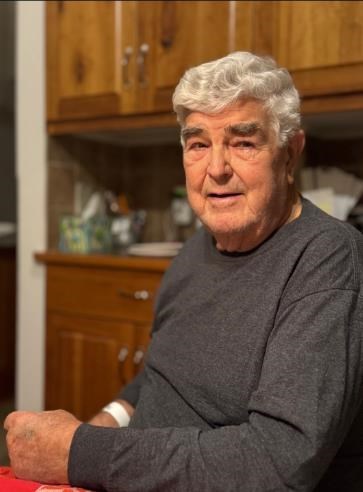
Gim’s Story
Bundled or not for the day’s weather, I would be securely tucked between my Dad’s legs on a tractor till sleep took me over. Mom and Dad would settle me down in the back of the 1941 Woody Chev wagon. As you might expect, a youngster like me would love or hate machinery. I can tell you those experiences showed me what that love would one day mean.
1943: During World War II, on the lip of the Pacific Rim, my Dad and Mom had to do more than work for themselves. For them, the reality had to have been “The best of times, the worst of times.” For me, it was exciting and wondrous. We lived on a gigantic ranch west of Santa Barbara, California. Twenty-eight miles of coastline, 38,000 acres was the little stake my ancestors had left several family members. Due to the war, they had to operate with the fewest people possible, nine men and many of their wives ran the 3,000-plus cattle and 1,100 acres of farmland. Day and night were consumed with work.
The Southern Pacific Railroad was guarded by absolutely greenhorn troops from downtown New York, the Bronx and Brooklyn — not one of them had heard a cow moo on a quiet wind-whispered surf-swooshed night. The whistle of a bird would set off a blaze of shots. The stories bespeak almost insane moments that still shiver me. Well, I had a part also. When Dad and Mom had to work in areas that were far from home, the Woody was a camp vehicle. After a long day of play, I would climb aboard Dad’s lap to go off to mow the hay field — and off to sleep. Dad built roads with a little bulldozer, and he remade the firebreaks with the bulldozer and a disc. And I would be there on his lap making roads and discing firebreaks, too, rumble-vibrating to sleep. It was the most luxurious and wonderful time of my life. In a way, I didn’t have a care, and I accomplished everything! Amidst all of the grown-up work I would take to my work on my mountains at the edge of the driveway with my incomparable toys built by “Model.” The toys looked like authentic Caterpillar carryalls and tractors and Mack trucks and cars.
1945: The great pressures of the war waned but the ranch manager wanted the men and women to work just as hard and for the same wage. Mom and Dad wanted more. They stalked the West for a place and liked Western Nevada. We kids lived in Santa Barbara, in town, while they made arrangements to buy our own ranch in Genoa. The only place in Santa Barbara I could pursue my work was in Granny’s side hill garden. I would build wonders-of-the-world roads and move entire mountains.
Finally, in late spring 1946 with the Woody packed to the roof and three kids stuffed in the back, we headed for our new beginning. Arrival was heavenly with glorious mountains surrounding the valley. And I couldn’t figure out why my oldest sister cried, wishing to die, or, more to the point, go back to Santa Barbara. I climbed-crawled out of the car with all my equipment in tow and headed to the nearest mountain piled at the edge of the yard. Bliss!
I learned to run Dad’s bulldozer at seven and a half. I practiced on my yard mountains and made mountain roads by bulldozing and dynamiting with my Model equipment and M-80 firecrackers.
Later, I learned to run Dad’s WD45 and round baler. I got so good that I could bale all day and not miss one bale unless I ran out of twine or the machine broke. And I was so good at listening that I could tell when something was about to break or was breaking.
Other times I would walk the bales of hay as they were pushed from the baler to the stack along a 60- or 80-foot ramp as Mom and Dad poked and tied. Then I would run back along the bales and start again.
In 1963, I began buying construction machinery to fix the ranch and make my own construction company. Although I didn’t lose money, I was not a ringing success. I sold most of my equipment to two young men I trained. I kept two machines for the ranch that I can work when I desperately need to play for an hour or two, to move entire mountains or create wondrous roads.
__________________________________________________________________
Francis Graham (Gim) Hollister Jr. of Genoa died Aug. 16, 2026. He was 86. He was born in Santa Barbara, Calif., and moved to Genoa with parents, F. Graham Sr., Janet Davis and sisters Margaret and Jean Hollister in 1946. As a youngster, he worked on the family’s Sierra Creek Ranch north of Genoa with his parents and sisters. He attended schools in Minden and Gardnerville until the eighth grade. He graduated from the Cate School in Carpinteria, Calif., and attended the University of Nevada, Reno, and Oregon State University in Corvallis, Ore. He married Joyce Aldrich of Aptos, Calif., in 1962 and they lived on the family ranch ever since.
Gim was a rancher and real estate broker. He operated a land-leveling business and leveled many agricultural fields in Carson Valley. Gim also made an impression with his portrayal of Teddy in the fall 1979 Carson Valley Theatre Company’s production of “Arsenic and Old Lace.” He also built the set including the stairs he ran up yelling, “Charge!”
He was a lifelong Democrat, coming from a political family. He ran unsuccessfully in 1986 for the same state senate seat his father sought in 1968. Gim worked for the Grant Sawyer for governor campaign in the late 1950s and early 1960s, when he became active in local party politics. He served two terms as chairman of the Douglas County Democratic Central Committee in the 1980s and early 2000s and was named Chair Emeritus in 2011.
Gim is preceded in death by his older sisters.
He is survived by his wife, Joyce, daughters Jennifer (Kurtis Hildebrand) and Heather (Cess Maglinao) Hollister; his sister, Amelia Hollister (Rod) Blanchard; grandchildren Anginette (Jon) Vangelderen, all of Genoa; Andrew (Maral) Mayes, great-grandchild, Markus, all of Littleton, Colo; and cousin Anne Hollister of Moro Bay Calif., and sons.
FitzHenry’s in Minden is in charge of arrangements. There will be no service at his request.
Show your support
Add a Memory
Share Obituary
Get Reminders
Services
SHARE OBITUARYSHARE
- GET REMINDERS
v.1.18.0