
OBITUARY
Joseph Joe B. Wilder
February 22, 1922 – May 9, 2014
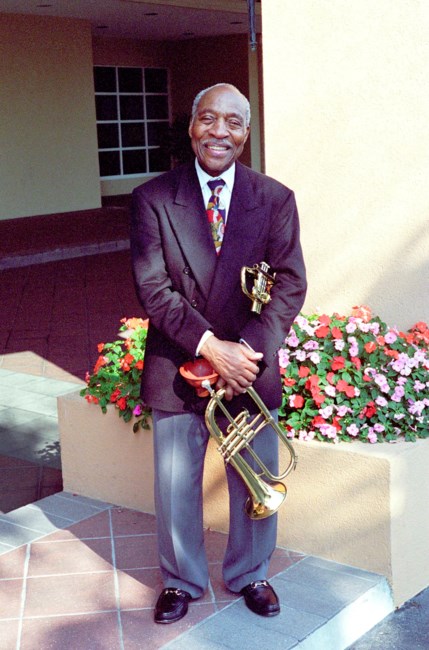
Joe Wilder’s musical accomplishments are legendary. From the age of ten, when he was featured on the Parisian Tailors Colored Kiddies radio program from the stage of Philadelphia’s Lincoln Theater, through a big band odyssey in the 1940s and early 1950s that saw him playing a key role in the orchestras of Les Hite, Lionel Hampton, Jimmie Lunceford, Dizzy Gillespie, and Count Basie, to his breakthroughs on Broadway, in the network studios, and in the classical world—not to mention the Marine Corps--he not only maintained the highest standards of performance, but developed a sound and a style that was truly his own and carried across all genres. Although he was always quick to downplay his own role as a pioneer, his triumphs were even more remarkable given the times and the barriers he faced. He overcame prejudice through sheer talent and dedication to his craft. But while his musicianship may have opened doors, his personality and character changed minds. Wynton Marsalis put it best, when he wrote: “Everything Joe went through isn’t readily apparent because he’s always so dignified and positive. But I know that his struggles made it a lot easier for the rest of us, and I love him.”
Wynton quickly learned what Joe’s family and friends already knew: that Joe was as great a person as he was a musician—and that is the highest praise possible. The qualities that set his playing apart—warmth, compassion, sophistication, and humor (puns included!)—were simply a reflection of the man himself. Joe’s devotion to his family, his generosity to friends in need, his genuine interest in the well-being of others (including perfect strangers), and his impeccable deportment were all manifestations of his extraordinary character. Again, the words of a close musical colleague, Warren Vaché, sum it up most succinctly: “Joe Wilder is the only man in the music business I’d let hold my wallet!”
Joe received some well-deserved honors in recent years, including being named an NEA Jazz Master, the nation’s highest award in jazz. But his humility and abhorrence of self-promotion undoubtedly prevented him from achieving wider public recognition. Perhaps his greatest legacy may be the many lives he touched as a teacher. Growing up, Joe benefited from the guidance of early role models, beginning of course with his parents, Gussie and Curtis, and continuing with teachers like Frederick Griffin and Alberta Lewis and, much later, William Vacchiano and Joseph Alessi, Sr. at the Manhattan School of Music. He always felt a need to give back. On the faculty at Juilliard for the last decade of his life, and in frequent visits to other schools and colleges, Joe influenced countless younger musicians both in the classroom and in informal encounters. Again, his approach to teaching was simply part of his persona. As one of his Juilliard students said, “He has a way of making younger musicians feel really special…He has a way of bringing people in and making them feel like family.” So, Joe’s song may be ended, but for his family, friends, and admirers, the melody lingers on. And no one could play a melody like Joe Wilder.
© Ed Berger 2014
Joe Wilder is survived by his wife, Solveig M. Wilder, his son Joseph C. Wilder, his three daughters, Elin Wilder-Melcher and her husband, Paul Melcher, Solveig A. Wilder, and Inga-Kerstin Wilder and her husband, Matthew Lipp, and his six grandchildren, Dylan Wilder, Samuel Melcher, Lynn Curd, Tamiko Wilder, Sonya Wilder and Margarita Wilder.
In lieu of flowers, the family suggests that donations be made to the JALC-Joe Wilder Fund, which enables underprivileged High School jazz students to continue their studies.
Checks can be sent to:
Jazz at Lincoln Center - Joe Wilder Fund
3 Columbus Circle, 12th Floor
New York, NY 10019
Show your support
Add a Memory
Share Obituary
Get Reminders
Services
SHARE OBITUARYSHARE
- GET REMINDERS
v.1.18.0