
OBITUARY
Jack M Okun
August 23, 1916 – April 19, 2012
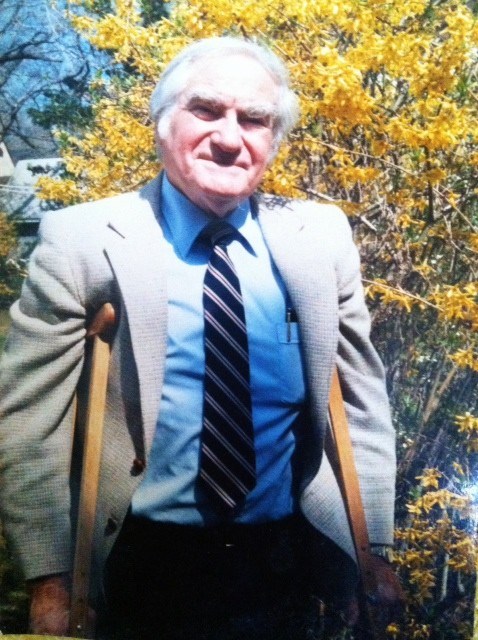
Jack Okun passed away in the early hours of April 19th, at home, at peace, and surrounded by those who loved him. Devoted husband, father, grandfather, and great-grandfather; loyal friend; respected businessman and community leader, Mr. Okun was liked and admired by all who knew him. He was 95.
Jack was born in 1916, in Brooklyn, New York. From early childhood, polio hobbled his gait— but never his spirit, which rose to every challenge with the strength, grace, and good humor that came to define his life. After fifteen grueling operations between the ages of two and fifteen, Jack went from wheelchairs, braces, and crutches to canes— and then back to crutches and finally wheelchairs in his later years. Despite spending so much of his childhood in hospitals and under the knife, Jack was a perennial optimist. Late in life he said, “I wouldn’t trade those years for a normal childhood even if I could. Because then I wouldn’t be me.” His favorite expression? “I have no complaints.”
Growing up on the streets of Brooklyn, Jack’s older brother, Sol, often dropped young Jack at Ebbets Field and ran off with his more mobile friends. So Jack became an avid Dodgers fan, until the Bums quit Brooklyn in 1957. In the ‘60s, he transferred this loyalty to his Amazin’ Mets (whose indomitable optimism and improbable rise during that decade were matched only by his own).
On Rockaway Beach during the summer of 1936, Jack first met Cecyl Zises, the love of his long life. He was 19; she was not yet 14 (“It was those pigtails,” he always said). They married 10 years later and were together until the day he died. Jack’s early years hinted at the fortitude and grit that would ensure his later success. “You make your own luck,” he said— and did. His legs useless, Mr. Okun won a race around a city block by running on his hands. When a mugger marked him as easy prey, Jack cane-hooked his attacker’s ankle and dropped him to the pavement like a stone. On a whim, he bet a friend $5.00 he could swim the East River from lower Manhattan to the Brooklyn Navy Yard— and won. In 1938, Jack graduated from The City College of New York. During the ‘40s he worked with the Army Signal Corps at Bell Labs and Watson Labs; when the labs moved out of state, Mr. Okun elected to stay in Bradley Beach to raise his family and start a new career.
After discovering a knack for selling real estate in the early ‘50s, Mr. Okun joined the Bander Agency in Asbury Park. Later that decade he struck out on his own with partner Herman Crystal. On the corner of Bangs and Main, the Crystal & Okun Agency, was a local institution for more than a generation, and Mr. Okun earned his reputation as an honest broker— a humanitarian with a plan to regenerate Asbury Park by treating all buyers with integrity and equality. In a 1981 feature
article in the Asbury Park Press (“City Broker Proposes Rebuilding Poor Neighborhoods”), Okun argued that cities like Asbury “could begin to regain economic health [only] by assuring a stake in the future for their poorest residents… [by] rebuilding rundown neighborhoods and helping to make… their residents self supporting and independent.” (7 Jan 1981 B5) This philosophy made him many friends among everyday people, who recognized Jack as one of their own. As civil rights and anti-war battles raged in the streets a decade earlier, Jack refused to close up and run, as so many others did; instead, he hung a large peace sign in his window alongside a picture of Martin Luther King. Jr. Convinced that these affinities saved him, Mr. Okun remained a fierce and unrepentant defender of the little guy all his life.
In his private life, too, Jack was a lion of a man with a unique ability to forge hardship into humor. Refusing to let his handicap slow him down, Mr. Okun every morning strapped on his leaden pair of orthopedic shoes, gripped a walking cane in his huge fist, and clomped off to confront the challenges of the day. To questions of his health he would shrug and say, “Listen: if you line up eight people and ask them their problems, you’ll keep your own.” But those who crossed him, he was quick to point out, should “go pound sand,” or “turn purple,” or even “grow warts under their finger nails.” If someone badgered him with questions he would playfully shoot back, “What do you, work for Scotland Yard?” Late in life, he recalled waking up in a hospital bed some seventy years earlier following a particularly severe operation. He was twelve years old. The room was pitch black and stifling hot. He was trapped inside a body cast; he couldn’t move; he didn’t know where he was; and he was gripped by fear. Then, in sudden wonder, he watched the black horizon give way to the orange sun, which rose out of the dark water like an old friend and suffused the ocean—and the frightened boy— with a gentle calm. Years later, he told me that all his fears lifted at that moment. “It suddenly occurred to me,” he said. “In a world so beautiful, our little worries don’t mean anything.” From then on, he faced life’s struggles with a simple adage he liked to exchange with his children: “Smile,” he’d say, “and your life will be happy.”
He did. And his was. In his time Mr. Okun faced down poverty, polio—even McCarthyism. When Jack passed away, his eyes gleamed with gentle awe; and playing at the corners of his mouth we all saw the hint of a smile.
Jack Okun is survived by his wife, Cecyl, his three children Tobi , Bobbi, and Peter (and spouses James and Lisbet); five grandchildren (Erin, John, Adam, Nadia, and Matthew) and eight great-grandchildren (Audrey, Brayden, Liliana, Emma, Jackson, Jack, Sophia, and Luca). We all miss him, and we all carry him with us.
Show your support
Add a Memory
Share Obituary
Get Reminders
Services
SHARE OBITUARYSHARE
- GET REMINDERS
v.1.18.0