
OBITUARY
Shiv Navani
March 14, 1933 – March 9, 2025
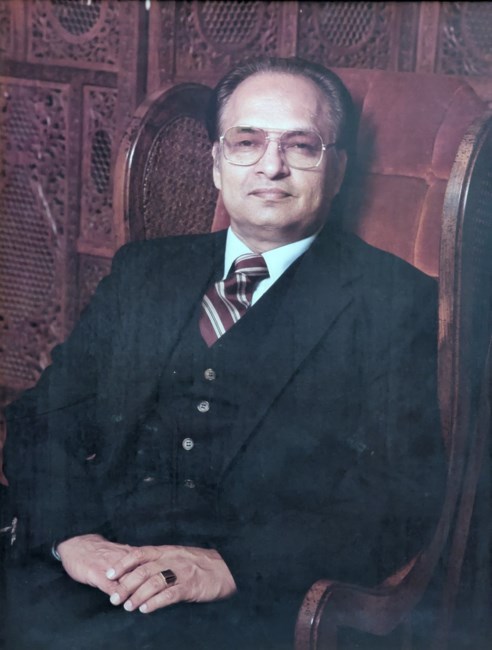
Dr. Navani’s life was a testament to resilience, determination, and an unyielding pursuit of knowledge. His journey spanned continents, from a childhood shaped by the upheaval of partition to a distinguished career in medicine and a life devoted to service. Though he immigrated to the United States in 1967, his story began decades earlier.
Born in 1933 in the small village of Larkana, Sindh, he spent his early years of schooling in Karachi. At 13, he witnessed the turmoil of the partition of India—a period he later described as chaotic and violent. Despite significant uncertainty, his family safely migrated to Mumbai, where he began his medical education. He later embarked on further medical training in England, fueled by a deep sense of adventure.
Dr. Navani often spoke of two instrumental figures in his early life journey: his aunt, whose generosity covered his Mumbai medical college fees when he had nothing, and his older brother, Hargobind, who encouraged him to take on an unconventional opportunity as a ship’s doctor. That experience—traveling from port to port —became one of his most cherished adventures, laying the groundwork for connecting to many diverse people and communities throughout his life, as well as picking up conversational Farsi, Arabic, and other languages along the way.
Determined to specialize in radiology after considering psychiatry, he found himself in Glasgow, Scotland, and then London, where he was accepted into the prestigious and highly selective Fellowship program at the Royal College of Radiology in London. During this time, he married his life partner, Saroj, whose spirit of adventure and resilience matched his own. Their years in England were filled with excitement—seeing The Beatles live, learning how to assimilate as outsiders into new surroundings, building their life together, and welcoming their first child, Vinay. But their journey was far from over.
In 1967, Shiv and Saroj made the bold move to the United States, settling first in Boston, where he began his American career as an Associate Professor at Boston University School of Medicine. It was here that they welcomed their second child, Vinita, marking another chapter in their growing family. Years later, becoming a U.S. citizen was a deeply emotional moment for him—one that, he often said, counterbalanced the sorrow he had experienced during partition. He believed that change is the law of life, often reflecting that its unpredictability makes the journey both mysterious and extraordinary.
In London and Boston, he encountered entrenched institutional barriers in his career, navigating a system that systematically limited advancement opportunities for non-white men, regardless of talent or dedication. This stark reality heavily influenced his decision to leave behind the rigid hierarchies of academic medicine and transition into private practice in southwest Virginia. There, he and Saroj embraced yet another new chapter—adapting to rural life while raising their children, carving out a space where their contributions would be on their own terms. It was there that they welcomed their third child, Sonia, completing their family. Bringing his radiological expertise to the coal-mining region, he became a specialized reader for Black Lung cases, earning recognition both locally and nationally. Whether answering late-night calls for a veteran coal miner, a young mother, or even his most famous patient—Elizabeth Taylor, who passed through town while campaigning for her then-husband, the Governor of Virginia—he was always there to serve. With unwavering dedication, he built his private practice from the ground up, spending four decades serving the communities of southwest Virginia and later, New Jersey before retiring in 2009.
A mentor and a trailblazer for many immigrant physicians, he became a stabilizing force in his community, offering the support he had once struggled to find himself. Understanding the intense challenges faced by newly arrived immigrants, he and Saroj extended a guiding hand to those navigating the complexities of a new country. For decades, they provided counsel and assistance—whether helping with medical concerns, offering guidance on employment and education, or simply creating a sense of belonging within the Sindhi community and the larger Indian community in southwest Virginia and New Jersey. His generosity to others left a lasting impact on those he served, both inside and beyond the medical field.
In 2008, he endured one of the most painful losses of his life—the passing of Saroj, his beloved wife and partner of 45 years. As a widower, he was forced to adjust once again to something he had never expected: that he would outlive her. Despite the depth of his grief, he carried forward, drawing on his lifelong belief in resilience and the ever-changing nature of life to navigate this new chapter without her by his side.
In his later years, he found joy in the company of his five grandchildren. He often spoke of them as his great blessings, delighting in their accomplishments and sharing with them the wisdom he had gathered throughout his life. He took every opportunity to instill in them the values of perseverance, curiosity, and kindness that had guided his own journey.
In retirement, he deepened his spiritual practice through a disciplined, cover-to-cover reading of the 1430 pages of the holy Guru Granth Sahib, an achievement that he celebrated with family and friends in New Jersey. He also reflected on the pursuit of true happiness, which he often described as the foundation of freedom. He explored these themes in three books he penned, each dedicated to his grandchildren, writing:
"The lure of happiness and the fear of pain are fundamental to all human beings. These are the two forces we call life… Attainment of perfect happiness requires coordinated interaction of spirit, mind, and body."
A seeker of both scientific truth and spiritual wisdom, he was shaped by hardship but defined by perseverance. As a devout follower of Guru Nanak’s teachings, he lived by the mantra Sat Nam—"whose name is truth." His legacy endures in the lives he touched, the wisdom he imparted, and the love he shared. Though his journey was marked by upheaval and transformation, he remained steadfast in his belief that resilience and the pursuit of truth were life’s greatest guiding forces.
Dr. Navani is survived by his children, Vinay & Swati, Vinita, and Sonia & Umesh, as well as his grandchildren, Samir, Sahil, Nisha, Ishan, and Vir.
Show your support
Add a Memory
Share Obituary
Get Reminders
Services
SHARE OBITUARYSHARE
- GET REMINDERS
v.1.18.0