
OBITUARY
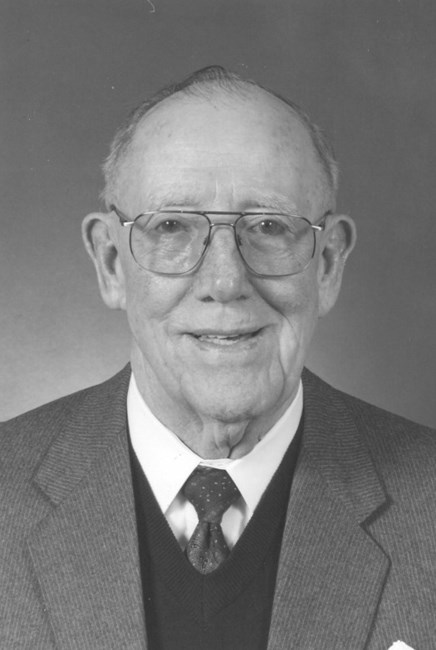
William Lane Bright
September 3, 1917 – December 28, 2016
A memorial service will be held at 10 a.m. Saturday February 11, 2017 at Lincoln Memorial Funeral Home in Portland.
Bill was preceded in death by his beloved wife Joan. Survivors include daughters Mary Olson (Dave) of Salem, and Betty of Minneapolis, daughter-in-law Debbie Sanguras (Larry, dec.) of Hood River, 8 grandchildren and 11 great-grandchildren.
Born 9/3/1917 in Saugus Massachusetts, Bill was the 4th of 5 children born to parents Edward and Anna Bright. He joined sisters Ann and Dorothy, brother George. Three years after his birth, sister Frances completed the family. When Bill was 10 years old, his father died and his mother went to work in a shoe factory to support the family. Bill graduated from Saugus High School in 1935 and was accepted at M.I.T., but had to pass up that educational opportunity as there were no scholarships and no private funds available.
Early on, Bill had decided on a career in electrical engineering. When the family home was destroyed by fire in Feb. 1929, Bill, at age 13, did the electrical wiring for the newly constructed home. This success solidified his career decision. After turning 18, he was hired at General Electric Company at the West Lynn Works, and he enrolled in night school at Franklin Union Technical Institute in Boston. After 3 years at GE, he was hired as an engineering student in the electrical department of Bethlehem Steel Shipbuilding Division in Quincy, MA. After 6 months Bill became a journeyman electrician, and then six months later, advanced to full electrician. Then he was given a job opportunity to hire on at the Union Iron Works in San Francisco that was going to be building destroyers to support the war effort. At age 22, his duties in this new job were to plan, organize, and supervise all electrical work for the ships under construction for the Navy. He continued to keep up with his education by correspondence courses.
In Jan. 1941 another opportunity arose in Portland, Oregon: a new shipyard with contracts to build Navy ships at the Willamette Iron and Steel Company, and at age 24, Bill was hired as assistant chief engineer in charge of all shipboard electrical engineering and construction, and was shortly promoted to chief electrical engineer.
In 1946 Bill foresaw that shipbuilding to support the war effort would be declining, so he enlisted in the army at age 28. He was shipped to Fuchinobe, Japan where he was in charge of all utilities and designed and built a new overhead power distribution system to replace the decaying underground system. One of his favorite stories was when requisitioning supplies from the Japanese, he was always required to sign for the items. He never used his true name, instead always signing “Joe Blow from Kokomo.”
Bill was honorably discharged from the Navy in November, 1947. In January, 1949 he was hired as a sales engineer with Maydwell and Hartzell in Seattle where he learned about the electric utility industry. Six months later he was transferred to Portland as the District Manager. In March, 1958, Bill left Maydwell and Hartzell and started his own company “Western Power Products”, to buy, sell, and distribute products used in the power industries and allied fields. Bill was very fortunate to have the solid guidance of a banker, an attorney, and a CPA to help guide the formation and early successes of the company.
Over time, Bill developed his own line of products, meeting the needs of electric utilities and others. After doing business in several locations in the greater Portland area, Bill started looking for a location to combine the metal shop manufacturing portion of the business with the fiberglass manufacturing. He received a good offer from the Port of Hood River and in 1975 built a manufacturing plant on a 4 acre parcel on the southern bank of the Columbia River in Hood River.
In August 1986, Bill sold WPP to Kearney National, and happily retired. Bill and Joan continued to travel and eventually purchased a low maintenance condo in downtown Portland. They left that condo in 2006, moving to Springridge Court in Charbonneau due to Joan’s declining health, the great food prepared in the dining room, and the personal care and attention of the staff.
Throughout his career, Bill continued to help utilities solve various problems, designing products to help them do jobs, faster, easier, and often more economically, and was awarded 16 U.S. Patents in the process. In 2000 Bill published his book “Two Bills from Boston” that detailed the personal and business philosophies that supported him on his path to business success.
Show your support
Add a Memory
Share Obituary
Get Reminders
Services
SHARE OBITUARYSHARE
- GET REMINDERS
v.1.18.0