OBITUARY
Deborah MacClosky
July 30, 1914 – September 16, 2013
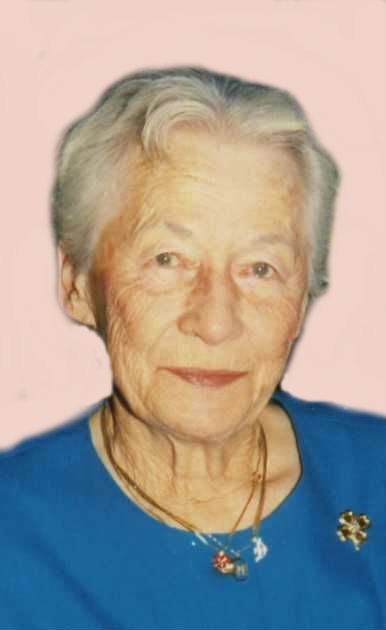
Deborah Bressi MacClosky passed away peacefully September 16, 2013. Preceded in death by two loving husbands, Dominic Bressi and Charles MacClosky; her son Anthony Bressi; and her siblings, James Hardenburg, Gerald Hardenburg, and Agnes Adams.
Deborah was born July 30, 1914 in Calgary, Canada, to Mr. and Mrs. Walter E. Hardenburg. She spent most of her childhood in Otay, California, near San Diego.
After graduating high school, Deborah entered secretarial school and became proficient in typing, Gregg shorthand, and other office skills. During World War II, while working as a secretary for the Pacific Bridge Company in San Francisco, she met and married Dominic Bressi, a civil engineer also employed by Pacific Bridge. After marriage, Deborah embraced her new role of homemaker. After a long and happy marriage, she was widowed in 1982. A friend and former associate of Dominic’s, Charles MacClosky--himself a recent widower after 54 years of marriage--began a correspondence with her. Their relationship bloomed, and they were married in 1984.
Deborah is survived by her son Christopher Bressi, two grandchildren, and many nieces, nephews, grand-nieces, and grand-nephews.
Visitation is on Thursday, September 26, from 4:00 to 8:00 pm at Harry A. Nauman & Son, 4041 Freeport Boulevard, Sacramento.
The memorial service is on Saturday, September 28, at 12:30 pm at Calvary Cemetery chapel, 7101 Verner Avenue, Sacramento.
In lieu of flowers, please make remembrances to Sacramento Food Bank or to your preferred charity.
Deborah Hardenburg Bressi MacClosky, whom many of us knew as Granny, was born July 30, 1914 in Calgary, Canada. Her father worked for the army health service, and her mother was a London-born Irishwoman. He wooed and wed her while in England testifying against Carlos Arana, a rubber magnate responsible for the deaths of nearly 30,000 Amazonian Indians along the Putamayo River. (Now, you need to remember that Granny’s father had traveled in the Amazon. It comes up again in few minutes.) Granny was very proud of her father, and would often recount stories he had told her about his Amazonian adventure.
As a child, Granny and her family lived in Calgary, in New York, and in Georgia before settling down on a ranch in Otay, California (near San Diego), where she spent most of her childhood. Life on the ranch was a bit rustic, especially when compared to modern conveniences. Granny’s mother cooked the family’s meals on a three-burner propane stove. Not only was television absent (well, it hadn’t yet been invented), the radio was a crystal set that Granny had to scratch with a special stylus until she found the dance music station. And when Granny and her older brothers attended the two-room schoolhouse in Otay, their “school bus” was a repurposed ambulance.
After graduating high school in San Diego, Granny wanted to choose a career. Her options were limited to teacher, nurse, or secretary. She used to say that she “didn’t think she could handle” the college work required for teacher certification, so that option was out, and her father didn’t want her to be going around sick people, so nurse’s training was out. She therefore entered secretarial school and became proficient in many office skills, including typing, Gregg shorthand, and bookkeeping.
Granny worked as a secretary at the San Francisco World’s Fair from 1938-1940. An engineer from the Pacific Bridge Company was so impressed by her secretarial prowess that he hired her when the fair closed. During World War II, while she was employed by the Pacific Bridge Company in San Francisco, she met and married Dominic Bressi, a civil engineer from New York who also was employed by Pacific Bridge. (As a side note: Dominic’s East Coast friends and family called him Dom, but his West Coast friends called him Nick.)
One thing that Granny remembered about those war years was that on several occasions when she would be driving home over the Bay Bridge, a blackout would be called because of enemy aircraft in the vicinity. All vehicles on the bridge would have to stop where they were and shut off their headlamps. All car radios would have to be turned off, lest an airplane pilot see the dashboard light. She couldn’t even have a cigarette, because the glowing end might be enough for the pilot to get a targeting fix.
After marriage, Nick told Granny that she ought to sell her car because they really needed only one vehicle--his. In recounting this anecdote, she would often say that she knew his real motive for wanting her to sell her car: to keep her at home tending to her new job duties as homemaker. Of course, those homemaker duties did nothing to prevent her carrying on a correspondence with Richard Collier, a former war correspondent interested in her father’s adventure in the Amazon. Her invaluable information about those experiences greatly assisted Collier in writing the nonfiction book The River that God Forgot.
Decades later, in 2006, Jordan Goodman, a professional historian from England, contacted Granny with a request for information about her father’s experiences in the Amazon. He visited from England and took photos of her father’s letters, pictures, and other documents from that time. The result was a nonfiction book called The Devil and Mr. Casement.
Granny and Nick lived in the Bay area and in Southern California before settling down on Pico Way in East Sacramento. While they were living on Pico Way their two sons, Tony and Chris, arrived. When the boys were toddlers, the family moved to William Land Park, where Granny raised the two children, kept house, gardened, nurtured wonderful bonsai trees, watched and fed the local birds, and knitted afghans for friends and family members.
Granny was widowed in June of 1982. Shortly thereafter, Charles MacClosky (known as Mac), a former associate and friend of Nick’s, began corresponding with her. Mac had been widowed six months previously, after more than a half century of marriage. In June of 1983, Mac asked Granny to move to Los Angeles and live in his apartment -- ostensibly to help him with his business concerns in and around LA. She agreed, the relationship blossomed, and they were married on Valentine’s Day of 1984.
Granny was Mac’s CFO, COO, CCBW (chief cook and bottle washer) and whatever else he needed until his passing in May of 1997. With the help of his CPA, Granny settled Mac’s rather complex estate and sold his apartment building. She returned to Sacramento in January of 1998. She bought herself a little house in William Land Park and lived independently. She drove her own car around town to the grocer, the post office -- wherever she wanted to go.
She re-did the entire garden of her house. By herself. At the age of 83. She pulled nut grass and dug up the plants that she didn’t like. She planted crape myrtle trees and guavas and roses that she did like. Granny was justifiably proud of her rose trees. One of her favorites was a variety called “Angel Face.” And she watched and fed the birds. Granny had her own recipe for hummingbird syrup, and she would booby-trap the garden fence near the hummingbird feeder so that the local cats would have to leave her “hummers” alone. She would shell peanuts for the doves and the blue jays, so they wouldn’t have to work so hard for their treats.
Granny’s door was always open to her grandchildren, who knew that they would find a sympathetic ear to their complaints about unreasonable parents. Not to mention a cookie or three. Granny joined us for dinner often, and always saved room for my home-made desserts. We often teased that she had never met a dessert she didn’t like.
Even though Granny was living alone, she made connections with those around her and so was never lonely. When I called Granny’s hairdresser last week, she said how much she had enjoyed seeing Granny for haircuts and how much she would miss Granny--especially when Granny would admonish her from the shampoo bowl to “get all the cooties out”. The pharmacist remembered Granny with fondness, and had often asked about her when I was picking up her prescriptions. More than one former employee of Mac’s said, “Oh, she was such a good person! I’ll really miss her.”
Granny’s independence lasted until May of 2010, when she fell in her front yard while pulling a weed. She broke a hip. After four days in the hospital and a week and a half in physical rehab, Granny was released to come home with us, but only until she should be healthy enough to return to her own little house, which she loved.
Of course, once we had her within the walls of our house, we found we couldn’t let her go. One of our cats claimed ownership of Granny and spent most of each day on her lap, and all night on her bed--making sure she didn’t fall out.
That cat has spent most of the past two weeks on Granny’s bed, missing her companion and waiting for her Granny to come home. And sad that she isn’t.
Show your support
Add a Memory
Share Obituary
Get Reminders
Services
SHARE OBITUARYSHARE
- GET REMINDERS
v.1.18.0