
OBITUARY
Stanley H. Schmidt
April 30, 1916 – March 10, 2015
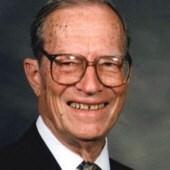
Stanley H. Schmidt, born April 30, 1916, passed on to a new life on March 10, 2015, at the age of 98 years and eleven months. We who love him know him as a gentle man who lived life to the fullest, and had a profound effect on many he met along the pathway of life.
Stanley was born in the home of his parents in San Antonio, Texas. He was the only child of Erna Donop Schmidt, a piano teacher, and Henry M. Schmidt, a railway postal clerk who spent his career working for the government. An amazing facet of his young life was that although he lived through the depression, his father never lost his job during the 1930s. This wonderful gift of employment for Henry meant that Stanley was afforded the benefit of travel as a young man, and the gift of a college degree conferred by the University of Texas in 1938. When he graduated from high school in 1933, his father took the small family to Chicago to attend the World's Fair. They traveled by train to Chicago to the site of the fair. Years later, he showed his children the site, near the Field Museum and the Aquarium near Lake Michigan. After enjoying the World's Fair, he traveled to Washington State, then returned to Texas across the state of Colorado. He viewed the Bridge across the Royal Gorge from the train tracks at the bottom of the gorge. He vowed that he would return and drive across that bridge. He did just that in 1958 when he took his wife and two children on the first of many travel escapades across the United States. Because his passion for travel continued, his family saw most of the states in the Continental United States. He used his travel experiences as an opportunity to show his children firsthand that history is more than a list of dates or a paragraph in a book. His passion for times, places, and people made the travel experiences interesting and instilled in both of his children their own passion for traveling with their own families.
Stanley was a great student of history, from a young age. He loved Texas history. He researched the story of his ancestor, Herman von Donop, who immigrated to Texas in time to participate in the War with Mexico of 1848. Herman settled at Sisterdale the Hill Country north of San Antonio, and was unfortunately killed by a group of Indians just a few years after the war.
Stanley also became interested in genealogy, a passion of his father, and he learned about people by learning of their ancestors, their relationships, their talents, and their faults.
Stanley learned a great love of the outdoors. As a young man, he spent much time with relatives in the Fredericksburg area engaged in the ranching business. He rode on trail drives as a boy, helping his Uncle Ben Kneese and his sons in driving cattle to market. He loved to listen to the tales of the old timers when he was young, telling stories of the era of a wild west and marauding Indian raiders.
He was a fine musician, learning some piano, and studying violin as a high school student. As a junior college student, he became a member of the San Antonio Symphony, which was not a fully professional organization at that time. When the big War came, he served in the Army Air Corps for four years. He always claims that he forgot how to play the violin during those years of service. Although his children heard him dabble with the instrument, he never performed in public. Instead, he learned to sing. As a high school student, he was recruited by a neighbor to sing in the St. John's choir for the dedication of the new sanctuary to be dedicated at the end of the year of 1932. He continued as a member of that group for 70 years.
Professionally, Stanley received a degree in marketing from the University of Texas, but took jobs as an accountant. He spent most of his work life career at San Antonio Portland Cement Company ("SAPC"). He started work as a clerk, learned the accounting functions, went to Trinity to learn cost accounting, set up the first cost accounting system for his employer, and used that system to tell management exactly how much money it took to manufacture a sack of cement. Stanley became an officer of the company, first the Secretary-Treasurer, then a Vice President, then, during the height of the energy crisis in the mid 1970s, he served as President of the company. He loved the employees, and he always assigned high moral purpose to his boss, Charles Baumberger, Jr. Interestingly, Stanley interviewed for the job with SAPC when Mr Baumberger was in his prime, walking and talking enthusiastically about his business. When Stanley got the job and reported to work, he learned that Mr. Baumberger had suffered a stroke. The boss spent the rest of his life in a wheel chair. If there was a theme in the work of Stanley during his time with the Cement Company, it was the sense of pride that he encouraged for the Company that was the first company west of the Mississippi to manufacture cement. Stanley knew which products and building projects had Alamo Brand Cement contained within those projects.
SAPC was controlled by Stanley's boss, whom he called, simply, "Mr. Charlie". When the boss died in about 1964, that death started a chain of events that would very much affect Stanley. The Boss left his interest in the Cement Company and a local bank to a Charitable Trust known as the Baumberger Endowment. Because of changes in the tax law between the time Mr. Baumberger's Will was drafted and when he died, the Foundation was required by law to distribute five percent of its value each year to the charitable cause for which it was formed. In the mid 1970s, when Stanley was
President, the margins on the product were very tight, because of the rapidly escalating cost of the natural gas used to produce the product. Professional advisers to the Executors of the Estate convinced them that the Cement Company must be sold. That happened in 1979, and Stanley retired shortly thereafter. He maintained a relationship with the purchaser of the Company, acting for more than 20 years as an unofficial historian of the purchasing company and SAPC, for whom Stanley worked.
At first, Stanley was not excited about his retirement. However, He was selected to be the Chairman of the new Baumberger Endowment. The purpose of the Endowment was to support "Texas boys and girls in the basic arts and sciences", so that they could earn degrees at Texas Universities. Stanley's love of history, learning, genealogy, and a great caring for people, supported his intense interest in advancing the interests of Mr. Charlie's Endowment. During his time as Chairman, the original $16,000,000 gift generated more than 30 million dollars in scholarships, allowing graduates of Bexar County High Schools to attend State and Non-Denominational Colleges and Universities in the State of Texas.
Stanley carried his love of people and education into his family. He made gifts to his children of moneys to establish small trusts so that his grandchildren could attend college. His initial gift was funded from his mother's estate, but he annually contributed to the Trusts, so that ultimately the four beneficiaries he supported received degrees.
His love of the outdoors found expression in the property that had been in his family for three generations. He traded 40 acres in southeast Bexar County, for 75 acres in Comal County in 1970. He and wife, Florine, and to a lesser extent his children and grandchildren, helped develop the property known as the Tri S Ranch to a place where fun and relaxation, along with cattle raising to stand, side by side. To this day, the extended family of Stanley H. Schmidt has the use and enjoyment of a property that affords hunting, locations for parties, and a place dedicated to the preservation of native birds and grasses, free from the incessant Juniper trees, with which there is a constant deadly battle.
As a leader in his church, in addition to singing in the choir, he supported the Boy Scout Troops of the Church, served on numerous boards and committees, and was a constant reader of the Bible and the great courses taught by lay and clergy leaders. He always demonstrate to his family that one important theme of life is to be faithful to God. He and Florine agreed, and even when the family traveled, Stanley and Florine attended church in the visited cities. Trips to Fredericksburg always involved documentation of attendance at Sunday school. He taught the habit of faith, and reinforced that teaching by being fair and loving to his family, providing help and encouragement in times of trouble, and essentially providing the leadership that a man and a husband is called on to provide for his family.
So, to the younger generations of the family, Stanley was an historian, student, cheer leader, financial supporter, and an exemplary example of one who tries, as best he could, and without apology, to follow the example of his Lord and Savior, Jesus Christ!
Stanley was preceded in death by his wives, Florine Schmidt and Irma Schmidt.
He is survived by his son, Ronald S. Schmidt (Belinda); daughter, Karen B. Iredale (Lee); grandchildren, Ronda Wenzel (Louis), Elizabeth Walker (Rusty), Kristi Small, Jonathan Schmidt (Kathy) and Katie Johanningmeier (Alan) and nine great-grandchildren.
Visitation will be held on Thursday, March 12, 2015
from 4:30 p.m. to 7:00 p.m.
at Porter Loring on McCullough Ave.
Service will be held on Friday, March 13, 2015
at 10:30 a.m. at St. John's Lutheran Church,
502 E. Nueva, San Antonio, TX 78205.
In lieu of flowers, the family requests memorial contributions be given to St. John's Lutheran Church.
Show your support
Add a Memory
Share Obituary
Get Reminders
Services
SHARE OBITUARYSHARE
- GET REMINDERS
v.1.18.0