OBITUARY
Walburga von Raffler-Engel, Ph.D.
September 25, 1920 – November 28, 2009
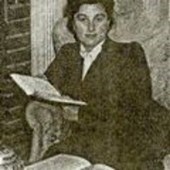
Von Raffler-Engel was born in Munich, Germany and raised in Italy. When Hitler came to power, most of her family members were exterminated in the concentration camps. Von Raffler Engel, however, fled to the mountains of the Aosta Valley in Northern Italy and joined the Partisans. Her harrowing ordeals doing undercover work in the mountains of Northern Italy are documented at the Holocaust Museum in Washington, D.C.
Von Raffler-Engel secretly carried coded messages, small weapons, and food, evading German troops and barely escaping death on many occasions. She credited local residents with risking their own lives to protect strangers like her and wrote a book to give thanks and recognition to these "unsung heroes."
When von Raffler-Engel's cover was blown, she cheated death one more time by fleeing to Switzerland. Once in Switzerland, she saved countless lives of couriers about to cross over to the Italian border by transcribing valuable information from paper to pieces of silk and then attaching the silk inside the lining of their coats so they would have a better chance of going undetected.
After the Allied victory, von Raffler-Engel returned to school and received her doctorate in Classical Greek at the University of Turin, Italy in 1947. She then completed post-doctoral work at the Italian Institute of Archeology at the University of Rome in Italy from 1947-1948.
During 1948 and 1949 von Raffler-Engel served on the executive board of the Federation of United Europe movement, a precursor to the European Union. In addition, she was one of the official delegates of the Italian Ministry of State to the Congress of the Hague, where she met with Winston Churchill.
Von Raffler-Engel came to the United States in 1949. She received an MS in library science from Columbia University in 1951 and a Ph.D. in linguistics from Indiana University in 1953. When asked how she was able to complete her doctorate in 18 months while working 40-hour weeks not to mention studying in a new language, she replied that she limited herself to short naps, read while eating, and was fortunate to have "built up strong heart muscles from mountain climbing and skiing."
Von Raffler-Engel began her career at Bennett College, an African-American college in North Carolina. Following her tenure at Bennett, she was hired by Morris Harvey College, now the University of Charleston, in West Virginia, where she was head of the Department of Modern Languages. She also served as an accredited guide-interpreter by the U.S. Department of States in French and Italian and returned to Italy to teach at the University of Florence and the Johns Hopkins Center in Bologna.
In 1965, von Raffler-Engel accepted an offer from Vanderbilt University, becoming only the second female professor hired there. She built up the linguistics program from scratch and directed that program until her retirement in 1986.
Von Raffler-Engel was a pioneer in the study of nonverbal communication. She was a prolific author-- 13 books and more than 500 articles of hers were published -- but she was also a highly sought-after speaker. Von Raffler-Engel gave invited papers all over the world at international conferences and symposia of learned societies, NATO, and UNESCO, in anthropology, linguistics, psychology, semiotics, sociology, and medicine. She also served as a visiting professor in Canada, Italy, China, and Japan, where she met the emperor and empress. Her work has been translated into several languages, including German, Italian, Japanese, and Chinese. In 1986 she directed the International Seminar on Cross-cultural Behavior.
Von Raffler-Engel has many firsts to her credit. She was the first to produce a text on Italian bilingual immigrants, completed the first cross-cultural interaction study focusing on nonverbal behavior in Canada, and organized the first congress on child language, which was held at the Tuscan Academy in Florence, Italy in 1972.
She was also the first to explore how children acquire nonverbal behavior, a research area for which she coined the term "Developmental Kinesics." For her sixtieth birthday, colleagues from around the world dedicated a book to von Raffler-Engel titled "Developmental Kinesics: The Emerging Paradigm," in which she was referred to as a pioneer in the field. They also held a special ceremony in her honor.
Over the years, she received letters from professors and students from all over the world to let her know what an inspiration she was to them. A number of former students continued to keep in touch with her for several decades, right up until her death.
After her retirement, von Raffler-Engel was professor of linguistics, emerita, and senior research associate at the Vanderbilt University Institute for Public Policy Studies. In 1999, she moved to San Antonio to be with her son Robert, her daughter-in-law Hiroko, and their two children, Max and Alex.
Von Raffler-Engel will be laid to rest next to her husband, A. Ferdinand Engel, in Baltimore, Maryland. A rabbi will officiate at the graveside. In addition to her son, daughter-in-law and grandchildren, she leaves behind a daughter Lea Engel and three sisters, all residing in Italy.
In lieu of flowers, contributions can be made to her grandchildren's college scholarship fund c/o Porter Loring Mortuary North, 2102 N Loop 1604 E, San Antonio, Texas 78232 or The Jewish Foundation for the Righteous, 305 7th Avenue, 19th Fl., New York, NY 10001, which provides lifetime financial support to aged and needy rescuers who saved Jews during the Holocaust.
Show your support
Send Flowers
Add a Memory
Share Obituary
Get Reminders
Services
- SEND FLOWERSSEND
FLOWERS SHARE OBITUARYSHARE
- GET REMINDERS
v.1.18.1