
OBITUARY
William Heywood Swinny
August 25, 1919 – May 20, 2015
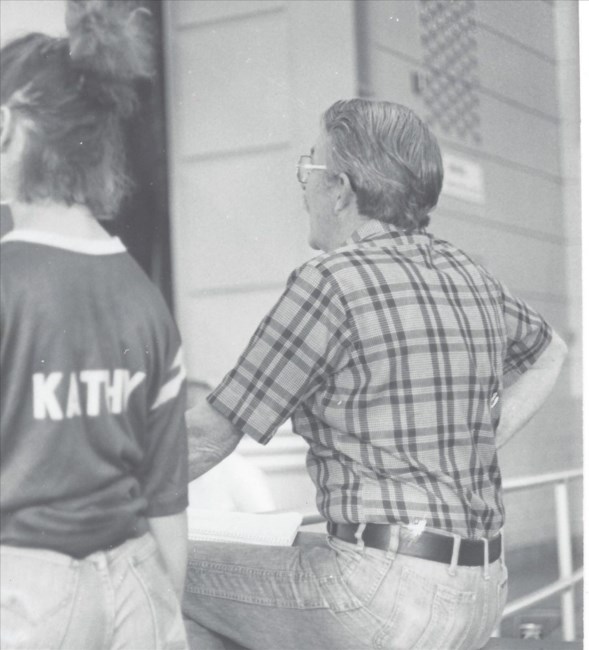
On August 25, 1919 in the rural town of Sinton, Texas, William Heywood Swinny was born of the consummation between Jules Verne and Carey Olene Swinny. The rowdy Swinny clan boasted four children (Carey Laverne, Peggy, Patsy, and Bill), three with red hair. All four children were born in the same bed in which they were conceived. Bill grew up around theatrics. His mother, Carey, learned to play the piano at a young age and accompanied her father (a preacher) to revivals. After Carey married, and became the mother of four children, she exposed them all to an appreciation of music and the joy of performance. Although none of his sisters pursued a theatrical life, it became Bill's obsession.
At the age of nine, Bill's father, Jules Verne, was diagnosed with Tuberculosis. Carey was terrified one of her children would get TB since there was no cure. Sunshine, wholesome food, and bed rest were the only treatments for those who suffered with TB. Bill had vivid memories of his father being routinely bedridden from the disease.
The Swinnys were members of the local Baptist Church in Sinton. The church leaders were all members of the KKK, and as a child Bill regularly heard racist sermons declaring blacks and Hispanics unfit for church or country. As a child Bill witnessed KKK cross burnings and even observed lynchings of blacks on the outskirts of Sinton. When Bill was 11, his father was asked to join the KKK because he was a valued member of the church. Jules Verne refused because the KKK abused both Hispanics and blacks, who were a valued part of his dry goods store clientele. Jules Verne had come to know and love these families. His failure to join the KKK caused the KKK to declare a boycott on the store, which ultimately caused its bankruptcy.
Bill witnessed Jules Verne go into a massive state of depression due to the bankruptcy and his TB. "My father was never the same, "said Bill. Since the store closed and his father was unable to work due to TB, Bill and his parents went to live with Aunt BeeBee (Louise) and Uncle John D. Cochran. Bill recalled his father lived on the screen porch on the second floor, Carey lived in the second bedroom, and Bill lived in the storage room upstairs. According to Bill this free housing saved the family. When Bill was 14 his father finally succumbed to TB. The death forced Bill to take up a variety of odd jobs to bring home money for the family, including cleaning spittoon's at his uncle's office, cleaning the courthouse, delivering newspapers, delivering potato chips, milking the cows every morning, and then delivering the milk in Sinton.
Bill attended Sinton High School and graduated in 1936. He was a member of the band (he played the saxophone), Glee Club, Boy's Quartet, and he became the Senior Class President. Bill recalled fondly that Don Hatch became very influential in his life and taught Bill about music. ("He saved me as he gave me love and attention after my father died.") After graduating high school, Bill was encouraged to go to Texas A&M University. His tuition and books were paid for by Boen Swinny, Sr. Bill hated it and after a brief stint at Texas A&M ("luckily I flunked out") he returned to Sinton. But soon after his return from college, his mother got a job at the state unemployment office in Victoria, Texas and Bill got a job at Frels Friendly Uptown Theater. Bill was already a movie buff ("I never missed one!). At Frels he ushered, sold concessions, and took tickets. During this time, he attended Victoria Junior College part-time studying English. Eventually he became the manager at Frels. He subsequently moved to San Diego, Texas and then Wharton, Texas where he was the manager of the theaters in both towns. Working in the movie theaters gave Bill the luxury of earning money while educating himself in the Golden age of Hollywood. During those many hours in the movie theaters, Bill began to dream of a life on stage.
When Pearl Harbor was attacked on December 7, 1941, Bill resided in Wharton. He returned to Victoria at the age of 22 to work in the civil service as a typist for the U. S. Engineers. Eventually he was drafted and reported to Fort Sam Houston in San Antonio for induction and then to Wichita Falls for basic training. During basic training he was asked his skills and Bill reported he was a good typist. After basic training, Bill was assigned to work as a typist at Sheppard Field for the U.S. Engineers. Bill worked as a typist for three years, but after the Battle of the Bulge, the Army needed additional infantrymen and Bill was assigned to infinity training for six weeks at Camp Maxi in Paris, Texas. Upon completion of that training Bill was ordered overseas to Europe, but by the time he arrived, Germany had surrendered. Bill returned stateside and was then issued orders to the Philippines. During the transpacific trip, atomic bombs were dropped on Japan and the war was over. Bill recalled the time of the Philippines as one of complete relaxation ("All I did was swim, sun myself, learn to smoke, eat bananas, and drink with my buddies"). Bill also routinely discussed his heroic contributions to the war in humorous terms ("I won the war in Europe and in the Pacific").
After his return to the states, Bill went back to his job with the U.S. Engineers as a typist at Foster Field. He resigned to become a purser for Braniff Airlines, stationed at Dallas Love Field, where his handsome mug landed him on the cover of the Braniff Airlines' brochure. After he left Braniff, he worked for Ford Motor Company in Dallas where he was promoted quickly as a biller, but refused a promotion because he tired of seeing people do nothing more than put their head down on their desk or
perform endless paperwork. Seeing no future for advancement, he decided to return to college and get an education.
In 1948 Bill moved to San Antonio to attend Trinity University as a drama major and his dream of performing on stage got back on track. Little did he know that Trinity would eventually offer far more than a theatre degree. It was here while acting in a number of productions ("At last, I had the courage to do what I was born to do") that Bill met Frances Cuny Richter, his future wife. A Professor of Speech at Trinity, Bill began a close friendship with Frances while a student in one of her classes. Bill would later return to San Antonio for Frances and theatre, but not before moving to New York to seriously prepare for a life in theatre.
After graduating from Trinity in 1951, Bill moved to New York and enrolled in the Neighborhood Playhouse, one of the most prestigious actor training programs in the country. Taught by Sanford Meisner of The Group Theatre and the legendary Martha Graham, Bill studied acting, movement, and dance and collaborated with such notable peers as Steve McQueen and Joanne Woodward. Bill recalled his tense relationship with the errant McQueen, who Bill felt Meisner unjustly favored. After graduating from the playhouse, Bill committed fully to the glamorous life of a starving artist in New York City. Landing gigs in both professional theatre and summer stock, Bill nevertheless found he needed a survival job to make ends meet. While at the playhouse, Bill was hired at The Friar's club as a waiter. After school he continued to rely on and eventually love this job where the generous staff would secretly grill him New York strips and the mostly Jewish clientele tipped liberally. Despite his home at the club, it wasn't long before Bill was seriously homesick. Bill swore that on one miserable winter day, bundled against the vicious New York winds, he got to a corner and thought to himself, I'm going home to marry Frances Cuny Richter. A few days later he was back in San Antonio and went straight to the Trinity campus where he found Frances sharpening a pencil in the hallway. She was quite surprised to see him. He had come to inquire, "how about I pick you up and we go to Earl Abels after work?" Bill made it known on that first date that "my intentions are honorable. "
Bill and Frances married on December 17, 1954. The pair started a family (Stephen in 1957; Lisa in 1959) and began their long tradition of involvement in the theatrical and academic community of San Antonio. Bill began teaching at Alamo Heights High School where he became known for his direction of the Senior Play. Each year, hundreds of students would sign up for the play and Bill emphatically insisted that any student wishing to participate could so long as they agreed to two simple conditions. First: Never be even one minute late to rehearsal. Second: Prioritize rehearsal above ALL ELSE. So long as the students followed these rules, even a linebacker from the football team could (and would) be in the senior play. This formula of inclusion and discipline made the Senior Play flower in popularity among the students. The Senior Play became renowned throughout the community for its artistic integrity, while allowing Bill to share his love for theatre with a whole new generation of eager students. To his dying day Bill cared passionately for his many students and felt tremendous pride for his work as a teacher. For decades to follow, former students would frequently visit and recall fondly the lessons learned under his tutelage.
While teaching at Alamo Heights High School, Bill also worked as an actor in local theatre, preforming in dozens of plays, and enjoyed great community support. In 1984, he retired from his teaching job for good to teach privately and act when he felt like it. It was during this period that Bill performed with groups like The Extended Run Players, The Reader's Theatre and the Billboard Theatre, simultaneously pursuing more abstract undertakings like the one-man play he regularly performed while a docent at the Witte Museum. Other endeavors of Bill's "retired" life included: travelling through Texas with a production of The Oldest Living Graduate, becoming the go-to speech coach for the Cavaliers in preparation for the fiesta season, spending endless hours imparting his beloved family with a knowledge of local flora and fauna, telling tall tales from times gone by, professing the virtues of posture and voice support, and even appearing in a Trinity University production of You Can't Take it With You at the ripe old age of 88. In 2008, Bill was honored for his tireless work by the San Antonio Theatre Coalition and named one of San Antonio's "Living Legends."
Bill is survived by his wife of 60 years, Frances Richter Swinny, their two children Stephen and Lisa, his daughter-in law-Betsy, and son-in-law David. To his delight, Bill was also granted time on earth with his six grandchildren, William and Eric Swinny; and Chloe, India, Keenan, and Bront Treat. Bill repeatedly stated throughout his life that above all else he "loved his family."
The "Living Legend" is now deceased, having passed away on May 20, 2015, but not before he had time to write a "letter to the world," his lessons learned in ninety-five years of living excellently.
Dear beautiful world-
I love you. I have always loved you. You taught me a formula for happiness; have a good daily dose of music, sing, dance, love, be kind, be gentle, be generous, be thankful and respect. To my former students- thank you for the many great days (years) I had with you. To my family, the higher power has blessed me-I'm up here writing to welcome you into the kingdom!
It was Bill's request that his obituary conclude, "I've loved my life."
Show your support
Add a Memory
Share Obituary
Get Reminders
Services
SHARE OBITUARYSHARE
- GET REMINDERS
v.1.18.0