
OBITUARY
Linburgh Wong
December 17, 1934 – November 8, 2024
Born in Guangdong Province, China,
Lindburgh’s formative years experiencing wartime deprivation and insecurity in China caused by the upheaval and brutal chaos of the Japanese invasion and subsequent Chinese Communist takeover, may have, in his adult life, driven him to seek stability, to pursue multiple endeavors that brought intense happiness in his life, and to develop an astounding need to horde stuff.
Around 1950, with his parents and siblings now safe in Hong Kong, Linburgh and his oldest brother Luther stayed behind enemy lines to continue high school at the boarding school he started before the war in Guangzhou, China. As an impressionable youth, Linburgh got caught up in the Maoist indoctrination to prepare for war in Korea. It was his mother, “Popo” Ellen Lynn, that came to his rescue. She plotted a plan to extricate her sons across a communist Chinese border to sneak back into Hong Kong. Whatever was in her plan, pure luck may have played a part. It was a lone young border guard who happened to be Popo’s former student that recognized her and helped smuggle them through the checkpoint.
Perhaps this is telling about Linburgh’s proclivity. Once he is attracted to something, he goes all out for it. Thank God Popo dragged him out and saved him from being a Communist. What seemed to be his happy-go-lucky days in Hong Kong, he floundered in his academic studies because he devoted his time playing violin, watching cowboy-western movies, and kicking soccer balls. However, by the mid-1950s, he refocused on school work. In 1957, he convinced two academics to write him a recommendation letter in support of his application under the US Refugee Escapee Act. The English Methodist theologian wrote that Linburgh was “one of the keen young members of the Kowloon Chinese Methodist Church,” and had studied two years at Chung Chi College. His American English teacher at Chung Chi College wrote about him being a good student and a “very reliable person who will take advantage of all opportunities offered him.”
True to form, once he landed in the United States, he wasted no time. By 1960, he had landed a job as a chemist with the Synkoloid Company where he remained until his retirement in 2005. Also in 1960, the story is told that once he saw the young Nelly Edith Maldonado serving at the Clifton Cafeteria in downtown LA, he pursued her with precision and passion. He was so excited about his new love, he apparently wrote about her to a good friend. In a reply, dated April 1960, Paul Chan praised Linburgh’s fortune in having a “very beautiful Spanish girl friend.” Although he is often thought of as having miserly tendencies, he has often been generous, and will spend what it takes for important things in his life. In preparation for marriage, he spent $116 on a diamond ring, a good sum against his $4,225 annual salary that year. A few months later he paid $900 in cash for a 1957 Plymouth wagon, large enough for his future family.
In his pursuit for happiness, Linburgh worked hard at his chemist job that gave him economic security, yet he found time to engage his family with music lessons and outdoor activities. Those pursuits he loved are still ingrained with his children, Ruth and Hector. Classical piano, a serious endeavor, meant years of practice and improving our musical skills and appreciation. At times, Linburgh’s approach to piano practice could get tedious, but he did devise a reward system based on memorizing a piece. Ruth recalls amassing a good amount of pocket money with this scheme. His young son, Hector, was once left alone during practice drills. Hector soon felt a need for companionship. He took Ruth’s hamster out to play on the keyboard while playing a Scarlatti piece. Sure enough the curious hamster got tired of the keyboard and found a way to hide below the sound board behind the dampers. Linburgh discovered the hamster later that night when he inspected what caused a thud when pressing certain keys. Linburgh rescued the hamster after removing the keyboard action frame. No animal or child was harmed during the performance.
We don’t know what led Linburgh to pick up skiing. Skiing was great, when having fun on the mountain. It was a pain for the kids more than a few times when he woke us up as early as 5 am, unexpectedly of course, but these trips allowed us to happily miss school which shows how much value Linburgh gave to these pursuits. The kids, following the routine, piled the gear into the car for the long drive to the ski resort. He once got so excited about skiing in the summer that he drove alone the five hours to Mammoth to say that he skied in July. Some years later, seeking a simpler activity than skiing, Linburgh played tennis with intense devotion. Every weekend, he and his tennis gang took over certain tennis courts around Arcadia.
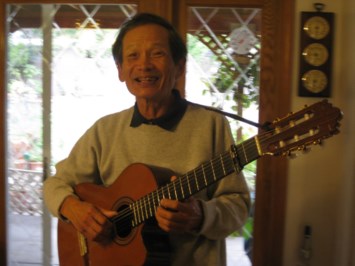
But music was always his first love. Linburgh often reminded his kids that to have a good life, it must include playing a musical instrument. His version of being a multi-instrumentalist meant learning new instruments over the years. He started with the violin and then the piano, which he ensured that Ruth and Hector learned to play. Even later in life, he pursued flamenco guitar, and finally polka-style accordion.
Who hasn’t gotten Linburgh’s advice about naturopathic remedies? As a walking encyclopedia of herbal medicine he had at least two cabinet drawers packed with bottles ready to share his potent combination of capsules and pills. Even the house pets received their daily regimen of herbs. When he tried to sell me on the benefits of uropathy, I nearly threw up. If you don’t know, look it up.
Linburgh would want you to know about the pure joy he received from his dogs and cats over the years. They were all rescued from the streets. A least a couple of times he’d go out to play tennis and come back with a dog. Even till his dying days, he often instructed Nelly to feed and take care of the animals. He created a backyard pet cemetery. His handcrafted headstones mark the spot where they lay. Be careful walking among the graves. Amateur-level burial techniques are evident.
Linburgh leaves behind his wife, Nelly, his daughter Ruth Arevalo (Tim Mukand) of Pasadena, CA, and son, Hector Wong (Lisa Wong), of Vista, CA. He relished his role as grandpa to Emily, Paige, Hannah, Anthony, and Matteo, and hoped that one of them would play accordion in a polka band. Left with many years of family gatherings and colorful memories are his siblings Rosemay of Placentia, CA, Lana of Puente Hills, CA, and Wilson of Pasadena, CA, sister-in-law Margaret of Pasadena, brother-in-law Allen of Placentia, and seven nieces and nephews. He is predeceased by his older brother, Luther.
Show your support
Add a Memory
Share Obituary
Get Reminders
Services
SHARE OBITUARYSHARE
- GET REMINDERS
v.1.18.0