
OBITUARY
Dr. Shihyun Chang Kim
May 1, 1928 – November 14, 2022
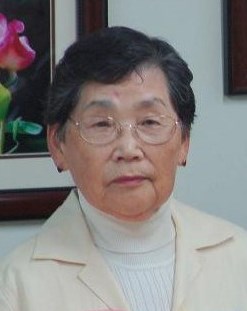
Our Mother, Dr. Shihyun Chang Kim passed away peacefully at the age of 94 on November 14th, 2022 in her home surrounded by family. She was preceded in death by her husband of 67 years, Dr. Hunzong Kim, her mother and father (Sukyeo and Samyong Chang), her sisters (Shiju and Youngja Chang), and sister-in-law (Hyunsuk Jeon).
She is survived by her children, Dongchul Kim (Yanghee) of Saratoga, CA, Haikyong Kim Russell (Paul) of San Jose, CA, and Sungchul Kim of San Jose, CA. She is also survived by her granddaughters, Kayla Kim, and Carmela Russell, and relatives in Seoul, South Korea, brother-in-law Hyungkyu Jeon, nephews Hyungshik Kim and Dr. Changhoon Jeon, and nieces Gaehyun Kim, Mihyun Kim, and Youngock Jeon.
Shihyun was born on May 1st, 1928, in Yongampo, a town just north of the city of Sinuiju by the Yalu River in northwestern Korea (today North Korea). She was born during the Japanese Occupation of the Korean peninsula (1910-1945). Sinuiju is a city that faces the well-known Chinese industrial city of Dandong across the Yalu River. Shihyun’s paternal grandfather, Chungam Chang was a large landowner and farmer in Bukjungmyun village who produced rice, apples, soybeans, pears, chestnuts & other produce. The northwest region of Korea in the 1920s-1930s was known for its rich fertile rice patties, as well as a fishery trade school & canneries, the only in Korea at that time. During the Japanese Occupation, many Korean farm owners were mandated to supply rice to the Japanese government. The rice produced at Shihyun’s family farm was of high-quality and was consequently exported to Japan and not used for local consumption. Our Mother’s extended family was extremely fortunate as they had ample food from their farm while many city dwellers experienced food shortages during this difficult period in Korean history.
Shihyun’s father was the fifth of six children and all his siblings lived and worked on the farm except for Shihyun’s father. Our mother and her immediate family lived in a nearby town, Yongampo, a few miles from her grandfather’s farm. Shihyun’s father held a government finance job overseeing the community’s irrigation systems, and later he owned a printing business. Shihyun had fond memories of when she was a little girl going to her grandfather’s farm every weekend with her father on a bicycle. Shihyun’s mother was active in women’s leadership roles in the Korean Presbyterian Church and was instrumental in teaching women how to read.
Shihyun’s maternal great-grandfather served as the Korean Ambassador in Singapore, Malaysia during the mid-1800s when Singapore and Malaysia was under British Colonial Rule. Consequently, Shihyun’s maternal family was influenced by Singapore’s British culture which encouraged women to be educated. During this period in Korea, the tradition was to educate only the men and not women. Shihyun’s mother encouraged her daughters to study hard and be educated like Mary F. Scranton, an American Methodist missionary in Korea who established the first women’s university in 1886, Ewha Women’s University.
Shihyun was the 2nd of 3 daughters in her family. Her older sister died at the age of 7 in 1933 of tuberculosis when Shihyun was only 5 years old. Although this event occurred almost 90 years ago, Shihyun vividly remembered her mother taking care of her sick sister and feeding her special healing foods like raisins and Korean melons that nobody else was allowed to eat! From a very young age, Shihyun excelled academically and attended Korean Schools which were segregated from Japanese Schools. Her father who was fluent in Japanese and proficient in English and was her Japanese language tutor after school each day. It was imperative for Korean students to be fluent in Japanese, even to attend Korean schools as Japanese was the official language during that time. Shihyun took piano lessons from first grade and later learned to play the accordion in high school. Her grandfather broke Korean tradition of teaching boys only Chinese Classical letters & writings and included Shihyun as one of his pupils on weekends. During the Japanese Occupation, it was rare for Koreans, especially girls to attend high schools. However, Shihyun and her younger sister both graduated from high school due to their family’s farm resources which were likely deemed essential for the Japanese occupiers.
Shihyun attended Sinuiju High School initially as a boarder, but midway she commuted on the train daily from home as the high school did not have enough food for boarding students. She graduated from high school in June 1946, after World War II which was also end of the Japanese Occupation of Korea. From an early age, Shihyun wanted to be a physician and her grandfather was very supportive, providing financial support for 6 years’ worth of pre-med & medical school expenses. Furthermore, her grandfather promised to build a hospital in his hometown after she earned her medical degree. Her grandfather and parents supported her career endeavor to go away to medical school in Seoul, approximately 255 miles away from her hometown.
In August 1946, Shihyun moved to Seoul with a family friend via train and stayed at her family friend’s house to prepare and study for the medical school entrance exam. Shihyun’s parents were active Presbyterians in their hometown and were well-connected with other Presbyterian churches in Korea. Her family friends who helped Shihyun relocate in Seoul were also Presbyterian Christians and their local Presbyterian Church connections provided her with initial housing. Also, Shihyun benefited from another friend of her parents, Dr. Kyungchik Han, a prominent Presbyterian Minister who wrote a letter of recommendation for her admission into medical school. Subsequently, she was admitted to the Women’s Medical College (now part of Korea University in Seoul) and started on September 1, 1946. Later in 1946, Shihyun’s parents and her younger sister moved from Yongampo to Seoul to be with Shihyun. Her mother had the foresight of converting cash to 24K gold bars to ensure future funding for Medical School tuition. The gold bars were hidden in traditional Korean socks when the family traveled on the train to Seoul.
Our mother graduated from Women’s Medical College in May 1952 during the Korean War. Her class was the 10th graduating class of all women physicians in Korea. Her medical school was established in 1928 as Chosun Women’s Medical Training Institute by American physician & missionary, Dr. Rosetta Sherwood Hall. Dr. Hall’s intention was to turn it into a Women’s Medical School which happened in 1942, the first Medical School for women in Korea. Sadly, Shihyun’s grandfather who funded for her tuition died before she graduated. Both of Shihyun’s parents who had moved to Seoul to be with her, also died before her graduation. At age 23, Shihyun lost her beloved grandfather, mother and father all within 5 tumultuous years, but she was determined to graduate from Medical School and persevere with her younger sister!
As there were five Battles of Seoul during the Korean War, many Seoul residents evacuated further south in the Korean Peninsula to the port city of Pusan and even to Cheju Island. Upon graduation from Medical School in May 1952, Shihyun’s first job was in Pusan as a Medical Officer in the 14th U.S. Army Field Hospital. Her main role was to interview and conduct physical exams of North Korean and Chinese prisoners of war. During this period, she met her future husband, a fellow refugee from Pyongyang area who graduated from Seoul National University Medical School in 1950. The Korean War ended on July 27th, 1953, and Shihyun married Dr. Hunzong Kim on October 14, 1953, in Pusan on a small NATO Officers’ Naval boat. Her husband served as a flight surgeon for almost 5 years in the Republic of Korea Air Force at Jinhae Air Force Base. This was the Air Force base where first Korean pilots were trained on the P51 Mustang for combat missions during the Korean War.
Shihyun and her family moved from Pusan to Seoul in August 1957, after her husband’s completion of almost 5 years of service in the Air Force. In Seoul, her husband worked as a general surgeon at Paik Foundation Hospital (now Inje University Hospital). Our Mother then set up her own private Pediatric practice after completing her internship & residency at Soo-Do Medical College Hospital (her renamed alma mater, now Korea University).
Shihyun and her husband were blessed with 3 children. Their first two children, Dongchul and Haikyong were born in Pusan and were delivered by her husband at home due to lack of civilian hospitals right after the Korean War. Their third child, Sungchul was born in Seoul, and delivered by Shihyun’s friend, OB/GYN physician at home.
Then in 1964, the Kim family moved from South Korea to Uganda, East Africa. Shihyun and her husband were members of the first team of physicians commissioned by the Foreign Ministry of South Korea to assist underdeveloped countries. Shihyun and her husband worked at a government hospital located in Tororo, a small town in eastern Uganda for 6 years from 1964 to 1970.
Next in 1970, the Kim family immigrated to the United States, and settled in Sylvania, a suburb of Toledo, Ohio. Shihyun’s husband passed the ECFMG (Educational Commission for Foreign Medical Graduates) exam and had to re-do medical internship & residency in the US before becoming certified in General Practice. Shihyun’s husband practiced and worked in Emergency Rooms at Toledo area hospitals for 27 years until age 70 when he retired in 1997. Shihyun made the difficult decision in 1970 when she was only 42 years old to sacrifice her career to be a stay-at-home Mom caring for her family. Shihyun took on several home projects and created a beautiful 3-acre flower filled garden which her family enjoyed for 36 years. She instilled in her children the importance of education and was instrumental in making sure that all her 3 kids graduated from college! Consequently all 3 completed master’s degrees.
Finally in 2006, Shihyun and her husband moved to San Jose, CA to be closer to her 3 children and their families. Our Mother transformed her small San Jose garden with beautiful colorful flowers. Shihyun was intelligent, confident, creative, determined, and energetic. Throughout her life, she followed Christian values and always helped those who were less fortunate than her. She practiced what she preached by showing us that it is better to give than to receive. Over her last 20 years, she suffered progressively from dementia, but on her good days she was still conversational and reasonable. Even in her last two weeks when she was bed-ridden and in pain, she was determined to get out of bed and would say multiple times “if I can’t walk, I will crawl”! We will miss our Mom dearly! She had so much wisdom, love, courage, and most of all a determined spirit! We are so blessed to have her as our Mother!
The family asks that any donations in Dr. Shihyun Chang Kim’s memory be made to the American Red Cross (P. O. Box 37939, Boone, IA 50037-0839) or their website:
Donate Now - Online Donations | American Red Cross
Shihyun’s husband, Dr. HunZong Kim’s obituary is also posted on Willow Glen Funeral Home’s website:
https://www.dignitymemorial.com/obituaries/san-jose-ca/hunzong-kim-9205964
To contact the family, please email Haikyong Kim Russell at: [email protected]
Show your support
Send Flowers
Add a Memory
Share Obituary
Get Reminders
Services
- SEND FLOWERSSEND
FLOWERS SHARE OBITUARYSHARE
- GET REMINDERS
v.1.18.0