
OBITUARY
Colonel Edward (U S Army Retired) Dean Larsen
February 23, 1928 – July 18, 2016
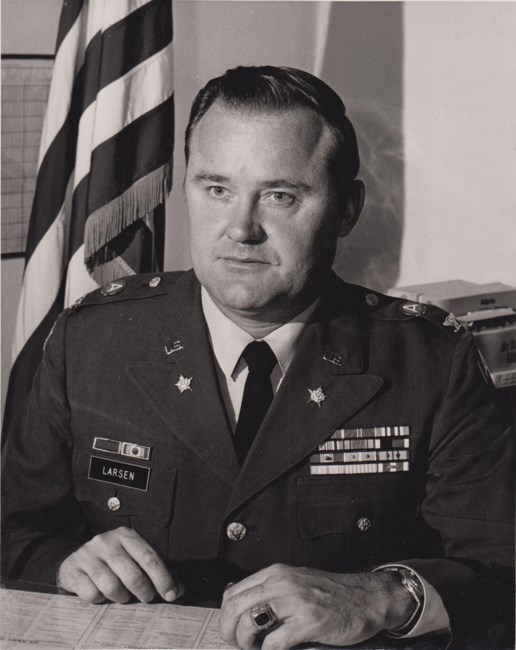
Ed was born in Milaca, Minnesota, the middle child of Emil and Clara Larsen. He was one of 13 children (six brothers and six sisters). He attended first grade in Page, Minnesota, where he walked 1.5 miles from the family farm to a one-room school. When he was six years old, his family moved to northern Minnesota, where he attended elementary school in Bear River and high school in Alango, graduating in 1945. Life in those post-depression years was not easy. The family lived off wild game, fish and food produced on the farm. Winters were harsh with temperatures that remained below zero on many days. These experiences turned boys into men at an early age and helped prepare him for the challenges that lay ahead.
Ed enlisted in the U.S. Army as a private in 1945 and was sent to a specialized training program in advanced science and mathematics at South Dakota State University. That same year he reported for active duty to Ft. Knox, Kentucky. In July 1946 at age 18, he was selected for and attended the Officer Training Program at Ft. Sill Oklahoma, graduating in December 1946 at age 18 as one of the youngest officers to complete Artillery Officers Candidate School in World War II.
Ed served with the WWII occupation forces in Japan and Germany. He met the love of his life and wife-to-be, Lillian Carriger, in1949 in Hawaii. His unit, the 555th Field Artillery Bn, which was part of the highly awarded 5th Regimental Combat Team, was sent to Korea in July 1950 where he served in combat, receiving a battlefield promotion to Captain at age 22.
After Korea, Ed served in a number of units and locations in the U.S. and abroad. These assignments included, in part, battalion executive officer for the 264th Field Artillery Bn, which commanded six of the 20 280mm atomic guns deployed globally after WWII. He also helped develop nuclear battle plans for defense of the Fulda Gap from Russia as part of the 36th Field Artillery group. He became an expert in command and control of the Redstone nuclear missile, providing training to missile units throughout the United States. He commanded the 2nd Missile Bn, a high readiness nuclear armed mobile rocketry unit that was placed on full alert during the Cuban Missile Crisis in 1962. He was selected for admission to the Army Command and General Staff College and attended the Nuclear Weapons Deployment Course as well as the Defense Spanish Language School. He also served three years in Peru, where he administered the Army Military Assistance Program. In June 1968 he was promoted to full Colonel, and in July 1969 he began a tour of duty in Vietnam.
Among his decorations and awards are the Legion of Merit with two oak leaf clusters, the Bronze Star, the Army Presidential Unit Citation, the Republic of Korea Presidential Unit Citation, Korean Service with six campaign stars, Vietnam Service with four campaign stars, Republic of Vietnam Gallantry Cross with palm, and member U.S. Army Artillery School Hall of Fame.
Ed retired in Dunwoody Georgia in August 1975 with 30 years of service. After retiring, he attended Georgia State University where he attained a Masters of Science degree in Political Science. He loved Lil, his wife of 57 years, who passed away in 2008. They spent 33 wonderful years together after his retirement enjoying family, friends, traveling and many good meals together. They experienced the marriages of their sons to Janet Gottfried (Mike) and Dee Edmonds (Greg) as well as the births of their three grandchildren - Julia, Stephen and Geoffrey. Ed is also survived by his sister, Shirley Eskola, and brothers, Ernest and Frank, all of whom reside in Minnesota.
Ed would view his story as unremarkable, one of many associated with his generation. His family is humbled and honored by his example as a father, grandfather and soldier.
Show your support
Add a Memory
Share Obituary
Get Reminders
Services
SHARE OBITUARYSHARE
- GET REMINDERS
v.1.18.0