
OBITUARY
Earl Kitchener Corbett
February 10, 1917 – April 6, 2012
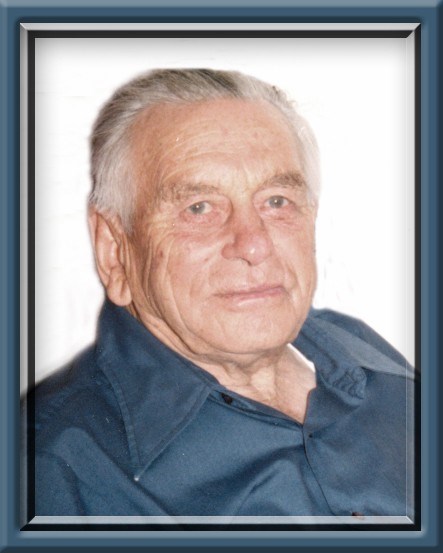
CORBETT, Earl Kitchener – Peacefully at the Sault Area Hospital on Friday, April 6, 2012 at the age of 95. Beloved husband of Hilda Elizabeth (nee Craig) for 70 years. Loving father John, Carol Corbett and Elaine Casola (Terry). Cherished grandpa of Jennifer Corbett, Earl Corbett (Lisa), Jason Casola and Corey Casola (Kaitlin). Great grandpa of Ashley, Dawn and Ryan Corbett. Predeceased by his brothers and sisters William, Gertrude, Annie, Rita, Elizabeth, Edward, Lawrence, Jessie, George, Nell, Jim and Walter Corbett. Friends may call at the Arthur Funeral Home & Cremation Centre on Thursday, April 12, 2012 from 11 am until time of funeral service in the chapel at 1 pm. Rev. Dr. David Zub officiating. Interment Greenwood Cemetery. Memorial donations to the charity of your choice would be appreciated.
At the going down of the sun
and in the morning
we will remember them
Members of the Royal Canadian Legion Branch 25 are asked to assemble at the Arthur Funeral Home & Cremation Centre on Thursday, April 12, 2012 at 1 pm for a memorial service for the late Earl Corbett.
A sermon by Rev. Dr. David Zub for the service of Earl Corbett, Apr.12, 2012
Somebody once said, “I have no idea where I’m going, but I do know where I’ve been”. That’s not a bad outlook in life. If you have a sense of what that means, if you yourself feel that way, then it means that you have a sense of place, a kind of confidence in your own identity, that can’t be replaced by achieving great things or having a lot of stuff or controlling other people’s lives. In fact, if you have a sense of what it means to know where you’ve been, then all those other things… things that so many people ruin their own lives over… well, all that stuff becomes kind of unnecessary.
When I sat with Earl’s family during the time of his dying, and later to discuss today’s service, I definitely got the impression that we were talking about a guy who “knew where he’d been.” In those conversations I heard stories about a man whose life, in many small ways, was too big in character and influence, integrity and love to be contained in mere words; often their silence spoke more. There were references to his humour, and the simple ways he could make his point, his ability to fix things, to work with clarity and pleasure, and his easy sociability. In all these stories, the attention of his family, and the anticipation of their grief for him there could be found the quiet confidence of people who knew him in the name of love and deep gratitude.
Earl was connected to this area in a way few can claim, and lived here fully, passionately, confidently and well his whole life long. He was born at Clear Lake near Iron Bridge just shy of a century ago. It was an unbelievably dark period in history as the world was enveloped in the first occasion of total war, and three years of conflict and untold casualties had both sides bowing deeply beneath the crushing costs of this new and horrifying way of waging conflict. Canadian families almost all carried deep grief, victory was a long way away, and it seemed as though the U.S. was never going to invest in their agreement to ally with Britain—and would not do so for another two months. But into this dark world Earl slipped as a baby, one of thirteen children who would grow to maturity in the rough northern world of deep snow and wild spring runoff, mosquito clouds and feasts of wild meat and berries, fish and all the plenty that nature provided. This was still his world when his family moved to Sault Ste. Marie in time for Earl to start school, and would remain something within him his whole life long—a life that included not only the places where wild things dwell, but also the world of church and worshipful community in which he learned to live in a conscious relationship with God. This balance gave him balance his whole life long.
As with everyone of his generation his life was stalled by the Great Depression, though he found work with Rafferty/ Boston that picked up on his talent with steel and machinery, and then with the steel plant where he would work until 1977. All this was further interrupted by the stark reality of World War II. On his birthday in 194s he married the girl he’d known since childhood—a smart move, since he never once forgot his anniversary—and four short months later shipped out with the Hastings Prince Edward Regiment to serve in active duty until the end of hostilities in 1945, taking part in the North African campaign, the desperate and slow offensives in German-occupied Sicily and Italy, then in Belgian and France, finally taking part in the liberation of Holland. It is my understanding that members of this regiment speak of fallen comrades as having “transferred to the White Regiment,” and so it may be for Earl now.
Earl was careful of the way in which he spoke of this period of his life, a period, events and the regiment of which Farley Mowat spoke when he wrote: “I was staring down a vertiginous tunnel where all was black and bloody and the great wind of ultimate desolation howled and hungered. I was alone....relentlessly alone in a world I never knew....and no birds sang.” Many people who survived those years in body were never again whole in mind or spirit. It is a testament to Earl’s courage, faith, love and sense of duty that this was not true for him. We can all be sure that there were dark moments and dreadful dreams, but Earl returned to this place of this roots and took up his job at the steel plant, bought the house on Roosevelt Ave. in which he and Hilda would raise their family, and a little later the wood lot way up Goulais Ave. that provided heat for their little home and would be his refuge and a source of the maple syrup that so many remember so fondly. In 1950 the first of there children came, 1,2, 3, and there began the years unfolding around seasons of raising them living life with all of its joy, sorrow, confusion and wisdom. And it would be a mistake to try to say too much about someone you all knew better than I… but there are insights I’ve enjoyed into the life of a man who was immensely proud of every year added to his age, but who would often invert his age numbers so often that when a lawyer recently asked him, “How are you?” Earl brightened and said, “I’m 59!!” A man who was stills stripping down engines until a few years ago, who would constantly move his stash of licorice around the house so the grandchildren would have to search it out and then return teasingly to him waving them around like flags of victory on parade; a guy who would pretend to be annoyed when the grandchildren would greet him with a hug and then muss up his hair, “What’d you do that for!?” as if he didn’t know; someone who did little things like save every pop can and tab for the Legion wheelchair program; a man who could fix almost anything involving steel and grease and moving parts, but whose patience with wood was limited to some spirituality involving chainsaws and an axe; a man whose diet of green vegetables was limited to peas; a guy who loved nothing more than to enter into the easy society of a few others in a boat trolling for pickerel, hoping for enough to have a shore lunch and bring a bunch home, eyes scanning the water dappled by sun and wind with the trees quietly whispering to him the simplicity of he childhood.
Earl was deeply rooted in the land upon which he lived. For those of us who know what that means, you know it’s a blessing. For those of us who have known it and lost that confidence, you know how important it is. And for those of us who never knew what it means to be deeply rooted in community and the land, you crave it without ever knowing what it is you miss.
Earl was deeply blessed in being so firmly rooted.
But to say a person is deeply rooted is not to say that he is stuck, and Earl was certainly not stuck. Indeed, the confidence that comes from knowing a sense of place is often the very thing that allows a person to try new things and to live with the confidence that is a gift to every generation that follows, with Earl that being life in his garage or at the woodlot with some child in tow learning how to pick up the right wrench at the right time and slip it to him under the car, or rig a tree so it falls just so; to hear his voice asking, saying, directing, falling silent to listen…
In the end, you know, it isn’t the things we do that count, even if we do them very well. It isn’t that we make a living that matters—it is that we make a life… and not just a life for ourselves. Life is a matter of bringing joy and purpose to the lives of others, and Earl had that gift. He didn’t just make a living. He lived a life full of what really matters, and that meant a life as a Christian as well, he quietly singing along with the hymns rising around him, his eyes remembering something of the faith of his fathers.
And there was always his deep concern and caring for others, especially his family upon whom, for him, the moon rose and set, his face full of the love and patience he bore for others.
Now, we needn’t be naïve here. No one who ever took up time trying to make a living working with steel and torches, wrenches and stubborn engines, dump trucks and overloads of fill and gravel without learning a few words you can’t repeat in church. His kids told me this great story about the first year they took sap off the woodlot to make syrup, but there was no shack yet so they hauled the stuff to town and he started boiling down in the yard. Some neighbour didn’t bother to ask what he was doing, just called the police and reported him for running a still, so the cops showed up… he ended up giving them a sample for their troubles but I often wonder how annoyed he must have been with his neighbour… and was it because the neighbour didn’t bother to ask, or was he really annoyed that anyone would think he was stupid enough to run a still right out on the front line!??
Either would have gone against his grain; in the end, Earl’s life was lived with an endearing respect for others…
… for everyone who was drawn into his realm, he provided something… more.
Now, it might seem a little odd here, but this is where I would like to talk about the Kingdom of God. You see, when most of us think about the Kingdom of God we think of heaven, some clouds in the sky place of angels and pearly gates that is so great and huge and perfect that it is beyond our ability to describe.
I don’t know about you, but I always thought heaven, according to that description, would be kind of boring. It’s not the sort of place where you could ever get your Sunday clothes dirty, you know what I mean?
Well, maybe not. But Jesus never once talked about the Kingdom of God like that. Jesus talked about God’s kingdom as a being like, well, like a mustard seed… so tiny, it could fit under your fingernail, but which grew into a tree in which birds could build their nests, and from which they could fly.
Now, at a time like this when your hearts are burdened with the loss of a good man who contributed to your lives, you might think that you should spend some time pondering heaven, but it seems to me that you might consider thinking about the kingdom of God, which is much more important and much closer to you. The kingdom of God, as Jesus described it, is a place of deep roots from which others might fly into… life.
And isn’t that what Earl did in your life? He fixed things and made space for gardens and had space for you in his workshop, on the woodlot, in his life: didn’t he provide an anchor, a place of confidence and security that helped you—if not fly, at least walk into life with a certain sense of confidence?
Christians believe that this is precisely what God did in Jesus Christ. God didn’t just rescue us from ourselves; in Jesus, God prepares us for life. We are given the gift of Christ to serve as an anchor that will allow us to move into the world, to be of use to the world, to help others, and to be kind and useful even when our very nature might conspire against us. And because God did this in Christ, we are given a kind of lens to recognize how the kingdom of God is touched upon in the life of someone who has spent his life as an anchor that secures others so that they may venture into the storm of life as useful and helpful and contributing people.
And it seems apparent to me that Earl Corbett, mustard seed though he may have been, rooted as he was, lived his life as an anchor on some level for many of you. He didn’t just rescue you from yourselves. He helped equip you, prepare you, for life with as much joy as he ever spent in time with the woodlot and playing with his grandchildren. And whatever stories are left untold, whatever stresses and strains, whatever regrets there may be or thoughts thus inspired… that makes him a good man, worthy of redemption in the coming kingdom of God.
As he lived, close to home, rooted in this place, Earl died… suddenly, quietly, peacefully a few days ago—nothing was stolen from who he was until those last few days before his last breath. And you… you are left now to live your lives without his among you. Take time together to think about how he offered you his roots, so you might take wing… how he equipped you for a life so much better than if he had not… how he was your anchor, and how his life gave you hope. Share with one another your stories of how his life affected yours, made your life better, and be at peace, for such is the kingdom of God, and in Earl, God has touched your life in a small but complete way. Amen.
Show your support
Add a Memory
Share Obituary
Get Reminders
Services
SHARE OBITUARYSHARE
- GET REMINDERS
v.1.18.0