OBITUARY
Joseph William Bye
17 April, 1930 – 27 July, 2022
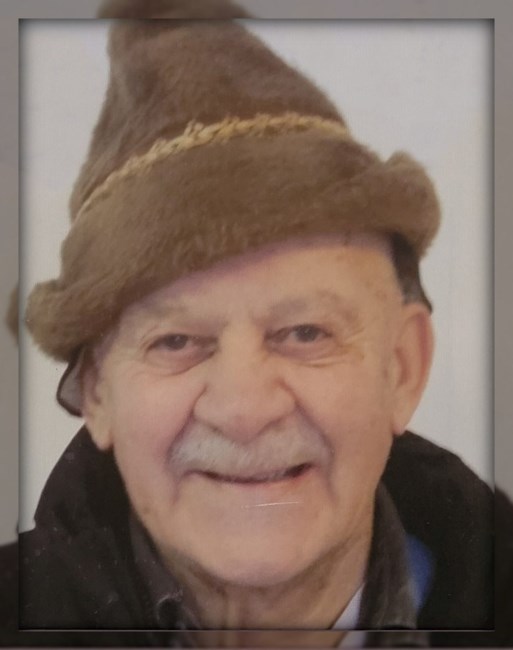
Joe's essence could be seen in the first couple lines from Josh Billings 'Laughter'. “There is one kind of laugh that I always did recommend; it looks out of the eye first with a merry twinkle,...” That merry twinkle was in almost every picture taken of Joe. It was there greeting family and friends. It was always present when holding children in his lap. Bank clerks of the female persuasion and nurses were bewitched by it. Stories and tales were told with it adding brightness. Simply, Joe enjoyed the life he lived.
Joseph William Bye was born on April 17th, 1930 in Sault Ste. Marie to William and Eileen (Joseph) Bye. He was their first child. Margaret(32), Roy(33), Kathleen(35), Clifford(37), Susan(43), and David(44) would follow. Joe would spend his entire life growing up and living north of the Sault in the community of Goulais River. William Bye was primarily a subsistence farmer there. Eileen was a farmer's wife, who would later garner the title of 'Grandma Bye' for the neighbourhood.
Joe's earliest memory of childhood was being tied to a tree trunk by his exhausted aunts who refused to chase him around the Joseph homestead any longer. A hint to where the inexhaustible energy of many of his grandchildren and great grandchildren may have originated. His prized position was his bicycle. There is a picture of a youthful Joe posing with the bike in Cleveland, Ohio of all places. The handle bars are at his shoulders in the picture. He must have grown into the bike. Joe road the bike anywhere and everywhere he could. During the second world war, he tried stuffing his tires with anything that would keep them solid because of the rubber shortage. When his wife asked who got to ride on his bike's handle bars, Joe would always smile shyly but not say, but Joy would say it was his girlfriends from Batchawana to Heyden. That bike got around. He rode it to the Trumble's. They were getting ready to go to a wedding in Waboose. Joe hopped in the back of the truck and went with them. He got home at 2 in the morning. His mother was waiting up for him. Joe always told his mother where he was going after the disappointed look she had given him that night.
Being the eldest on a farm during the depression and then the war meant Joe did a lot of hard, menial work. There were a lot of absences marked on his last report card. His parents took him out of school to work on the farm during harvest time especially. He finished school after grade eight, and started working full time. He helped with the chores on the farm of course, but also cleared land for farming. He worked for Billy Snooks cutting pulp with cross cut saws, and drove horse teams to get the logs to trucks or water ways.
One job at that time became the most important in his life. Joe was caretaker for the one room school near his parents farm. That is where he met Joy McMullin, a young school teacher just starting her career in 1948. Soon they began dating. Kathleen, Joe's sister, recalled being asked by Joy to go as their chaperone on said dates. Kathleen remembered sitting between Joe and Joy as the date started, but riding with Joy in the middle next to Joe on the way back from the dates. One of Joe's favourite stories was always told when one of his children or grandchildren got engaged to be married, and showed him the engagement ring. Joe would relate how he worked hard to afford a nice ring for Joy. Joy's grandfather asked to see the ring, and said with a high pitched voice (Joe's voice would always go high), “That's a nice piece of glass you have there on your finger.” Joy recounted scandalizing her mother by saying she was marrying a half-breed. Joe was half English and half Syrian.
On August 16th, 1950, Joseph Bye married Joy McMullin at the Terantorus United Church. Irene Koivisto, was their flower girl; Roy Bye was the best man, with Miriam McMullin, as bridesmaid; Clayton and Ruth McMullin filled out the wedding party. Joe marrying Joy brought him into an even bigger family than his own. Joy had ten siblings. Joe spent many summers and holidays with the McMullins ever growing family connections. Joy had seven sisters, so there were Koivistos, Pinders, Mcgruers, Pinnells, and finally Kuwalyks to get to know.
Joe must have thought he found the right girl. He bought the property across Pine Shores road from Joe's parents home in 1948. There was a condition to the sale. Joe could not take ownership of the house until 1950 and William Bye could have nothing to do with the sale. The owner was in a heated dispute with Joe's father. There was a small apple orchard, a enormous spruce tree, and cleared fields to farm on the property.
In 1970, they sold a portion of the southern field as a corner lot to Robert Martson which enabled them to build a new house on the opposite side of the apple orchard facing Goulais Bay road, and the Bailey bridge which spanned the river. In the late 70's and early 80's most of the rest of the southern field was sold as lots to his children, Donald and Karen for them to build homes. Terry was sold a portion of the northern field just below his parents home. When the government bought up property to build a new bridge over the Goulais River, Karen was forced to sell. Joe sold her a portion of the field just beyond Terry's property. The new bridge was never built, instead it was replaced at its old site. Karen has a beautiful view of it off her front porch.
From the late 40s until the 70s Joe belonged to the Orange Lodge. He was a staunch supporter of the Protestant cause. That did not stop three of his children from marrying Roman Catholics. Nor did it stop him from making good bonds with his children's in-laws. While as a member of the Orange Lodge Joe took on the responsibility of leading a youth group for boys. These youth were not saints in the community. No one died, and there were no fires while under Joe's watch, but there were plenty of shenanigans he was oblivious too. Joe gave up going to the Lodge after the Goulais River Lodge burned down. The Goulais Orange men joined the Sault's Lodge, but Joe did not like it, so he quit.
Being from large families, Joe and Joy wanted the same for their children. They had seven children purposely. Starting with Nancy in 1951, Donald in 53, Terry in 55, Karen in 60, Peter in 65, Thomas in 67 and finally Henry in 1968. There were 17 years between the first and last child. Goulais River and the world changed a lot in that time. The constant were Joe and Joy putting their children before anything else.
Joe was not a hard nosed disciplinarian. Joy had to take on the role of the disciplinarian when dealing with their children. Nancy recalled their mother saying to her, Donald and Terry - “wait until your father gets home”. Joy had the three siblings sitting expectantly for their father to come in to the house and deliver their punishment. Joe came in bone tired after a long day at work to find Joy hovering and his children watching attentively. Joy announced, “Joe, you have to put your foot down!” at the moment Joe pulled off his boot. The boot hit the floor with a loud bang. The children broke out into uproarious laughter. Joy looked to a startled Joe, and gave up.
Joe proved there is more to parenting than using the rod. Donald got the family car in a fender bender as a teenager with Terry and Jimmy Cronin in the car. It was dark when they got home. Donald told his dad what happened. Joe asked, if anyone was hurt. Donald said no. Joe said, we'll deal with it in the morning. Terry remembered Jimmy Cronin being totally amazed by Joe's quiet response. Things that came up always got sorted coolly and calmly.
On Sundays Joe stayed home to relax as Joy took their kids to church. Until one of the children in the late 70s asked, “Why doesn't father go to church?” Joe started to go to church. He joined the church board, and as a elder, was asked to do pastoral care for the elderly in the community. Visiting the old folks was a gift to him. He explained, he just had to have tea and talk about the old days. He kept visiting, well after he was off the board, until the elderly all passed away. Joe and Joy started to attend bible studies, with John and Miriam McDonald, Ed and Myrna Moran, and Carry and Sharon Muncaster. Eventually the group started to hold services in Light Haven Retirement home in Echo Bay on Sunday nights. Bud and Relda Pitt replaced the Morans. Joe went as moral support for Joy who played the piano for the services. The group went to Light Haven for twelve years. Joe only mentioned the meals at Bobber's restaurant after the services, especially the pies.
During the fifties Joe worked for the provincial government's department of Transportation. Crews would shovel sand or aggregate into trucks, then shovel it out again. It was hard work, and payment was always delayed months. Joe decided to quit, and work in the bush instead. He worked with his father, his brother Roy, Alan McLean, or Onni Koivisto cutting hardwood or pulp to sell to the local mills. He would tell his children nothing tasted better than tea heated over a fire on cold winter's day. You stirred the tea with your thumb of course. They logged with cross cuts and axes, then chainsaws. They skidded the logs with horses, then dozers or tractors. They loaded the logs on trucks by hand, or with booms. It required a lot of man power, and long hours. Joy recounted how after a snow fall, she was out shovelling the driveway when Tom Richards stopped his truck on the road. Tom asked, “Young woman, shouldn't your husband be doing that?” Joy proudly answered, “No, he is gone to work!”
A one room shack across the apple orchard was home to Alan McMullin and Robert Case in the mid fifties. They worked for Joe cutting pulp for a year. Alan moved back to the Sault to work for the PUC. Robert moved in with Joe's parents, and became a permanent fixture in Goulais River. An older bachelor took up residence in the shack after that, Frenchie. After Frenchie moved across Pine Shores road to live with Joe's parents the shack became a chicken coop.
Joe and Joy seemed to make a secure place for young people to go. Paul Koivisto, said he and his cousin Kenny would go to Goulais on the weekends. They would tell Joe and Joy all the things there parents were doing wrong and all the great things they were going to do when they got the chance. Paul laughed, and said, looking back at it years later Joe and Joy must have thought they were crazy. But Paul said they just nodded and went about their household chores. No snorts of contempt, no “I am sure.” They just let Paul and Kenny express and have their dreams
The sixties brought home the dangers of working in the bush. Joe was struck by a branch from a tree. His father was working with him at the time of the accident. He found Joe, and went for help. It was winter time, so they got a snow mobile to go and get Joe out of the bush. Joe's injuries were so severe the doctors did not think he would walk again. It took a year of convalescence for Joe to recover. That was the end of working in the bush full time. Joe looked for other work. He served on the ferries that ran the St Mary's river between the two Saults the last year they ran. The International Bridge would put them out of business. Joe then went back to the department of Transportation. He started out as a custodian at the Highways big yard in the Sault.
In the Seventies, Joe started working in the carpentry department for his cousin Etsil Haynes. Joe apprenticed and became a certified general carpenter in 1973. The Highways carpenters worked all over Algoma from Marathon to Blind River. Joe was gone on the road from Monday to Friday a lot of weeks at that time. Low man on the totem pole, Joe sat between two chain smokers in the cab of their Highway's truck for years. The carpenters made highway signs, repaired work trailers, sand domes, anything that got broken. When Eatsil Haynes retired, Joe studied hard and was named the new foreman of the carpentry shop for Algoma. Steve Hurdle worked with Joe until Joe retired.
In 1990 Joe retired from the Highways after 22 years of service. At his retirement party, Bob McDonald and Ken Stafford dressed up like Crocodile Dundee and sang, “Joe Bye ain't got no damn job!” to the delight of the crowd. Later that year Nancy and Bruce packed their three kids and Joe and Joy, in their van and went on a road trip around western North America. Joe got to see the back drops of all the American westerns he read. They visited Joy's brother Clayton in British Columbia, and saw giant red wood forests. In 1992 they all did it again, but this time they went east. They saw the red earth of Prince Edward Island, the Atlantic ocean, and a lot of civil war sites in the United States.
The fabled helmet deserves a mention. Joe became known for wearing his yellow hard hat. He seemed to put it on every time he went out the door. Whenever he was working outside the hard hat was on his head. In the 80's his yellow hard hat became a treasure in a scavenger hunt put on by the Goulais River Recreation Committee. Joe said he wore it anytime he thought he might have to work. Which was pretty much most times he went out the door. Neighbours saw the yellow hard hat on his head all the time, whether while out on his tractor, sitting under the apple trees, or puttering around doing some chore. Joe said he started wearing it all the time, because at work he kept bumping his head while under desks, or cabinets while fixing trailers for the Highways. After knocking on wood a number of times, he figured wearing his hard hat was a good idea.
Living over 90 years Joe saw a lot of vehicles come and go. The first car he remembered being in was his father's model A Ford. It had no roof. Joe remembered coming home from a trip to town, and the car and its passengers were covered in snow. Joe said his father got a car with a roof the next year. The last truck Joe bought was a Ford f 250 super duty. He said he started out with Ford and he was going to end with them. He owned Plymouth and Dodge cars mostly. The river bank near his house became the resting place for most of them from the fifties and sixties. You can see the chrome winged fenders glistening in summer sunshine when the water in the river drops to its lowest. Terry remembered riding in the Meteor with Donald in the backseat. They started swatting the ceiling causing dust to billow down inside the car. Joe said the road sure is getting dusty up ahead. The Dodge Aspen in the late seventies was the bane of Karen. It would die at intersections. Joe would take it for a spin around the block in Goulais and report that all was fine. This lasted a year until it finally conked out on Joe in town. The Aspen was soon replaced.
On the farm one vehicle is paramount, the tractor. Joe owned a few. He started with a Ford half-track, then moved to a John Deere dozer, both more suited to work in the bush. In 1962 he bought a 1010 John Deere farm tractor. The tractor did everything and went almost anywhere. For upwards of twenty-five years the 1010 seemed part of Joe. While buying parts for the 1010 Joe saw a bucket being installed on a Universal tractor. Joe came home with the Universal. The Universal and its bucket were worked for almost a decade, until it started to come apart at the seams. When the pivot pin snapped in sub 20' temperatures. Joe tied chains around the front wheels and drove it out of the bush by steering with the chains in hand. The Universal was traded in for a John Deere 540 with a bucket. A match made in heaven. Wood splitter, rotavator, and fertilizer spreader attachments were purchased. The only time the 540 rested was when Joe did. His time in retirement was spent in the seat of the Universal and 540 tractors.
Another thing found on a farm are animals. There were Doll and Prince, workhorses that skidded logs in the bush and worked on the farm. Prince was killed by hunters while in his shanty stall in the bush. Doll eventually went to work for Alan Mclean. There was the mighty Billy and the cantankerous Samson later on. Taffy the cow was bought to be eaten, but Joe grew fond of her, and hinted at making her a milking cow. Joy, who grew up on a dairy farm, put her foot down, and Taffy became stakes and roasts. There were laying hens, meat birds and turkeys. The pets were mostly dogs, though there were a pair of cats in the fifties. Shep, the border collie lived until he went blind. Shep would bark and howl when lost down a embankment or stuck in brush. Joe would have to get up and go fetch him home, usually in the dark. Mutt and Jeff would follow. There was Sandy, then lastly little Canine. Whenever Joe went to visit his children, their dogs would be greeted by a hard pat , and “You're a good fella,” from Joe. Then there the dogs that visited Joe. Karen's dogs who seemed inclined to come for a snack everyday. Terry's husky Tasha, that stole the potatoes Joe dug. Henry's little bacon addicts, that would sit under the kitchen table at Joe's feet waiting for the bits of bacon Joe would drop to them.
As far as hobbies go, Joe liked to hunt in his bachelor days. He covered most of the bush in Goulais River valley. He remembered one winter coming upon a herd of deer. There was awe in his voice when talked about seeing all the deer together. Joe enjoyed the outdoors. He marvelled at the power of nature. He remembered going down to the end of Pine Shores road one day after a big wind storm. He had worked all summer helping to pile pulp along the lake shore. When he got to the pulp piles, they were all washed across the road, the beach left bare.
Joe was a big reader. He loved to read western stories. Whether in books, or pulp fiction papers. He had hundreds of western stories in his house. Most were paperbacks with tightly glad women and big brawny men on the covers. When he was younger, his siblings and their friends learned not to bother Joe while he was reading. He would toss them down a low flight of stairs if they did.
Joe could play rummy or crib for hours. He was famous for the cascade. He would have seven or eight cards in his hand, then miraculously go out, putting down cards he never knew he had in his hand. When Joe retired, he and Joy would play cards every night after supper for a hour. Then they would each take a book and read until the late news came on.
In 1983 Joe had a heart attack. A life altering event. He was on pills for the rest of his live. He went through some serious withdrawals as he stopped having sugar in his tea and coffee. By the late 90's he was having trouble getting his breath after walking or bending down. In 1999 he was sent to London Health Sciences Centre to have bypass surgery by Dr Catania and Dr Gupta. All four arteries into his heart had to be replaced, and a cyst sack was removed from his heart. Six months of recovery were ordered after the surgery. Joe was a good patient and did what the doctors ordered. But when the six months were up he went back to the bush with abandon, amazed how much better he felt.
In 2008, Joy went to the hospital with jaundice in need of a gall bladder surgery. She was then diagnosed with Pancreatic cancer. She never left the hospital again. On Joe's birthday he was told she had ten days to live. Joy died ten days later. The love of his life was gone.
Peter recounts in the 70's as he was getting ready to go to school in the morning, Joe would say, “Mother, I'm off to work.” Joy would reply, “Give us a kiss then.” Joe would kiss her and go out the door a happy man. Joy would watch him leave, and say a prayer for him. They did that everyday Joe left for work.
A ulcer started in Joe's colon as a result of the worry and pain Joy's passing caused. He had allergic reaction to the medication given for colitis ulcers. He lost a lot of weight until he stopped taking the pills. He never fully got his weight back, though he tried eat all he could for a time.
In the spring of 2012 Joe lost a finger to the wood splitter. He had a bad habit of putting his hand on the block just before the block met the knife. The knife cut his pointing finger on his right hand off just above the first knuckle. Further surgery removed a bit more of the bone down to that knuckle.
In 2016 Joe became a type 2 diabetic after skating for years in the pre category. It did not change his life style. Being in his eighties, he figured there was not much point.
In the spring of 2018 Joe suffered a hidden stroke. It damaged his short term memory. He was diagnosed with dementia. The biggest consequence of his early dementia was the loss of his drivers license. His freedom of movement was gone. His love for driving was taken away. Fortunately, Joe was aware of his memory loss. He voluntarily stopped feeding the wood stove, cooking meals or any other activity which could endanger him or others. The advent of the Covid-19 restrictions only added to his isolation. The happy wanderer slowly became afraid to leave his house. In July of 2022, the latter phase of dementia set in, he did not want to eat or drink. Joe passed away at home in his bed on July 27th.
Joe liked to reminisce while driving in his truck. He talked often of the adventures he had while pulling the thrashing machine around to the various farms that needed grain to be harvested. He always smiled while remembering the Finnish lady that gave him potato soup. Joe had worked all day, and the lady said to him, “Come in young fellow, you must be hungry. I have just what you need.” She put a bowl of soup in front of him. Joe said he looked at the bowl. It was just water, dirty water. The woman smiled, “Eat up,” she said, “It is good potato soup.” Joe said he ate it, with a shake of his head, but it tasted more like potato peelings. He took what was offered without complaint. Joe was a blessing to all who met him or knew him. Of that there can be no complaint or argument.
* * * * * * * * * *
BYE, Joseph William - It is with deep sorrow that we announce the passing of Joseph, at his home on Wednesday, July 27, 2022 at the age of 92, surrounded by his family.
Beloved husband of the late Dora Joy (nee McMullin). Loved father of Nancy Lennox (Bruce), late Donald, Terry (Sandra), Karen Perreault (Yves), Peter, Thomas and Henry (Rose). Grandfather of Kelly, Craig, and Lindsay Lennox, Bradly (Tammy), Tyler (Kandice), Tyson (Kearstin), Ashley and Jamie Bye (Kayla), Natalie Hurley and Nicolas Perreault. Great grandfather of Cheboe, Chelsee, Zoey, Zaydee, Logan, Juniper and Riya Bye, Rylyn, Dacian and Aviella Hurley. Great great grandfather of Mackenzie, Carter and Chloee Bye. Brother of Susie Burnett (Dave) and David (Darlene) and predeceased by Margaret Morphet (late Ron), Kathleen McLeod (late Ken), Roy (Darlene) and Clifford (Mary Lou). Brother-in-law of Alan McMullin (Annis), Rosemary Pinnell (Wayne) and predeceased by Clayton McMullin (late Josie), Margaret Koivisto (late Onnie), Enid McMullin, Miriam Pinder (late Bob), Robert McMullin (late Wilma), Ruth McGruer (late Tom), Nora Kowalyk (Dave) and Carol McMullin. Uncle to many nieces and nephews.
Friends may visit the Arthur Funeral Home - Barton & Kiteley Chapel (492 Wellington Street E. 705-759-2522) on Tuesday, August 2, 2022 from 12 noon until time of service in the chapel at 2 pm. Mrs. Helen Smith officiating. Interment Goulais River Cemetery. Memorial contributions (payable online or by cheque) to Heart & Stroke or to the Alzheimer Society would be appreciated. The family would like to thank Sunnie Armstrong and Sierra Grey for all their support and care in dad's final days. We would also like to thank Dr. Catania and Dr. Miriam Bedhun for dad's care over the years. Fond memories and expressions of sympathy may be shared at www.arthurfuneralhome.com for the Bye family.
Show your support
Add a Memory
Share Obituary
Get Reminders
Services
SHARE OBITUARYSHARE
- GET REMINDERS
v.1.18.0