OBITUARY
Benjamin M. Paris
July 15, 1884 – January 8, 1950
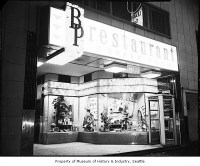
Well-known sportsman, conservationist, and owner of landmark Seattle restaurant. Benjamin Paris was born in Birmingham, Alabama, on July 15, 1884. As a youngster he moved with his family to Texas, where he grew up with his four brothers and five sisters. His formal education ended when he completed the third grade. His father died when Ben was 14 or 15 and his mother passed just two years later. At the age of 17, Ben went to Mexico to work on a railroad construction project, which is also what later brought him to Port Hope, Alaska. He then came to Seattle for 18 months before moving to Missouri, where he worked as an ironworker until an on-the-job injury prompted him, by age 22, to return to Seattle for good. In 1906, Paris got a $600 loan to start a five-table billiard parlor on Admiral Way in West Seattle. In 1912, he incorporated as the Ben Paris Terminal Concessions Company, of which he was president and general manager. By 1922, he owned four first-class billiard parlors, one at 912 ½ First Avenue, one at 120 ½ Pike Street, and one each in Bremerton and Mt. Vernon, totaling $80,000 in value, plus Ben Paris Cigars, Lunch & Cards in the Eitel Building at 1501 - 2nd Avenue. The managers of his establishments, which had the most modern equipment and catered to the upper class men of the area, each owned an interest in his company. In the late 1920s, his company, along with Bartell Drugs, established a 76-year lease of the Eitel Building. In 1930, he established the Ben Paris Restaurant at 1609 Westlake Avenue. Paris, who was an avid sportsman, also sold sporting goods at some of his establishments. In particular, he loved fishing and even installed a large circular fish tank containing live bass in the lobby of at least one of his downtown Seattle restaurants. To help boost sales of his fishing rods, he started Seattle's very first fishing derby in 1931. That same year, the Washington Conservation League was formed to try to change the county-controlled gaming commission to one that was state-controlled and Paris was elected president of that committee. In less than 18 months, Paris made 211 appearances in support of Initiative 62, which voters passed in November 1932. He was subsequently appointed to the newly formed state game commission, but resigned after only 3 months due to the needs of his businesses. When Paris complained that commercial salmon traps were snaring all the fish before they could even reach Puget Sound or its tributaries, the State Legislature took notice and, in 1935, outlawed those traps in Puget Sound. Not everything went the way Paris wanted, however. As a bar owner, he didn't think that selling beer on Sundays should be illegal and in 1934, he took his argument to the Supreme Court and lost. In 1935, Paris began publishing the now-iconic "Fishing (and Hunting) Guide to the Northwest," which ran from 1935 to 1980. In addition to his many business ventures, Paris was head of the Gander Club and was very involved in several other conservation organizations, such as the Western Bass Club. He also was active in the Eagles, Knights, and Shriners and sponsored semi-pro baseball teams. Ben Paris, a man with only a 3rd grade education, made quite an impact on our local area.
Show your support
Add a Memory
Share Obituary
Get Reminders
Services
SHARE OBITUARYSHARE
- GET REMINDERS
v.1.18.0