OBITUARY
Mr. Robert Eiichi Murakami
July 20, 1927 – April 29, 2024
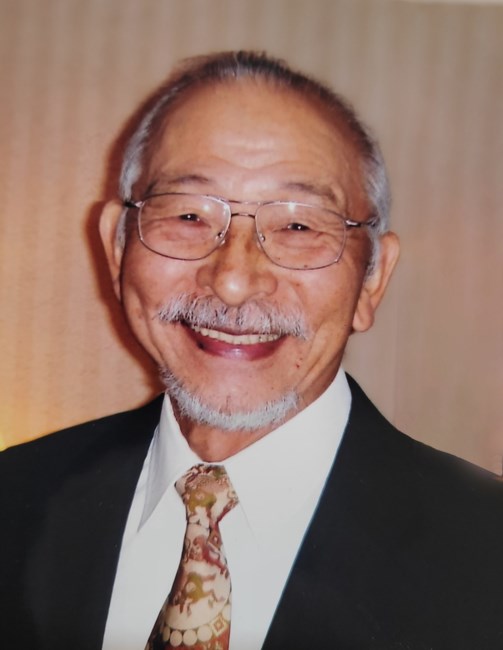
Robert Eiichi Murakami passed away peacefully at home in Redmond, Washington, on April 29, 2024, surrounded by his loving family. Born in Seattle on July 20, 1927, he was the second of three children and only son of Eizo and Ishi (Kyono) Murakami.
Robert’s father, Eizo, had a successful business as a produce broker with an office in the Pike Place Market. Life was comfortable, but when Eizo passed away unexpectedly on October 30, 1929, Ishi was left to raise three children alone. She moved the family to Nakajoo (known today as Tainai-shi) Niigata, Japan in 1934 to be near her family. For several years, the family received funds from a trust created by Eizo’s business colleagues in Seattle. That came to an end when the US entered World War II in 1940. Money and food became scarce, with Ishi resorting to selling off personal items brought back from Seattle. Robert recalled eating meat but twice a year- chicken at Obon in the summer and rabbit at New Years.
In 1943, Robert passed the entrance examination for the Rikugun Shikan Gakko (Imperial Japanese Army Academy), one of the few American citizens to enter the school. He learned to march, carry and clean a gun, as well as equestrian skills. In October of 1944, he became ill with pleurisy and was hospitalized for 6 months. Because of the school’s proximity to the Allied air raids on Tokyo, in June, 1945, the entire student body was moved from Saitama to the safety of the mountains in Nagano prefecture. On August 15, 1945, Robert remembered gathering around a radio with the other cadets, listening to the Emperor’s surrender speech. “At first, we weren’t sure that it was the Emperor, because no one had ever heard his voice before,” recalled Robert.
After the war, Robert worked several odd jobs to support his family. In 1949, with an ambition to continue his education in Japan, possibly to pursue a career in medicine, Robert decided to travel to the US to claim his share of the funds that were in the trust. He arrived in Seattle on Thanksgiving Day, 1949. Dr. Unozawa, a friend of Robert’s father, helped him check into the Bush Hotel in what is now the International District. Soon, it became apparent that it was going to take some time to secure the funds in the trust, so Robert decided he would work, save money, and go to school in Seattle instead. He worked at a fish market, then as a driver for a retired doctor who was in a wheelchair.
Robert recalled, “I helped him take a bath, washed his socks and underwear, then drove him around in his nice car for 2 hours. I got paid the same amount working for 4 hours as I did working all day at the fish market.”
In addition to earning money, Robert needed to learn English if he wanted to go to school in the US, so he began taking English classes at Edison Technical School (formerly Broadway High school and now Seattle Central College). Robert remembered some English words from his early years in Seattle, such as ‘table’ and ‘uncle’ but not much else. “I remember a teacher telling me to guess the meaning of a word that I didn’t know. But I didn’t know what the word ‘guess’ meant!” He had to take a few classes in order to earn his high school diploma, which he completed in 1952.
By then, Robert had saved enough money to enroll at the University of Washington. In 1950, a teacher at Edison had helped Robert find work as a houseboy for Elvin and Ruth Cochran in West Seattle, a job that allowed him to work and earn enough money ($10/week) and to go to school.
In exchange for room and board, Robert worked for 2 hours after classes and for 8 hours a day on Saturdays. He sent half of his monthly salary to his mother in Japan, but was still able to make ends meet. The job also helped him improve his English and develop other useful skills, such as the care and maintenance of cars (Mr. Cochran owned a Ford dealership in the U-District), the care and maintenance of plants and a lawn, how to split wood and use a chainsaw. Mr. Cochran would drive Robert to classes at the University of Washington in the morning, and he would take the bus back to West Seattle in the afternoon. One day, Mr. Cochran gave Robert his first car; a 1940 Ford. “Mr. and Mrs. Cochran loved me like their own child,” recalled Robert. For many years following their deaths, every Memorial Day, Robert would visit them at the Evergreen Washelli Columbarium.
Robert graduated with a Bachelor’s Degree in Chemical Engineering in 1956, then married Sachiko Inaba, whom he had met at the University of Washington, on June 17, 1956. They moved to Los Angeles, CA, where Robert worked for the Navy, and his eldest daughter, Cathleen, was born.
The Navy sent him to study at the UCLA School of Nuclear Engineering. The program required further studies at the federally funded Oak Ridge National Laboratory in Oak Ridge, Tennessee. Upon returning to California, Robert lived and worked in Vallejo, CA as a civilian, developing nuclear submarines for the Navy.
Shortly afterward, with his wife, Sachiko, missing her family and the green of the Pacific Northwest, Robert accepted a job with Boeing and moved his family of 3 back to Seattle. His work as an aerospace engineer spanned 33 years, where he worked primarily on government military contracts, often traveling to the US military testing range in White Sands, New Mexico. He also worked on the launch escape system for NASA’s Saturn V rocket and the Navy’s Tomahawk missile.
From 1959, Robert, Sachi and Cathie lived in South Seattle in a house with a view of the Duwamish Valley. In 1964, I-5 was built and the resulting traffic noise did not sit well with Robert. In 1966, Sachi gave birth to Kimberley and a year later, Michelle was born. Although it would mean a longer commute for Robert in the 1949 Chevrolet Coupe (inherited from his father-in-law upon his death in 1965), the family moved to Redmond, Washington in 1973, a time when there was only a single traffic light in town.
The Cape Cod style home with a steep roof pitch and dormer windows sat on an acre of land, 5 miles east of the city of Redmond, surrounded by Douglas firs, pine, maple and alder trees. There were no street lights or sidewalks. At night, it was very dark and very quiet. Robert had found the perfect place to employ his chainsaw and gardening skills!
Upon retirement in 1992, he spent his time volunteering at the Seattle Japanese Language School, where Sachiko had been teaching since 1977. For several years, Robert served as vice president and treasurer of Seattle Japanese Community Service, now known as the Japanese Community and Cultural Center of Washington (JCCCW). Back then, the organization did not have a strong financial foundation and it was a struggle to maintain the old buildings that were built around 1913. Around 1995, in an essay about his life, Robert wrote that although he wasn’t certain that his efforts would “bear fruit”, he believed that restoring the school buildings was a worthwhile challenge.
As a retiree, Robert began playing golf regularly, getting together with longtime friends Masaru Hamamoto and Shogo Kusumi, and Jim Shinoda, often at Foster Golf course in Tukwila. So as not to be late for the 9 am tee time, Robert would leave Redmond at 7 am, arriving in Tukwila at 8. He would eat an onigiri then take a short nap in his car. After playing 18 holes, he and his golfing buddies would enjoy beer and nachos at the club. He and Sachiko also joined a karaoke singing club, started by his friend from Edison, Fred Moji. The club met twice a month on Saturday evenings for over 10 years. They even won a few of the “friendly” singing competitions!
Unfortunately, Sachiko, his wife of 43 years, passed away unexpectedly in 1999. Robert continued to live a quiet life, enjoying working in his garden, often accompanied by his cat, Tiger. He traveled to Japan annually with friends or family, visiting Japan for the last time in the Fall of 2019. In March of 2020, Robert suffered a mild stroke, one that affected his balance and ability to walk unassisted. Unable to work in his beloved garden, he turned his attention to the stock market, current events, and sports, enjoying sumo wrestling, the Seahawks, and the Mariners.
When asked what kind of work he might have done had he not become an engineer, Robert said he might have become a history professor. He lived a long life and had seen many changes in the world, but he remained curious until the end. He often said that he wanted to live longer “to see what happens next”.
A loving father and husband and loyal friend who was always willing to help, Robert will be missed by all who knew him. He is survived by his daughters, Cathleen Murakami, Kimberley Murakami and Michelle (William) Murakami-Hatt, sister Alice Kiyoko Murakami Uchi, brother Yasuo Hada, nieces Theresa Uchi (Bob) Kurtz, Linda Sasajima (Scott) Kaneshige, Naomi (Yutaka) Murakami, and nephews Warren Uchi, and Keith Hosoda, and numerous members of his extended family. He is preceded in death by his wife, Sachiko Murakami, parents Eizo and Ishi Murakami, sisters Mary Yayoko (Tatsuo) Murakami, and Hisako (Henry) Sasajima.
In lieu of flowers, please donate to The Museum of Flight or charity of your choice.
A celebration of life for Robert will be held Saturday, July 20, 2024 from 1:00 PM to 4:00 PM at Evergreen Washelli Funeral Home & Cemetery, 11111 Aurora Ave N, Seattle, Washington 98133.
Show your support
Add a Memory
Share Obituary
Get Reminders
DONATIONS
Past Services
Celebration of Life
SHARE OBITUARYSHARE
- GET REMINDERS
v.1.18.0