
OBITUARY
Florence Jean DeGregory
September 23, 1933 – August 24, 2025
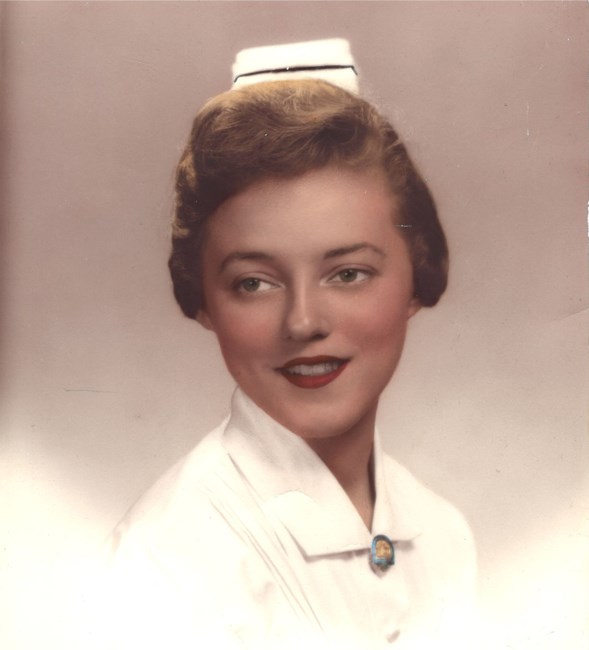
Three-year-old Florence loved the “swish swish” sound the crisp white uniforms made when the nurses walked by. She was in the hospital after having sat in a pot of boiling water. Hospitalized in 1936, at a time when antibiotics didn’t exist, she almost died from her burns. But the nurses took good care of her. They made a lasting impression that changed her life. She always knew she wanted to be like them; to do what they did. To be a nurse.
And that’s exactly what she did. She took the bus to the Newark Public Library to find out where she could go for nurses training. Coming from a poor family, it would have to be a free education. She worked in her aunt’s concession stand at the bowling alley. She was able to save some of her earnings because her mother kept the secret that Florence wasn’t handing over all of the money she made. The choices for a free nursing education came down to Bellevue in New York City and Boston City Hospital in Boston. She always said, “I bypassed New York and went for Boston; it was one of my best decisions”.
The nursing students lived in a dormitory on the hospital campus. The matron made sure all the girls were in by curfew, and the doors were locked. They had a blast. The comradery, the concerts at symphony hall, the dances they hosted (which were a hit with the medical students from Harvard). The challenges of caring for the poorest in the city. The gun shot wounds, injured sailors, the hungry, the homeless. The polio epidemic (which was at its worst in the late summer). No air conditioning. No vaccine. Iron Lungs. Take your uniform off when you leave the ward. Pray you had been careful enough.
After graduating in 1954, her first job was as a head nurse on a ward at the State Hospital for the Mentally Ill in Mattapan. I asked why she chose such a difficult first job and she answered, “someone had to do it”. After she married and had kids she worked the night shift in hospitals and took care of us during the day. Many a night she held my hand while I struggled to breathe during yet another asthma attack. She was a calm, competent force and I believed her when she told me it was going to get better.
When we were in grade school she became head nurse of an ER, then of a Cardiac Care Unit. While working, she went to college and completed a Bachelor of Nursing, a Master of Nursing and a Master of Education. This was before the age of distance learning; she would take the Long Island railroad from Smithtown to Penn Station and then the subway to Harlem to attend classes at Columbia University.
She decided, given all her experience, she should teach others how to nurse. As a professor at Suffolk Community College, she taught medical/surgical nursing for 25 years. For her sabbatical, she went to Kenya with a group of nurses to visit clinics and help the nurses there. After she left, each year she would send them her outdated textbooks as they had none. She always wished she could go back.
She had one grandchild, my son Christopher, who was jaundiced at birth. She swooped in scooped him up and sung “rockabye baby” for hours while sitting in my kitchen window seat so that the sun would reach him. She knew his parents didn’t have a clue. The love affair between my mother and my son started then and has never ended.
During her retirement, if she was visiting me in Boston, she would ask that we take her for a ride to Boston City Hospital. Back to a time after the hunger and deprivation of the great depression and the air raid drills and rationing of a world war. Back to the start of a young woman’s grand adventure. “All that is not given is lost” she wrote me. That was how she lived: a life of giving and caring for others.
It has been a privilege to be her daughter.
Love for Eternity,
Karen Theresa DeGregory
September 2, 2025
Show your support
Add a Memory
Share Obituary
Get Reminders
Services
SHARE OBITUARYSHARE
- GET REMINDERS
v.1.18.0