
OBITUARY
Herman Charles Cohen
May 28, 1917 – November 29, 2017
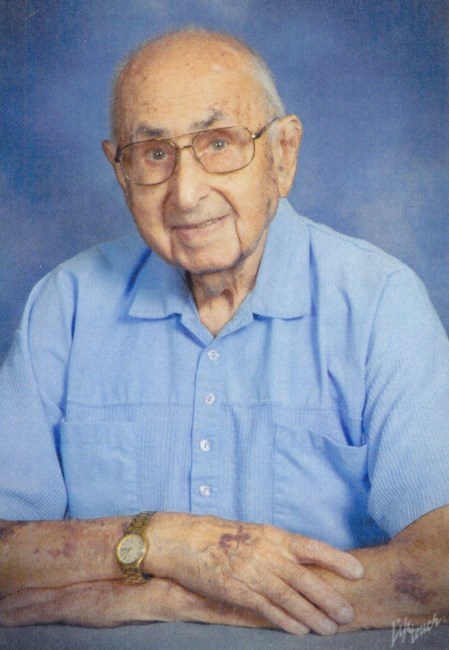
Herman Charles Cohen passed away in his sleep on November 28, 2017 at an age of over 100. He had a distinguished career in soil and water conservation and natural resource planning before retiring, first to Orlando, Florida, and then to Sun City, Arizona.
Herman was born May 28, 1917 in Los Angeles to Jewish immigrant parents from Eastern Europe. The primary language spoken around the home was Yiddish. He had an older sister Cecelia and a younger brother Joe. He developed an early interest in gardening and raising rabbits, thus foreshadowing a career in agriculture. He attended the College of Agriculture in Davis, California, then a part of the University of California, Berkeley. He was graduated in 1940, becoming the first college graduate in his immediate family.
While in college, Herman took up boxing, then an intercollegiate sport. He won over half his fights. Because of his great ability to knock his opponent out cold, he had the nickname “cold cockin’ Cohen.”
After college, Herman worked on the Census of Agriculture for the U.S. Census Bureau in Washington, DC. But his career in agriculture was interrupted by World War II. He enlisted in the Navy in 1942, serving as a hospital corpsman (medic). He served during most of the war on the U.S.S. Baltimore, a heavy cruiser, in the Central Pacific and South Pacific Theaters. He suffered shrapnel wounds to his legs caused by an incorrectly timed fuse while on board. At one point, near the end of the war, the U.S.S Baltimore narrowly averted a Kamikaze strike. Herman developed malaria during the war and had recurrent, but gradually diminishing, bouts with it after the war.
When the war was over, Herman met and married Evadna Fern “Sissy” nee Tull and became a farmer with a small farm in San Mateo County, California. The farm grew straw flowers, Brussels sprouts, and strawberries. He also worked part time for the Soil Conservation Service (SCS), now called the Natural Resources Conservation Service, of the U.S Department of Agriculture (USDA). At his wife’s urging, he eventually went to work for the SCS full time.
In 1955 the USDA transferred Herman to Dixon, Solano County, California to head an SCS office with responsibility for natural resource planning and development covering several counties. There his office chalked up numerous accomplishments including irrigation development, soil-type mapping, and water planning for efficient use and to control mosquitoes.
One of his personal accomplishments of which he was very proud was finding a plant that would grow on some rather barren slopes of the Sierra Nevada Mountains and getting it planted, thus averting potential mudslides during the wet season. Herman also did path-breaking work in what is now called ecosystem services. For the Inverse Delta Project, he analyzed the benefits as well of the costs of leaving the delta in its natural state. He thus anticipated a major current thrust in environmental policy studies.
Herman’s last assignment for SCS was heading the California Emergency Watershed Program from July 1978 to July 1979 in response to widespread flooding. This was described by the head of California SCS as “… the largest and most complex Emergency Watershed Program ever undertaken by the Soil Conservation Service” and involved $55 million in funding. The head of California SCS further noted that Herman “… never hesitated to work long hours when it was needed.” Herman received a Special Achievement Award for his “distinguished and professional work”.
Herman retired from SCS in 1979. At the time of his retirement, he was Vice President of the California Soil and Water Conservation Society.
Herman’s parents had suffered bankruptcy during the Great Depression, and Herman was a very frugal person throughout his life. But he had a soft spot in his heart for education, and he and his wife were generous in helping their two sons with their education. Both sons have Ph. D.'s in the sciences.
Herman considered himself Jewish. But he encouraged his family to explore all religions. While living in Sun City, he began attending the Grace Bible Church where his close friends, his wife’s nieces, were members. These nieces are Dorothy Mae Hirtzel, Ruby Donivee "Doni" McKinney, and Patricia Ann Barr. At the age of 98, Herman converted to Christianity, was baptized, and became a member of the Grace Bible Church.
Herman’s wife Sissy passed away in 2006 after over 60 years of marriage. Herman is survived by his brother, Joseph H. Carol, his sons Michael P. Cohen and Jerry D. Cohen (wife Susan D. Cohen), his step-daughter Nell Morris, his grandson Aaron E. Cohen (wife Hoernisa Cohen), and his great grandson Eli A. Cohen. During his last month of life, Herman said, “I just want to plant something.” But he planted much during his life and we are grateful for it. Rest in peace, Herman.
Show your support
Add a Memory
Share Obituary
Get Reminders
Services
SHARE OBITUARYSHARE
- GET REMINDERS
v.1.18.0