
OBITUARY
Mr. John Yurchesyn
August 2, 1926 – September 16, 2003
I have finished the course
I have kept the faith
2 Timothy 4:7
Sitting down to write this memorial for my beloved dad, loving grandfather to 14 grandchildren, husband and companion to Mena for 53 years and cherished friend to so many others, has been a very difficult journey of the heart. Our dearly beloved Johnnie passed away early on the morning of September 16th, 2003 in Cape Breton, Nova Scotia due to complications from surgery. He was a very youthful and spirited 77 years old at the time.
It’s been almost one year since Dads passing and a very long delay in publishing this memorial to honor him. With each and every passing day, he has been in all our hearts and minds, to the extent that it seemed impossible to adequately express how much we cherished him while continuing to feel such incredible sadness. It's hard to find the words when celebrating the life of such a splendid person.
I was first inspired to begin writing this tribute in November of last year. We had an incredible and unexpected wind storm in Lynchburg, Virginia that came from the North-east. Buildings were left disheveled and trees and power poles were unearthed everywhere. That same day, I received the heart-rending news from home that my father’s much-loved older brother, Michael had joined him in the Kingdom of Heaven. All day long, as I continued to pray for them, I realized that these winds carried my thoughts and prayers back home again to my family in Cape Breton where there continued a river of tears. When I asked my husband if he knew why the winds were blowing so ferociously, he began talking about air pressure systems in the atmosphere. Then I told him my thesis. “It’s because there’s a great family reunion taking place in the Kingdom of Heaven,” I said. “At last, the Yurchesyn family has been reunited after many years and there’s a joy so immense, that it’s entered into our atmosphere in the form of these winds.” He was silent. But that was perfectly OK because I knew these winds were a definite sign of hope. As long as I could remember, Dad always loved celebrations, and I knew in my heart that this reunion was by far the greatest celebration of his life.
He was born John Yurchesyn (Iwan Yurchyshyn), on August 2nd, 1926 at 45 Henry Street in Whitney Pier, Cape Breton, Nova Scotia. John had no middle name and often, humorously remarked that, “I have no middle name because I was drug up.” Cape Breton is a beautiful and remote island on the northeastern coast of Nova Scotia and it was there that John was born into hard times. He was the youngest of eight children born to Katherine Koziol and Joseph Yurchesyn, both of whom had immigrated to Nova Scotia in either 1912 or 1914 (this date has never been officially confirmed), from the village of Zavidoviche (this spelling may be incorrect)in the province of Grodek Yagiellovski, Ukraine. John’s oldest siblings, Mary and Alex were both born in Ukraine. Soon afterwards there came six other children, all of whom were born Canadian. First there was Stanley, who died during his childhood, Annie, then Eva (who was nicknamed Ruby by a schoolmate), Michael, Joseph and finally John, the youngest of the bunch.
As was so often the case with many immigrant families that arrived in Canada during the early 20th century, life was tough. John recalled that growing up in Cape Breton with a last name like “Yurchesyn”, was never trouble-free. During his lifetime, he told us many stories about how he was teased and tormented, and occasionally confronted by hostile classmates because he was, as they put it, “a hunk.” John recalled that, “it was a different world back then. It was very different from the Cape Breton of today." While he took his share of cruel remarks and gestures, he refused to back down in the face of prejudice. John was proud. He was proud of his family and of his Ukrainian heritage. He often told us the story of how on one particular day after school, he became involved in a physical scuffle with a rival twice his size who had teased him because of his ethnicity. Dad was just kid at the time and not a terribly large one. But he recalled that it was his pride alone that gave him the physical strength he needed to defeat his competition twice the size. As he put it, “I was so damn mad, it was strictly mind over matter.” John defeated the bully and things became clear to him at that time. He knew who he was and what he was made of and he made up his mind right then and there. He decided that he would make something of his life and in doing so, prove to his classmates and everyone else that he was so much more than just a Ukrainian in Cape Breton.
John embraced this undertaking with an energy that fueled his determination and steered his willpower to succeed. He was so wounded by the constant intolerance he and his family faced that he would stop at nothing to make his objective a reality. As time certainly would prove, he would become "a somebody."
John was an individual with no shortage of great ideas, but life on the family farm represented tough times where hard work was mandatory, money was scarce and there was little time for childhood games. Sacrifices were an accepted part of life throughout the 1930’s and 40’s and if you had to sleep in a cold barn during the bitter winter months while the family dwelling was being built, (which was exactly John’s fate during one harsh Cape Breton winter), then that’s what you did. There was no point in complaining. John quickly learned to never take things for granted and that to endure the hard times you have to have an abundance of patience and understanding. He would carry this ideology with him his entire life.
Very little is known about those early days in the family's history and how they managed to make ends meet. We do know that there were two farms, the first of which was located closer to Whitney Pier and was on the waterside of the highway. Soon after arrival in Canada, Joseph, John's father built and operated a Turkish bath in Whitney Pier. The building is still standing to this day but has been converted into apartments. In the year of 1942, the family moved to the more recent family farm (Formerly Mike and Wanda's Farm) also located in South Bar. John was 16 years old at the time.
Like many young people at that time, John was at a disadvantage. He had many great aspirations and he loved attending school, often coming first in his class where learning came easily to him. But as a young man of immigrant parents, it wasn't long before John had to leave school in order to work full-time on the family farm. By the tender age of 19, he had already put in 5 years of full-time farm labor and had lost his father Joseph, who was only 66 years old. Now, only he and his brother Joe were at home and they would have to take on the financial responsibilities of the family.
One of Johnnie’s dearest friends from those days was William (Bill) Serwatuk who lived and worked on the farm in South Bar for a period of time. Bill and John continued to be close through the years and in fact, had an opportunity to enjoy one last visit together during the Ukrainian Reunion held in August 2003, one month before John’s death.
Bill has been a great comfort to me and the family since last September and offered to share some of his memories about my Dad during those early days in South Bar. He recalled that back then it was hard to find a balance between getting a good night’s rest for the next day’s work and wanting to be out on the prowl late at night. Bill recalled that John had a routine he would employ when M.A., (the nickname given to John’s mother Katherine) would yell up to them at the crack of dawn to get out of bed for work. Still in bed, John would call back down to let her know that he was “up and getting ready.” He would take his heavy boots and thump them against the floor as though they were on his busy feet, scrabbling to get downstairs. "It always seemed to work," recalled Bill and it gave them the chance to catch a few more minutes of shut-eye before their long work day started. Bill’s wife Stella was a wonderful cook and it was she who gave Mena her recipe for carrot cake. Almost fifty years later, Mena is still making all of us fat with her delicious cake.
Johnnie and Mary Philamena, or “Mena” as she was called by her family and friends, met in 1947. Little did they realize then that she would become the love of John’s life and his companion for 53 years. At the time they met, Mena lived on Morrison Street in Sydney and was employed at Swifts, a meat-packing company where she packed eggs. Like John, she too had little choice but to quit school before completing her education in order to work and earn money for her family of 13. She was the second oldest of 11 children born to Phyllis and Hubert Pettipas, both of whom came from the St. Peter’s area of Cape Breton. The Pettipas home was located across the street from Chapel’s Building Supplies and it was there that Mena became acquainted with a young, Polish man named Walter Durkacz who worked in the company lumberyard. Walter told Mena that he knew a fellow named, “Johnnie” who was “just the right fellow for her.” Mena agreed to meet John and Walter made all the arrangements. “Johnnie drove up to the house in a great big, sedan to pick me up,” Mena recalled. From there they went to the Vogue Theatre on Charlotte Street where they watched the movie, My Reputation. Obviously, both made a very good first impression on one another because two years after that, John and Mena exchanged wedding vows at Sacred Heart Catholic Church on August 31, 1950.
As was stated earlier, John was a thinker who was always churning up big ideas. Two years before getting married at age 21, the wheels were already turning and John was thinking about building his own home. At first, John thought of building on the family farm in South Bar and started digging the hole for its construction near the highway. But he changed his mind when his older brother Mike who had been working on a tobacco farm in Ontario, returned home. Following Mike’s arrival in Cape Breton, John soon decided to leave the family farm for greener pastures. He moved to Sydney where he lived with his sister Ruby and her husband Tony Hasiuk. John began doing odd jobs while saving his money and occasionally working with Mena’s father Hubert, a Frenchman from Arichat Island and a masterful carpenter. Hubert helped John learn the skills of woodworking which he would employ the rest of his life. At a time when discrimination was so prevalent and inter-cultural marriages unheard of, it was extraordinary that Hubert accepted John as he did, “like a fish takes to water.” They both became fond of one another early on and remained close until Hubert’s death many years later.
With the limited money and the skills that Johnnie had acquired, he began construction on his first home in Howie Center not far from Sydney. Construction was slow and the house was still unfinished by the time John and Mena married in 1950 and moved in. But shortly afterwards, John managed to secure work at Sydney Steel Corporation. With a more secure and steady income, he had their first home finished in no time and soon, a son, David was born in 1953. While Mena was carrying their second son Robert, news of eminent lay-offs at the Sydney Steel Corporation meant that tough times lay ahead. John immediately began inquiring about work through their next-door neighbor Dan MacDonald who worked at Municipal Ready Mix Ltd at the time. Dan couldn’t do much to help John, so John decided to talk to the one person who could help him out, Mr. Al Sibley.
Old man Sibley as he was affectionately called told John that he had nothing to offer him. But John was adamant and refused to take “no” for an answer. Time and again, he went to Sibley’s office making it clear to him that he was willing to do any kind of labor and that he was not afraid of hard work. Still, Sibley told John that he had nothing all to offer.
Refusing to give up, John returned to Sibley’s office and now changing his tone of voice and sense of urgency, faced Sibley directly and told him that he had a newborn son to support and another child on the way. Being so forthright and seeing his determination as he did must have struck a chord. Sibley changed his mind and decided to give John his start at Municipal Ready Mix. It would not be a decision that either man would come to regret. Before long, Sibley realized just how driven and naturally gifted John was. It was 1954 and their second son Robert had just been born. Within one year of having been hired, Sibley promoted John to foreman of the small jobs department at Municipal. In the years that followed, the relationship between John and Sibley grew stronger, much like that of a father and son.
Meanwhile, life in the Yurchesyn household in Howie Centre was thriving. Between 1953 and 1960, John and Mena would be blessed with six sons in seven short years. As John used to put it, "We had no luck for the first two years, but after that, every time I hung up my pants, Mena was pregnant." Their third son, Michael was born in 1955, followed by their fourth, Gary in 1956, and a fifth son in 1957 called Brian. They took a little break before celebrating the birth of their sixth and last boy, Paul who was born in 1960. John and his by now, big family were members of the Holy Ghost Ukrainian Catholic Parish in Whitney Pier and during his early years at Municipal, he worked hard to aid the parish by providing materials and labor for the construction of the parish community hall. Throughout their entire 53 years of marriage, Johnnie and Mena continued to grow in their faith and support of their church.
In 1963, wanting to be closer to local schools and hospitals, they moved from their first home in Howie Centre which by now was getting a little small for their growing family, into Sydney’s shipyard area. (Incidentally, with the exception of this second family residence on Gritton Ave, John designed and built every home that the family lived in). That same year, John and Mena celebrated the birth of their seventh child and first daughter, Jo Ann. By now, John worked long days at Municipal to keep his family comfortable. Years later, our family would recall the many comical stories of keeping up with the veracious appetites of six growing boys. One story in particular recollects a clever attempt to permanently put an end to their ravenous appetites for ice cream. It seemed that John could never have enough of it in the house. So, he went to Modern City Dairy and brought home a huge, commercial-size bucket of ice cream, the likes of which you still find at convenience stores and ice cream parlors. He placed the bucket in the middle of the kitchen table, gave each kid a spoon and said, “O.K. boys, Dig in!” Apparently, the boys finished that bucket of ice cream in record time, but their taste for the sweet treat remained unscathed. John and Mena could hardly believe it. John followed this attempt with another involving a crate of bananas. Again, they proceeded to eat the entire crate without blinking an eye and their taste for bananas remained quite intact.
The 1960’s represented the best of times and the worst of times for the Yurchesyn family. John’s mother Katherine died at the age of 76 and soon after in 1961, John and Mena’s second oldest son Robert contracted tubercular meningitis from his elementary school teacher. He required intense hospitalization in Halifax and later slipped into a coma that lasted for two weeks. John’s faith in God was strong and he recalled that it was his faith alone that gave him the strength to understand God’s plans for Robert. Robert did slowly recover from his illness, but he was never the same afterwards. Tragedy befell the young boy again in 1968 when he drowned in a city reservoir in Sydney. Again, John and Mena turned to God to reclaim their strength and continue onward with their lives. Without a doubt, it was the most difficult experience of their married life together. Dad always told us that losing Robert instantly took 10 years off his life. However, happier times came again when five months after Robert's death, there came the birth of their final child, a redheaded girl they named Brenda Elaine.
Old man Sibley developed a deep admiration and respect for John and the sentiment was mutual. After 17 years of dedicated service to Municipal Ready Mix, Sibley offered John the opportunity of a lifetime. It was the chance to buy the small jobs division at Municipal Ready Mix at an affordable price and to form a new company. Now, John could see the future before him and being the risk-taker that he was, he immediately discussed the option with Mena. Taking his chances, he decided to give it a shot and in 1970, he formed Joneljim Concrete Construction Ltd. with two fellow co-workers from Municipal, Nelson Latimer and James Kehoe. John located his new company on the hill just behind Municipal and he continued to maintain and draw upon his ties with his former employer as his own company continued to prosper and grow. John’s relationship with Sibley also continued to grow. John felt a strong devotion and love for the old man that had been so good to him for so many years.
John and Mena both loved to travel and even with seven, young children under their wings, they managed to escape to distant shores all over the world. They vacationed in Barbados, Jamaica, The Canary Islands, Antigua, The Virgin Islands, and many years later, in Hawaii and Alaska. But during their many years of traveling together, their favorite destination was always the sunny landscapes of Florida where John and Mena vacationed every winter for more than 25 years. John loved laying in the hot sunshine and when the sun came out from behind the clouds, he would jokingly proclaim, “Ahhhhhhhh, Bach!” In particular, he loved vacationing in the small, quiet and always sunny town of Lehigh Acres, just a few miles from the city of Fort Myers in Southwestern Florida. There, John and Mena met with their many friends from Canada and around the world every year. For them, it was like a second home and while they were there, John never missed the chance to go to the dog track at nearby Bonita Springs. John dearly loved the races, and no doubt harness racing topped John’s list of most favored pastimes. Not to exclude the Cape Breton card game known as tarabish. It’s impossible to say which one he enjoyed more. It was likely John’s good friend Robert Walsh, also an avid tarabish player from Sackville, NS, who introduced him to the sport of harness racing in the early 1970’s. It was a sport for which John’s enthusiasm never-ended. During his business hay days with Joneljim, he became a serious player in the world of harness racing. Starting around 1975, he became a major standard bred owner for many years in Cape Breton and, as he did with all things that he took a shining to, he became deeply absorbed in the sport studying all there was to know from bloodlines to pedigrees. His thoroughbreds included Pine Bud Key, a fine gelding called Bret Hershey and his finest and most revered horse of all, a grey stallion called Hard Chance who was raised in Lexington, Kentucky and loved to eat bananas. In fact, as the expression goes, “Hard Chance loved to eat like a horse,” and so he had to be kept on a constant diet. Together, with his accomplished jockey Dave Pinkney, John’s Hard Chance won many victories in the Maritime horseracing circuit, one of the most memorable being the Cape Breton Metro Invitational Pace in 1981. Ironically, many years after his involvement with the horses, John would go to the theatre to see a movie called, Seabiscuit. It told the true story of a loser racehorse that taught others how to find hope during a hopeless period. Dad loved it and it was the last movie that he would enjoy at the theatre. (Note: You will be able to view the many newspaper articles that John collected throughout his horseracing years by visiting the website address at bottom. These articles will be published to the internet this fall).
Never short of having “bright ideas,” John decided to look for some land in Cape Breton where the family could enjoy summer getaways. He first looked in the area along the Mira River but found that it wasn’t quite what he had in mind. Then, he learned of a place that fully captured his imagination and his fancy. It was a large lot of undeveloped land along the shores of the Bras d’Or Lakes in the village of Beaver Cove. With a shoreline measuring 6 chains wide, the lay of land rolled across the highway, deep into the Boisdale mountainside. John immediately threw the idea at his business partners Nelson and Jimmy and both agreed that it was a great acquisition for the company. John soon presented his offer and shortly afterwards, wrote a check for the purchase of the land. By deed, the land was thrice divided amongst the three partners and development started immediately. Along with an old barn, there was also a farmhouse that was used for company and family gatherings while a road from the highway to the waterfront was developed, a well drilled, power carried and a summer dwelling built. Once John’s plans were completed, the parties soon grew with an abundance of food, friends and summer fun. Afterwards, John’s partner Nelson built a summer home beside his and the parties grew larger and louder. All in all, Beaver Cove was a place of family, good times and coming of age. Many years have passed and yet each time one stands and looks out through the pristine birch stands along the magnificent Bras d’Or, they can still see Johnnie readying his wooden boat to go out cod fishing, a pastime that he enjoyed for many summers past.
John’s life by all accounts, was full and far-reaching. He raised a large and loving family. He was a successful and respected businessman in the Cape Breton community and he was loved by all who knew him. He enjoyed a long and fulfilling retirement, and in his 77 years, he had achieved what few others ever do, and he did it with, "something special." There’s no doubt that John was indeed deeply opinioned. But by his very nature he was also a leader, a smart decision-maker and a big risk-taker. He led by example and throughout his lifetime gained the respect of his employees, his colleagues, his friends and his family. In everything that John did, responsibility, observance and deliberation were brought into play. He always remained calm and in control no matter how upsetting the circumstances and he was methodical in everything he did. From the time he was a young man, he always knew the importance of having a good plan. He believed in following a process and having patience. He had a strong and pioneering spirit and a generosity that he freely shared with everyone. For John, it was a great pleasure to see others do well and he expressed this sincere sentiment at every turn. Not only to his own, but to everyone! He enjoyed sharing his knowledge, aptitudes and love without reservation and he taught us many fine lessons in the process.
Physically, John was built strong. He had a large upper body and a massive chest that seemed slightly disproportionate to his lower half. He was a workaholic and in his mind, no job was too big or unachievable. Many were amazed by his enviable capabilities, but more were amazed by his, “that’s no problem” attitude. John preferred to remain as busy as possible, always working on one project, then on another, which gained him the reputation for never wasting his time. He loved to be busy and his interests were as extensive and ever-evolving as his talents. Be it gardening, learning to use the internet, tracking money markets, or learning how to fiberglass an old wooden boat, when it came to having the interest, John would pursue each pastime with an eagerness that was awe-inspiring.
He was chock-full of imagination and creativity, not only for the business of construction, but for many things. He began purchasing real estate in the mid 1960’s and later started Beechwood Realties Ltd. during the 1970’s. He loved to learn and enjoyed gardening, building furniture, traveling, and cooking. He was a master at the barbeque and he earned himself quite a celebrated reputation for his specialties. At certain times throughout the year, John could be found in the kitchen making his marinated fall mackerel, his bread and butter pickles, or a variety of chows and dills from the fresh produce that came from his brother’s farm. Amongst his most celebrated of homemade creations however were his wonderful selections of wines, beers, and in his earlier days, spirits. John even landed a spot on a local Atlantic news broadcast (ATV’s Live at Five), in recognition of his wine-making talents. In the segment, he shared his thoughts about the craft of winemaking and jokingly commented that he had five sons, all of whom appreciated his talents for making good wine. It can never be over-stated enough that John dearly loved the finer things in life, like having a big, rambunctious family and a fine glass of red wine made with his own hands.
Throughout the process of his creativity, he was very often inventive coming up with any variety of fascinating and functional designs that were uniquely his. He never wasted a thing and always put plenty of patience, skill and love into his labors. Although he was thrifty and didn’t believe in wasting, John was never tightfisted. He would never hesitate to spend his money on a superior horse, a fine clock or a newer car, providing of course, that it was a domestic model. John proudly proclaimed himself, “a General Motors man.” His thinking was, why patronize a foreign car company when so many Canadian workers were unemployed? It was simple logic and it reflected, at least in small part John’s extremely practical view of the world and of life.
As a person, he was deeply sincere. And those of us who knew him best realized just how important this trait was to him. John hated conceit and pretension almost as much as he did paying taxes during his retirement. He had no time or patience for those who liked to, “put on the dog,” as he would say. John considered honest hard work and kindness to be the key to getting ahead in life. And no doubt, although he had all the ambitions and abilities that he needed, he in no way achieved his successes at the expense of others. As one admirer and former horse-enthusiast put it, “John was a great guy who always put people ahead of money.”
His kind and charitable heart led him to give generously to those less fortunate. In fact, for more than 40 years, he and Mena supported one or more foster children in the developing world. He was always generous to his own children and his grandchildren, to his church and to a bevy of social charities including the Canadian Cancer and Diabetes Research Foundations. Every year following his retirement, he would call local businesses and banks and knock on community doors to raise money for both diabetes and orthopedic research. Some years after retiring, he and Mena would take part in the Cape Breton Hip Hip Hooray walkathon, continuing to do this until he was no longer able.
While John supported and believed deeply in philanthropy, he also noted the importance of supporting only bona fide causes. He believed deeply in benevolence, fair opportunism and tolerance, but he had no patience or sympathy whatsoever for laziness in others and he hated the idea of social handouts to those who could work, but choose not to. John’s straightforward principle of hard work was established early on in his life and he was well-known for always having practiced what he preached. He rejected nepotism at every turn and in his 77 years, had honed his skills as an excellent judge of human character.
It’s wasn't surprising that John had so many talents. After all, he was more observant then most people and, in an almost systematic way, could be found scrutinizing the world around him. He could never pass by a construction site without inspecting the job and observing the process. John wanted to know how things worked and he considered the how and whys of everything with the enthusiastic spirit of a child. He could take anything apart and fix it with absolute self-confidence, and there was rarely a job that he couldn’t do on his own. When it came to being a handyman, John was just a natural. He never liked reading books because he found them too limiting. Instead, he took pleasure in good technical diagrams, racing programs and the daily stock market report. Like the sun that rises in the east, John could always be found at the kitchen table reading the Post Record most every retirement morning.
“Johnnie was always thinking,” recalls Bill Serwatuk. “During the years while working with him down on the farm in South Bar, it was easy to see that the wheels were turning in his mind. He’d grow quiet and you could just see it in his eyes.” No wonder he loved the game of ‘tarabish’ so much! Like fine cheddar, John's mind seemed to just grow sharper with increased age. Even at 77, John’s mind had the acuity of a man in his prime. He remained a master at checkers and could outwit anyone at practically any game involving tactical strategy, where memory and planning were crucial to winning.
In his later years, John would recall that when he was a young man, he could, “set the world on fire.” Given his larger than life personality, no doubt it's true! But, having been such a hard worker with such strength of mind and body presented later challenges for him. Getting older was tough for Johnnie to accept and no longer having the ability to do many of the things that he loved was a difficult change for him. In spite of the fact that he was becoming older, he still couldn’t be persuaded to slow down much, especially if an unfinished project occupied his mind. It was frustrating for him because “getting the job done” was always so paramount and staying busy was just a natural state for him. It's fair to say that perhaps the only two things that truly slowed him down and made him take it easy were a Toronto Blue Jays Baseball Game and a game of tarabish.
During the three years before his last surgery, John suffered through a variety of illnesses that took their toll on him. This was an especially difficult period for him because he never wanted to burden others. He grew increasingly less mobile due to arthritis and severe pain in his back from degenerative spine disease. At one point, he lost the mobility in his left arm and underwent orthopedic surgery on his shoulder. His recovery was slow but he was determined to regain the mobility in his shoulder and arm. However, his diabetes complicated matters and he was soon back in the hospital undergoing a second surgery for a local infection on that same shoulder. This was shortly followed by a third, major mastoid surgery in which they removed much of John’s inner ear and the bone at the base of his skull due to severe infection. This procedure left him extremely weak and close to profoundly deaf. It’s hard to say what was more difficult for him, growing frail due to dizziness and an inability to eat, or struggling with his loss of hearing. It was a long time before John was back to his old self again, but he surely made it back through sheer determination and willpower. He regained his appetite and with the help of hearing aids and lip-reading, which he refused to believe he had learned, John was communicating again with his family and the community as well as he ever did. Then, the family received the news that purely by chance; they had discovered a large aneurism in John's abdomen during a routine heart checkup. John was a strong, active and thriving senior when he entered into surgery last August. Although he was anxious about the serious nature of the surgery, he never showed it to anyone in the family because he didn't want to burden them with worry. He decided that he could not enjoy his life while knowing that he had a time-bomb ticking in his chest and therefore elected to take his chances and go through with the procedure, dangerous as it was. True to his nature, he knew he had to take this risk and he believed it was the right thing to do. This was by far the greatest risk of his life. But John had his way of doing things and yes, sometimes they were just plan crazy things, like getting into an arena with a raging bull somewhere in the Latin world. I have included a photograph of this in the MeM moving memories movie. Please have a look.
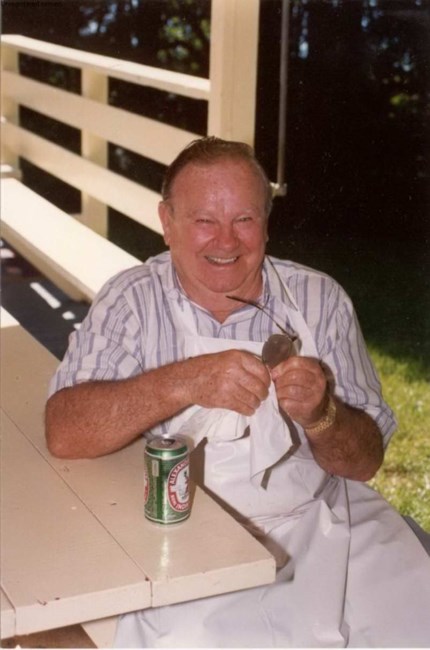
Of all his many special qualities (and by all accounts, there were far too many to recall here), it will always be his smile that I remember most vividly. It was brilliant and inspiring and it wasn’t just any smile. It was filled with a pleasantry and warmth that immediately lightened a heavy heart or a darkened space. It was pure and filled with love, and had a compelling joy for life within it. In John's smile, I could see hope, human kindness and deep compassion. And while there are those of us who have more difficulty finding happiness and smiling than others, John seemed to have enough for everyone. It was never long before he had everyone around him laughing and smiling with him. For he so loved to laugh and make others laugh. He had such a great sense of humor and he never liked to miss his favorite TV program, “All in the Family” with Edith and Archie. His love and talent for joke-telling was unbeatable and he was rarely able to tell a good joke while sitting down. With John, humor always required theatrics and in keeping with the man that he was, he found humor in both good and bad circumstances. His objective was to make others feel better through the laughter and he always made that effort no matter what. Even after his surgery with little energy left in his body, he made sure that all who surrounded him at his hospital bedside had at least one, good belly laugh before he departed. John was brave and just like he had done all his life, he thought about us, and put his family first. He was by far, the single most unselfish person I have ever known and we will all forever miss his sense of good humor and his great capacity to love. The last thing that he said to me before being taken into the surgical suite was, "Take good care of your mother."
John was as brave and confident as a soldier leaving for war that morning, and he had the perfect attitude to beat the odds. If anyone could beat them, John could beat them. Even during the darkest periods of his life, through personal and public misfortunes and difficulties, John was akin to a warrior spirit who could never give up the struggle. He fought with everything he had during his month long stay in the hospital following that last surgery and we were all there with him to cheer him on every step of the way. But after a month, his body had grown weak and perhaps, so also did his ability to keep going with such an affliction. In the end, his lungs and kidneys began to fail but not his heart. John had the heart of a lion. In the end, the one thing that refused to stop was his strong and beautiful heart.
John wasn’t alone at the time of his passing. He was surrounded and comforted by all who loved him, his wife Mena, his five sons, two daughters, grandchildren and in-laws, and his loving nephew, John.
Each and every passing moment, there is so much that we miss about him and we are reminded more and more of how much his life has brought meaning to ours. As we go about our daily routines at work and at home, we also remember that he is here with us, HE IS LOOKING OVER US and sharing his guidance and advice, his thoughts and his blessings.
It’s been hard for all of us to smile and laugh since Sept 16th of last year and although almost a year has passed, it seems like yesterday. But those of us who knew Johnnie best, fully understand that he would be distraught to learn of our continuing sadness. His wish would be that we celebrate and honor his life by example.
Those of you who have come to visit this memorial can honor John by contributing your own thoughts, stories and fondest memories to this website. Please do. Simply go to "SEND TRIBUTE" on the right hand side of this page. Click it on and start typing. In this small way, we can all be of assistance in helping each other to deal with our great loss, while also celebrating our immense good fortune in having known such a remarkable person as Johnnie.
I'd like to end here with this thought written by F. Collis Wildman in 1926. It was written the same year that John was born. Strangely I found this writing in an old picture frame after Dad's death. It seems to tell us what John might say if he were here today.
Remember This
Be good, but not too good - a little naughty, but not too naughty.
Say a prayer if you feel that way, say “damn” if it gives you consolation.
Be kind to the world always, if possible - yet if you must be unkind, smash right and left,
Get it over and forget it.
Smile, always smile. Have a smile ready even though sometimes it hurts.
Grab all the happiness you can – wherever and whenever you can – don’t let even a wee bit slip past you.
Live, above all things live,
Don’t simply exist.
If you are blessed enough to know what real love is – love with all you heart, soul and body.
Live your life so that at any hour you will be able to shake hands with yourself and try to accomplish at least one thing worthwhile each day. Then, when your nights come, you will be able to pull up the covers and say to yourself,
“I have done my best.”
F. Collis Wildman, 1926
Thank you for visiting this everlasting memorial to John. Visitors here should know that Tony and I will be creating a special website dedicated to Johnnie, to our family and to our Ukrainian heritage in Cape Breton beginning this fall. Seldom do we have the resources at our disposal to learn about our shared history, especially when it has come with turbulence and war. However among the few family photographs and memorabilia that has survived the journey, is a brief documented history of the family that was written by my father’s sister Ruby Husiak Yurchesyn, a few years before her death. Construction of this website will begin in September and visitors can enjoy reading Ruby’s recollections, some of Johnnie's homemade recipes, some old handwritten letters and family photographs, along with a short history of Ukrainians in Cape Breton. I hope you will take the time to visit the site periodically this fall.
Here is the link to follow: http://www.beavercove.net/john/
Show your support
Add a Memory
Share Obituary
Get Reminders
Services
SHARE OBITUARYSHARE
- GET REMINDERS
v.1.17.0