
OBITUARY
Rafiq Amin Farah
16 June, 1921 – 11 May, 2020
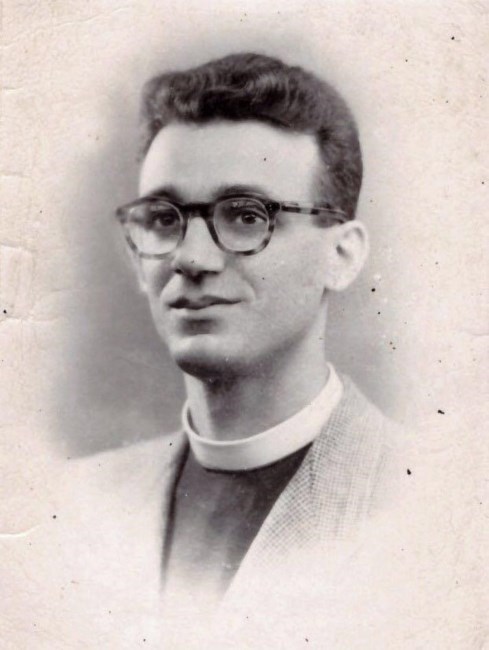
On Monday, May 11, 2020, Rafiq Amin Farah, loving husband and father of four, passed away at age 98.
Rafiq Amin Farah was born on June 16, 1921 in Shefa-amer, Palestine to Amin Elias Farah and Salma Habibi. He received his theology degree from the American University of Beirut, Lebanon, and was ordained as an Anglican priest in 1948. Rafiq spent over 50 years of active service ministering to congregations in the diocese of Jerusalem.
.
Shortly after his ordination in 1948 Rafiq took the last train from Nablus to Haifa being one of a handful of passengers, at a time traveling towards a city in turmoil when Palestinians in towns and cities were fleeing the violence of occupation. His mission was to attend to both the material and spiritual needs of not only the congregation but to all those displaced, destitute and in need. This was his introduction to what became a lifetime of ministry and social care, mostly conducted in the discomfort of prevailing conflicts in the Middle East.
On May 18, 1950, he met and married a young Nazarene writer and orator Najwa Kawar. Whilst in Haifa he became chairman of the Society for the Defence of Arab Minority Rights in Israel from 1951-1965, engaging mostly in defending Palestinian human rights, especially of the rights of those facing expropriation of their lands. Rafiq and his wife Najwa spent a year in Canterbury in the 1950s where he attended a course of theological seminars. In 1965 the Church posted Rafiq to East Jerusalem, which at the time was under Jordanian administration, where he attended to congregations in Jerusalem and Ramallah. The 1967 war saw the return of Israeli occupation, and during his time in the West Bank, and together with his wife Najwa, they increasingly took on advocacy of human rights in their respective life-calling centred on the plight of Palestinians under occupation. During this time Rafiq was recognised for his service with the position of archdeacon; he also became one of the founders of the ‘Living Stones’ a society which aimed to bring to the attention of visiting pilgrims to the Holy Land, not just the stone relics making up the historical vista, but to also introduce them to the indigenous people who are a living legacy of such history. Rafiq and Najwa travelled extensively in Europe, North America, and Asia Pacific accepting invitations to expound on the challenges faced by Palestinians, focused specifically to debunk biblical interpretations of a chosen people being favoured to occupy land by divine intervention; a brave endeavour considering that on many occasions this crossed red-lines of traditionally held beliefs of the attendees. He was well read in theology and philosophy, and later in his life he preached and wrote frank reappraisals of his beliefs challenging conventional theological thinking, and framing old-testament biblical narrations as having no relevance to divinity let alone Christianity; he simply believed that the essence of being a Christian is to emulate the life and teachings of Christ
In 1981 Rafiq was asked to attend to the needs of the congregation in Beirut Lebanon, where one of his main contributions was to raise funds for the setting up of St Luke’s Centre for Disabled Children. Rafiq remained in his appointment in Lebanon until the end of the devastating war in Lebanon in 1982 when he retired and in 1985 accepted a position as an honorary priest in the Southwark diocese serving at St Saviours Church Herne-Hill as well as conducting services for the Arab congregation in London for some eight years.
In 1995, Rafiq and Najwa left the UK to live in Canada, where he accepted to assist as an honorary priest in the parish of St Andrew’s Anglican Church in Toronto
Archdeacon Rafiq authored many books throughout his life as a priest, the most noteworthy is a history of the Anglican Diocese of Jerusalem in two volumes in Arabic, from 1841-1991, and a shorter history of the Episcopal Diocese of Jerusalem in English, titled ‘In troubled waters’. He also published two small books on the Christian Faith, including the Anglican liturgical practice, in Arabic. In recent years he wrote several articles questioning traditional Christian beliefs and advocating alternate universal and liberated perspectives for the 21st Century, which are being compiled in a booklet to be published titled Christ for the 21st Century – Reflective thoughts in retirement.
Rafiq will be remembered by all who knew him for his positive reassuring presence, diligent in doing the right thing and putting service ahead of form, for his openness and love of people regardless of colour or creed and on the other hand his intolerance for blinkered beliefs based on adhering to legacy rather open and questioning attitudes. Whilst he admitted wobbles in his traditional Christian beliefs, his faith was anchored by his dedication to the example of the life of Christ promoting love as his driving force.
“In the depth of your hopes and desires lies your silent knowledge of the beyond;
And like seeds dreaming beneath the snow your heart dreams of spring.
Trust the dreams, for in them is hidden the gate to eternity.
Your fear of death is but the trembling of the shepherd when he stands before the king
whose hand is to be laid upon him in honour.
Is the shepherd not joyful beneath his trembling, that he shall wear the mark of the king?
Yet is he not more mindful of his trembling?
For what is it to die but to stand naked in the wind and to melt into the sun?
And what is it to cease breathing, but to free the breath from its restless tides, that it may
rise and expand and seek God unencumbered?
Only when you drink from the river of silence shall you indeed sing.
And when you have reached the mountain top, then you shall begin to climb.
And when the earth shall claim your limbs, then shall you truly dance. ‘
-Jubran Khalil Jubran
Rafiq is survived by his four children Amin, Nabil, Randa and Karma, as well as his beloved grandchildren: also his brothers Sami and Hani, sisters Salwa, Nadia, and Samia, several cousins, nieces and nephews. A funeral service will be held on Tuesday, May 12th, 2020 at R.S. Kane Funeral Home, 6150 Yonge St., North York, at 4 o’clock p.m. with restricted attendance by close family members. Donations in aid of Medical Aid For Palestinians.
Show your support
Add a Memory
Share Obituary
Get Reminders
DONATIONS
Services
SHARE OBITUARYSHARE
- GET REMINDERS
v.1.18.0