
OBITUARY
George Bingham
June 1, 1919 – December 27, 2014
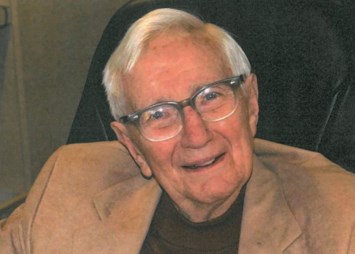
On December 27th, enjoying life and optimistic about tomorrow to the end, George Storrs Bingham departed our stage, age ninety-five.
George was a New England boy, born June 1, 1919, in strawberry season, in the central Massachusetts town of Fitchburg, second son of Robert and Alice Belding Bingham. Storrs was his middle name, for prominent relatives down Connecticut way. Grew up in a three-story apartment building on Day Street which his father owned, and ran his tiny Thimble Theater in the coal-scuttle basement, spooling borrowed training movies on his cobbled-together projector, five pins or a whistled tune for admittance.
His pianist mother spawned a musical family, and the boys Robert, George, Richard and Bill played a variety of instruments, and did their growing up in the Big Band Era, with the heroes of the age headlining local venues.
George and Bill were the engineers. George was first to go off to Worcester Tech, to indulge his naturally omnivorous analytical brain. He’d hoped to be an architect of concert halls, but his degree read Civil Engineer, devotedly multi-disciplinary before that name ever came along.
He began his professional ramblings during the war years on defense and power projects in Salt Lake, Little Rock , Nashville, and Quebec. When he arrived in Duluth, he was promptly smitten by the secretary to the President of Minnesota Power and Light, one Patricia Jean Ann Ryan of Ishpeming, from the Upper Peninsula of Michigan, and she was smitten right back. They married on his next project, in Portland, Oregon, June 6, 1943, and took up residence in a back corner apartment at the Ongford, which is still downtown.
Fifty years later, they celebrated their wedding anniversary at Sand Castle Day in Cannon Beach, but not before a great deal more wandering had intervened.
In 1950, they flew to Greece aboard a TWA Constellation as part of the Marshall Plan, George to be project manager for three hydroelectric projects and one steam-generating station which went some way toward electrifying the rural parts of the country in the face of civil war. These were some of the best times of their young lives, enjoying their sunshine days in suburban Athens, summering on Rhodes, and skiing in Davos.
When they returned to the States in 1956, George went on to projects in Turkey and Pakistan, until signing on as Chief Engineer for the Bonneville Power Administration. George and Pat were able to rekindle their love affair with the Pacific Northwest, as all the while George swanned off to Russia and points east and west on various goodwill missions.
He finished his engineering career in Portland in the private power industry. He and Pat lived in Lake Oswego for many years, and with Pat’s passing, he moved to Terwilliger Plaza, where he indulged his boyhood love of apartment living -- all play, no yard work.
He grew up at a time when all trains went choo-choo. His infatuation with that sound lasted his life long, and he was proud to be a supporter of the local train museum. He skied till he was eighty, and was an equally proud supporter of the U.S. Ski Team. He wants his ashes spread on his favorite run at Mount Hood Meadows
He was an excellent table tennis player, till he broke his hip playing doubles, at the tender age of ninety.
He read voraciously all his life. He has left us his complete set of Charles Dickens. He had read all three feet, complete. He ignored Woody Allen’s dictum, and read Moby Dick cover to cover.
He was a dedicated contributor to all sorts of causes, red and blue, and a committed recycler, even back when that was viewed by many as vaguely un-American. He was intensely devoted to Portland, a tireless, some might say relentless, booster, who believed its citizenry was without flaw and its amenities nonpareil. He loved his Blazers, who had won their championship the year he, Pat and Mary moved to the Fontaine, and never ceased to report every sighting of Bill Walton at the local supermarket. He never missed a televised game of the 2014 version, and was unfailingly excited about their prospects.
He could never see any point in smoking, and that served him well. His proudest bartender’s invention was a drink he cooked up during his years in Greece, and named the ouzini – three parts gin, one of ouzo. The bendable straw came along in later years, not his invention, but one which he embraced wholeheartedly.
He was the last Worcester Tech civil engineer from his class, the oldest living Chief Engineer of the BPA, and the last of the sons of Robert and Alice.
He leaves behind daughter Mary, son Hugh, granddaughter Tai and grandson Nolan, great-grandson Cylus,, a host of daughters, granddaughters and grandsons and great-granddaughters by marriage, and a fond family of nieces and nephews and their offspring once, twice and three times removed back in Lunenberg , Mass., and environs, to whom he is universally Uncle George.
At the approach of his 90th birthday, George decided he had been without bongos long enough, and without warning, and typically, went out and bought himself a set. And promptly taught himself to play them.
Last year he sang “The Sadder But Wiser Girl” at the Plaza’s annual talent show. His project to sing “Maria” at next year’s show, in honor of his daughter and his many other female caregivers, must now always go a-waiting.
The zumba group will miss his bongoed accompaniment (“I watch their feet to keep the beat,” he would say), as will the folk dancers and the Sunday brunch piano. His habit of breaking into one of his beloved Broadway tunes at the slightest provocation will likewise leave a lonely hole unlikely to be filled. The employees will be hard-pressed to find another so-committed “We wish you a Merry Christmas” caroler.
For him come June 1 every year, we’ll spoon a mound of strawberried shortcake, all heaped with real whipped cream, and lift him high a toast or two – an ouzini, say, or a Terminator-- for certain sure.
For now, for always, Good Night, Sweet Prince.
Show your support
Add a Memory
Share Obituary
Get Reminders
Services
SHARE OBITUARYSHARE
- GET REMINDERS
v.1.18.0