OBITUARY
Mike Kovacs
May 26, 1949 – July 10, 2015
Epitaph
An honest man here lies at rest,
The friend of man, the friend of truth,
The friend of age, and guide of youth:
Few hearts like his, with virtue warm'd,
Few heads with knowledge so inform'd;
If there's another world, he lives in bliss;
If there is none, he made the best of this.
Robert Burns
From Roza
2015 Februarba volt a negyvenedik hazasagi evfordulonk.
Az elso Gamma Knife treatment alkalmaval megjegyezte az apoloknak
nem erti mert kapja ezt a buntetest es ram mutatva mondta negyven eve vagyok vele hazas. Remelem viccelt.
Remelem viccelt es nem azert ment el mar nem birta velem. Nekem a negyven ev nem jelentett negyvenet, huszat se. Ugy szerettem es kovattem ahogy az elso evekbe kezdtem. Mi egyutt csinaltunk nagy dolgokat es egyutt kuzkodtunk eddig. Nem ertem miert ment el annyira hianyzik hogy szavak nincsenek ra.
O megadta nekem a legnagyobb ajandekot amit kaphatsz az eletbe a ket gyerekunket. Mint mondta; O az egesz eletebe azert dolgozott hogy a gyerekeinek jobb legyen. Megteremtette hogy jo iskolazast kapjanak.
Segitett abban hogy jo helyen jol eljenek a draga unokaival akiket imadott.
Legnagyobb orome az volt amikor ott nyuzsogtek korulotte, fozhetett nekik,
mehetett veluk az ocean partra vagy a medencebe. A nagy volt boldogsaga amikor a ket kis ember vissza adta a szeretetet, amikor atoleltek es csungtek rajta.
Az en szuleim imadtak Ot. Az Edesapam mindig Draga fiamnak szolitotta. Neha nem ertettem miert szeretik jobban mint engem de ha bele gondoltam akkor rajottem azert mert sokkal jobb, okosabb, megertobb, turelmesebb ember volt mint en.
Misi egy nagyon okos, gondolkodo tipus volt.
Magyarorszag elhagyasa egy rendkivul nehez lepes volt de akkor nem lattunk jobb jovot a gyerekeink szamara.
Buszken mondta, hogy O valasztotta ezt az orszagot ami nagyobb szeretet
mutat neha mint aki csak bele szuletet.
Imadta es felnezett Imre testverere. Janost ugy szinten es nagyon becsulte azert amit megteremtett a csaladjanak. Kornel nagyon kozel allt a szivehez.
Nem tudom hany ember kuzdott, dolgozott olyan nehezen mint O hogy egy teljesen uj vilagba megteremtse a csaladja jo letet. Az egyik ilyen nagy tette volt hogy Ohio-bol eljottunk. mint O irta a testverenek:
“ Megyunk at a napos oldalra”
A businessbe mindig nagyon becsuletes megbizhato volt.
O teljes mertekbe betartotta, hogy akik a munkat adjak azok a legfontosabbak.
A tudassa, a gyakorlata, a megbizhatosaga, a becsuletesen vezetett muhelye
sok dolgozonak es munkaadonak adta a tudast hogy ott jo munkat kap.
From Anita
For Dad
Mike or Mihaly Kovacs, or Misi, Misike, Miska, really in Hungarian you can go on and on with the nicknames, was born on May 26, 1949, in a smallish village near Debrecen, Hungary. The farm house was small, with enough room for one horse and one cow, but plenty of chickens. Farm life was hard, grueling work, but his dad was as strong as an ox and the kid helped where he could, feeding the animals, and avoiding the most hated of chores, all of them.
Dad and his older brother lost their mother Eszter (Esther) early on, when they were two and four years old. Eszter contracted tuberculosis, which was a death sentence at that time, all the more horrible because it was contagious. So she isolated herself in her room, and didn’t let her two kids near her. She wrote two notes to her husband Imre: one a shopping list for what to get the kids and how to prepare their food, and a goodbye letter, where she told him she loved him and signed it: your faded flower. Soon afterwards she hung herself from the rafters, sparing herself from a long, drawn-out disease and her sons from inheriting the same fate.
The boys grew, and their dad Imre later remarried, giving them a kind stepmother, and two younger brothers. Soon Dad learned about life in a soviet satellite country first-hand. The government wanted Imre to be a good comrade and sign his land away to the regime. Imre refused. Soldiers were sent to the house to live. Imre chopped off a support beam in the roof to cave in the ceiling in the room where they were staying. The soldiers spilled the breakfast soup out into the muddy yard so the kids had to go to school hungry. And so it went on and on, the daily lessons of standing your ground, a sinister regime, questioning authority, and the senselessness of throwing out good soup.
Pretty soon Dad had ideas of his own. He asked Imre why they kept a cow, when she cost more to keep than what she produced in milk. Imre shook his head and smiled, and said she was a good cow. Pretty soon he was calculating what things were costing all around the farm, and talking his dad’s ear off about how to make things better.
There was a lot of work to be done, so efficiency was paramount, and doing work well was important, because you only wanted to do it once if you could help it. Dad got good with his hands. He could build and fix anything, and broke lots of things in an attempt to make them better or more efficient. It was okay, he just fixed it again, except now it had extra nails holding it together or a big weld mark on the side. But you can bet it worked better than it did before.
In school Dad learned what he wanted, and conveniently forgot the rest, like the Russian language. He worked on his tan when he wasn’t working, and summers were spent at the strand, a series of swimming pools where everyone went. He went to trade school to learn surgical equipment repair and graduated with honors. He later met his wife at work, my mom, and after a hasty wedding ceremony where she wore a mini-dress and he sported a full beard and lamb-chops, they were married and had me.
A few years later they thought they were going to have a soccer-playing boy by the kicks she was getting in, but it was Monika who burst in upon the scene. They got a flat on the ninth floor of an apartment building, and there we were until Dad had it with the whole communist system.
He was going west, come hell or high water. So he bought a rusted out van, convinced my mom this was a brilliant idea, hid their money inside bell peppers, said goodbye to his brothers, and piled us into the car. He drove us to Austria, telling the border guards we were going on a ten day vacation. Soon after crossing the border, the car promptly broke down. A two hour ride took six days to complete, but finally we were in Munich, Germany.
He spent a year in Germany hauling frozen meat at a factory, all the while planning to go west. Or to the southeast, he wasn’t too fussed which, so long as he had Europe in back of him. He and my mom applied for citizenship to the U.S. and Australia, and the U.S. accepted, so they packed all their worldly goods, mainly pots and pans and spices, and flew to Ohio. The overstuffed, cheap luggage got caught in the convertor belt and pots rained down on everyone in baggage claim. Lots of unintelligible Hungarian was being shouted as they collected everything. It wasn’t smooth or easy, but they had successfully landed in what was to be their home country forevermore.
The next few years had my parents leaving Ohio for the warmer climes of California, or the “sunny side of the street,” as Dad liked to say, because he didn’t immigrate to the U.S. just to freeze his ass off like he did in Hungary. A business got up and running, and my parents decided to explore their new neck of the woods. My dad bought a Toyota truck, and off we went to the beach, to see all of Sequoia National Park in one day, and to places like Lompoc where you don’t know there isn't anything until you get there. My sister and I laid on a mattress in the back of the truck, which was an adventure in itself. We were really happy when Dad bought a camper shell for the truck, as it was less windy that way, although peering through the small window on the side made the lightning storm in the desert much less exciting.
Camping was by far Dad’s favorite, spending most of the afternoon setting up the tent, building a fire in the dark, and having a steak for dinner followed by the baked potato at midnight. Then we’d sleep in the tent with nothing but a flimsy sleeping bag between us and the cold hard earth, the sounds of nature drowned out by Dad’s loud snoring.
We grew up, Dad grew into his life in the U.S., but some things never left him. He was always looking to make things better. He had lots of ideas about the economy and the government, and how to make life better for everyone. He was an idealist, with lots of ideas, and lots of explanations on how those ideas would work, and collectively our asses were sore from sitting there so long as he worked through every idea to the next.
He took risks, and some paid off well and some cost him, but he believed that not taking a chance was also risky. He truly was an entrepreneur, and lived his life according to his ideals.
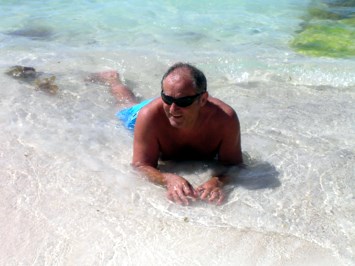
He loved his grandkids, and had them over every chance he got. He’d take them to the pool and teach them to swim and float. He’d hold their hands as they jumped around in the water at the beach. He never really took vacations after a while, declaring that he already lived in paradise, so why bother visiting somewhere else?
Dad is now gone, and too soon. He went quickly, and that is for the best, because he was never a good patient and losing his independence would have annoyed him greatly. There is great comfort in knowing he lived his life on his own terms, and had no regrets, save for that one trifecta he didn’t bet on at the races which would’ve netted him a hundred thousand dollars. He lived full heartedly and generously, ethically and logically. Sometimes pompously and drunkenly. What a life!
Show your support
Send Flowers
Add a Memory
Share Obituary
Get Reminders
Services
- SEND FLOWERSSEND
FLOWERS SHARE OBITUARYSHARE
- GET REMINDERS
v.1.18.0