OBITUARY
Helen Widen
May 15, 1933 – March 1, 2025
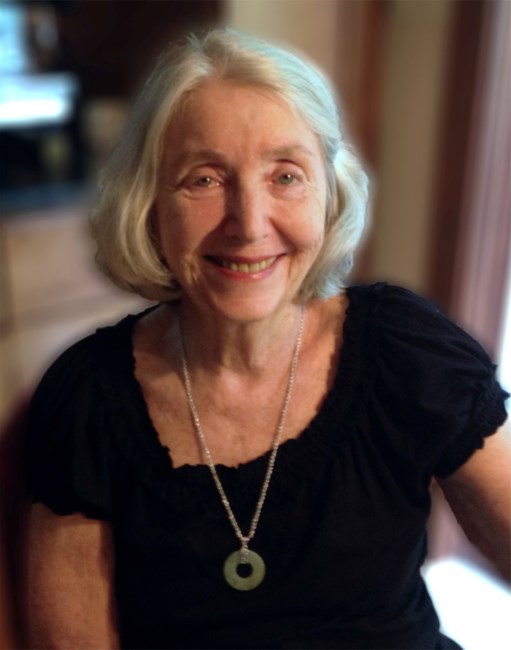
For more than three decades, she worked as a psychotherapist at Northwestern University’s Student Health Service and also conducted a successful private practice. At her core, Helen was an educator. She helped her patients, family and many friends better understand who we are as people. And she made the world a better place.
Helen Widen lived life fully. She was married twice, had four children and six step-children. Through the years, she remained the matriarch of an extended family that she held close to her heart. She was an avid reader and world traveler. She once told a daughter, “You can do it all, but you can’t do it all at one time.” Near the end of her own life, she said, “I’ve done everything I wanted to do.”
Helen Ann Frank was born in Minnesota in 1933 and grew up in the tiny town of Beulah, North Dakota, about 500 miles to the west. She liked to say she was born during the low point of the Depression. Her father, Samuel Frank, ran a general store and owned land from a government land grant. Hers was the only Jewish family in Beulah.
Her mother, Celia Mosby Frank, was a unique presence on these wind-swept plains. She owned a baby grand piano and wore designer clothes. “I got my civil rights orientation from my mother because the Indians used to come in the store, and my mother deplored how they were always put on the worst land.”
Young Helen—a freckled, luminous girl—learned a lot about country life in North Dakota. She learned how to slaughter chickens, how to milk a cow and how good a tall glass of milk tasted. But at her mother’s insistence, the family left the farm for the big city. Chicago, where two of Samuel’s sisters lived.
In 2020, Helen wrote about those formative years in Chicago in a short memoir.
At the age of twelve, she found her first close friends. She joined a club of girls on her block in Rogers Park. They would save her, she wrote, from “the agonies of being thirteen.” She was the baby of the group, shy and a bit inhibited. “Most of the time, I didn’t know what to say, but fell back on becoming a good listener,” she wrote. They would meet on the beach, go to movies and chat. Helen listened—and found her voice. “The talkative girls showed me the way to self-expression by being open and genuine and modeling how I wanted to be.”
It was also around this age that Helen embraced Judaism. Helen’s parents, first-generation immigrants from Europe, were secular. Soon after moving to Chicago, Helen declared she wanted to go to services. She would take her brother on the bus to a nearby synagogue. She was enthralled by the richness of her heritage and loved the power of the text. A love she kept her entire life.
Helen attended Sullivan High School and was accepted at Northwestern University. When she was 19, she met Arnie Widen at the Edgewater Beach Hotel. He was studying to become a doctor; she was studying to be a teacher. It didn’t take long for them to marry. They would have four children—Claire in 1954, Mark in 1956, Brent in 1960 and Jeanne in 1962.
In 1954, Helen graduated from Northwestern with a Bachelor of Science degree with distinction. But she devoted most of the next dozen years to home and motherhood. She was very involved with her children. No-nonsense, she would encourage them to work hard. Study. Push. Get things done. And she would rock them. Take them on walks. Drive them to museums. Cook with them and sit with them on the piano bench. Helen loved fun. One daughter remembers: “She would think about how to make every day a nice one.”
During the early ’60s, Helen returned to school, registering at the National College of Education to prepare for a career as a psychotherapist. She took one course every quarter. “Naptime was my time to read for school,” she said. “I refused to do housework during naptime. My children had to put up with me doing it while they were awake.” She graduated in 1966.
She worked part-time as a therapist at National College and soon switched to Northwestern University. Because many of her clients were students, she emphasized short-term therapy, imparting skills they could use long term. She also created a private practice. There, too, her clients did not stay long. “I terminate people early,” she once said. “They love me. They want to keep on going. I don't mind the fee, and I don't mind the relationship, but they need to go off on their own.”
Helen moved to Evanston in 1960 with her young family. “In the conformist 1950s, a lot of people married young and focused on building marriages, families and our husbands’ careers,” she wrote. “It seemed like we always ‘did the right thing,’ what we were ‘supposed to do’,” she wrote. “It was during those years that the Women’s Movement was burgeoning. We were reading and talking about ‘The Feminine Mystique’ and ‘The Second Sex’,” books by Simone de Beauvoir that questioned the idea that women were lesser.
“The 60s were tumultuous times that touched us all in a deeply personal way. The lynching of Emmett Till in 1955 woke up the country,” Helen wrote. She watched as Black people mounted protests against Jim Crow policies in the South. “As often as not, protests were met with the state-sponsored violence of law enforcement,” she wrote. “Closer to home, we became more aware of segregation in Evanston, and particularly in the schools.” She became active in the integration of housing. “That was our baptism into social action.” She attended discussions about race and civil rights at the Unitarian Church of Evanston and joined in the early efforts to integrate Evanston schools. She was part of a group that purchased a 19-unit apartment building on Sheridan Road to racially integrate Southeast Evanston. And it worked. ”No one lost a penny on the deal,” she wrote.
Helen was ironing clothes in her home on a Tuesday morning in March of 1965, a few days after Selma, Alabama’s “Bloody Sunday” march, when she heard that Dr. Martin King Jr. was calling “Americans with conscience” to come join him and other protestors to their march from Selma to Montgomery. She called her neighbors, Nina Raskin and Gracie Mertz, and suggested they take a train to Alabama. The women immediately agreed, but soon others wanted to join. The group rented a Greyhound bus for 38 neighbors. The bus left on the Clinton Place cul-de-sac near Helen’s and Nina’s homes a few days later.
“Twenty-four of us on the bus were housewives like ourselves, leaving a total of 89 children at home,” Helen wrote. “We were venturing into unknown and scary territory.”
The group arrived on the outskirts of Montgomery on March 25, 1965. As they marched downtown with thousands of others, they felt under siege. “There were nasty comments and booing and hissing,” she wrote. “I realized how responsible I felt and how focused I was on getting our group through this experience intact and safe.”
The Evanstonians made it safely to the rally outside the state capitol and made it back to the bus. “To this day, I am not sure how we were able to find our own bus after the rally broke up,” Helen wrote.
Back home, she joined marches to protest the Vietnam War and served on the board of the Peace and World Affairs Center of Evanston, which created a gathering place in a Chicago Avenue storefront for people protesting the Vietnam War.
“I had a season where I stood up for peace and social justice,” she later said. “A number of us as well marched in downtown Chicago and had our pictures taken by police for the files and for those of the FBI.”
After 28 years, Helen and Arnie ended their marriage. Divorce was one of the biggest tragedies of her life, Helen later said. But she was determined not to let it put a shadow on her family. “I learned a lot from her about forgiveness,” one of her children said. “She decided to put aside anger and disappointment and conflict and became very forgiving and accepting. She maintained a close relationship with her first husband and welcomed his second wife.”
Helen took on a new family when she married Philip Lottich and became the stepmom of his six adult children. Phil adored Helen, and the feeling was mutual. They shared a love of books, travel and food.
She retired around 2000 because she wanted to spend more time with Phil. And she also wanted a more contemplative, relaxed life. Retirement gave her time to read. She was a woman of letters. She read fiction and non-fiction, philosophy and literature. “There's nothing better than curling up with a book and letting your imagination take hold,” she said, and the books in her home tell of her life as a reader. She was, her children say, perhaps the most informed person on the planet. She read the Chicago Sun-Times and New York Times every morning and devoured magazine, including the Atlantic, Economist, New Yorker and New York Review of Books. She never missed the nightly news.
And she wanted to learn more. Helen was a star of the Osher Lifelong Learning Institute at Northwestern. She took literature classes, wrote poetry and (thankfully) a memoir. And she co-taught sixteen classes at OLLI. Instead of teaching what she knew, she figured out how to teach what she wanted to learn. Courses on the Silk Road, the Rivers of the World, Irving Berlin and the course she was proudest of, a year-long study of Islam and the Quran that included field trips and exchanges with the local Muslim community. It was at OLLI that she met the third love of her life, Tom Squillace, a man of letters, with whom she spent many of her later years. They loved and respected one another.
Helen gave up OLLI when her hearing declined. She braved several serious health scares and hospitalizations, and always seemed to make it back. She flunked out of hospice, one of the few endeavors she failed. Her doctor once called her a chronic survivor.
In all this full and busy life, it’s important to note that nothing was more important to Helen than her family. She played the role of matriarch with joy: giving emotional, spiritual and financial support to her children, grandchildren and great-grandchildren. She paid college tuitions and opened her home to anyone who needed a place to stay and time with her. And they gathered around her at her 90th birthday one last time.
She’d stopped swimming at the Northwestern pool by then and taking walks around the neighborhood. She focused on taking care of herself. Eating well. Taking naps. And, of course, reading. Even during the last weeks of her life, Helen would read in her front room. For hours. When a 700-page book became too heavy, she would ask that someone cut it in half so she could still hold the book. E-books, cell phones and computers were not for her—even though she tried them. The living room became her world. Last year, she said, “In a way, it's kind of lonely. I had an overpopulated life, and I was so active. Here there are thick walls and it's kind of sweet to have solitude.”
She would look out the window to check on friends and neighbors. She called most each of them “Honey.” And until her very last day, every visitor would be honored with Helen’s warm, irreplaceable smile.
Helen is survived by her children Claire (Dan and Lisa), Mark, Brent (Sabina), Jeanne (Rodolfo); grandchildren Carolyn (Zach), Tanya (Clayton), Sofia, Isi, Sebastian, Jack, Samuel, Shalev, Asher, and Remez; great grandchildren: Amelia, Zoe, and Levin; step-children David (Chizu), Marilyn, Sandra, Alan, Mark (Marica), and Brian (Estrella); step-grandchildren Matt (Kylan), Derrick (Brittney), Melissa (Lawrence), Elena, and Andrew; and step-great grandchildren: Grace, Matthan, Christian, Landon, Ariella, Calla.
Contributions to your favorite charity in memory of Helen would be greatly appreciated.
Show your support
Add a Memory
Share Obituary
Get Reminders
Services
SHARE OBITUARYSHARE
- GET REMINDERS
v.1.18.0