
OBITUARY
Roy Atkinson
22 April, 1916 – 29 February, 2012
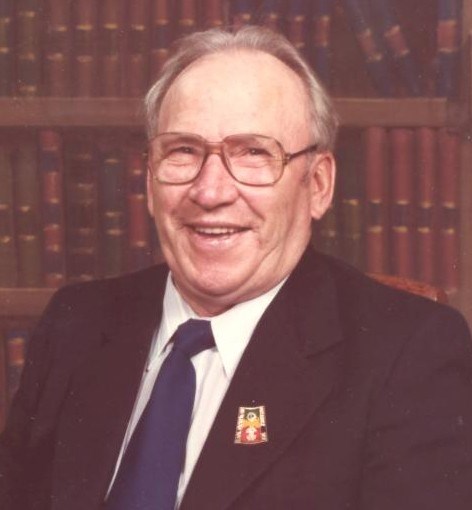
John Roy Atkinson (Roy) was born April 22, 1916, on his parent’s farm in the Bender district, which is about four miles east of Kipling. He was the fifth of six children born to John and Rosetta (Lawrence). John came west to homestead in 1902 and built his required homestead dwelling. He returned to Ontario twice, and in 1905, on a third visit back, he married Rose and returned to his homestead. John and Rose’s children were Elmer, Jim, Bessie, Hazel, Roy, and Eva. The Atkinson family attended the United Church and the children were baptized there.
Life on the farm, as experienced by Roy as a child, was not an easy life because farming was not a particularly lucrative business. His parents had built a comfortable good-sized home 1917, and there were many animals on the farm which Roy loved, but there were endless chores that had to be done in order to benefit the whole family. Horses were the power for farm implements in those days
Roy and his siblings attended Crystal Springs country school, which was about a quarter of a mile across one field. Perhaps this school was unique because the pupils were a mixture of students from ethnic backgrounds, which were Russian, Scotch, Hungarian and Canadian. He had many friends all through life, but as a young lad he was particularly close to the Santo boys, Bob and John, who were twins, and their brother David became his best friend. After Crystal Springs School burned down, the children began attending Bender School in 1928.
Roy told stories about the days when students were encouraged to collect gopher tails in order to help eradicate the rodent population. These tails could be exchanged for money and he recalled that one time he went behind the school, gathered up the same gopher tails that he had been paid for and turned them in again for more pay. This was quite a ruse in his mind. He must have been somewhat of a rascal because on several occasions he frequently incurred the wrath of his teacher and received the strap as punishment. The game of baseball was a popular recreation pastime in schools of that era and Roy being ambidextrous was a left-hand hitter even though he wrote with his right hand. There wasn’t time for sports after school because there were always chores to be done on the farm and Roy and the rest of his siblings didn’t have much free time.
Country schools could be a good place to learn the basics and Roy was a very good speller; however, there often weren’t enough students to have the curriculum taught for every grade. This situation would come to affect Roy. After Grade 6, he was required to skip a grade because of the absence of other students in his grade. In order to master the eighth grade, Roy had to spend two years in that class and he left school feeling that he wasn’t able to undertake more school work. He did not have positive memories of his academic abilities.
The Atkinson children created their own fun and could be seen skiing behind horses on home-made skis in the winter. Roy especially enjoyed swimming and there was a “swim hole” at the southwest edge of Bender Lake. During the dry 30s, the water levels in the lake were low. From the time he was a young lad, Roy had quite a sense of humour and he loved to pull pranks on Jim and Bessie, particularly. It amused him to hear Bessie scream and he found Jim’s gullibility delightful. One family incident that Roy remembered was the time that three of the Atkinson children had their tonsils removed in Kipling. One of the children required the surgery and the Kipling doctor suggested that by including two more children for surgery, as well, the price would be cheaper. The reward for this misery was ice cream at the end of the day. Family holidays were practically non-existent, but Roy recalls his mother making the journey back East and taking some of the girls with her. As the years went on, he and his siblings kept in close contact in spite of time and distance.
During the years between schooling and marriage, Roy always had something to do. After he made the decision to end his formal education, Roy worked on his father’s farm. His only possession at that time was his horse, “Diamond.” In the “dirty thirties” jobs were scarce. His older brother was helping on the farm so Roy decided to look for a job elsewhere. During the years of 1939-1940, he “rode the rails” to Vancouver where he lived with his eldest brother, Elmer, and his sister-in-law to obtain employment, but he was quickly discouraged because any work he found was only part-time and sporadic. During this trip Roy recalled being so hungry that he and other men left the train to raid gardens along the way in order to procure food. When his older brother Jim got married, Roy was needed back on the farm to help his father, so he returned home from B.C. During this time he became very good friends with Carlyle Santo and Calvin Sexsmith. David and Carlyle Santo along with Calvin and Roy would often travel to Kenosee Lake to dances. Sometimes they travelled in Roy’s car which was an early thirties model Chevrolet.
When World War II began, Roy joined the local army reserve forces, donned a special uniform and took part in their meetings and drills. Sadly, by the end of the war, two of his good friends Bob and John Santo, who were in the armed forces, died overseas.
Roy met Joan Frances Moore, from the Kennedy area, at a dance. During her teen years, she occasionally played the piano to accompany a dance band, who provided music for dances. Never one to want to be in the limelight, Roy found that Joan was even shyer than he was. After a short courtship, they married three days after Christmas, December 28th, in 1945; Joan had turned nineteen on December twenty-fifth, and Roy was twenty-nine. Because Joan was Anglican, they drove to St. Mary’s Anglican Church in Whitewood to have the ceremony performed; this was a considerable distance to travel. Their attendants were Joan’s sister Marjorie and her husband, Jim Clark. Their honeymoon consisted of one night away.
After their marriage, Joan and Roy lived for a short time with his parents. In two years time, when the elder Atkinsons retired to Port Coquitlam, B.C., Roy approached his father to buy the farm. About five years later Roy’s father agreed to sell his farm; Roy purchased the home quarter and most of the land and his brother Jim acquired a couple of quarters to add to his farm at that time. Roy got a loan to buy the land and he and Jim often shared farm equipment to reduce their farming costs. During these five years, Roy purchased a work team of horses, “Tillie” and “Queen,” as well as a few head of cattle, a few chickens and later some pigs. Roy loved the farm and his animals. Seeding and harvest time were especially favourite times of the year, although they were very busy. He purchased one of his first tractors about 1954 and worked at building up his cattle herd, which at one time was made up of Shorthorns and later Herefords. The farm also had milk cows and Joan was the one who did most of the milking. It was the money received for the cream they shipped that gave the family cash; this was welcomed because there always seemed to be money issues. The family was quite self-sufficient; in addition to having their own meat and milk they had a huge garden. Roy did much of the weeding and garden care while Joan did the canning and preserving of the food. Joan was a boon to the farming operation because she had a natural ability to manage the farm books.
Three children, Donna, Kenneth and Robert, were born to Roy and his wife. The youngest, Robert, had several health problems and it was a struggle for them to keep up with the doctor’s bills. Joan managed the day to day child care and became the disciplinarian in the family. The children were expected to speak and act properly, and bad manners were not tolerated. Roy was more easygoing with the children but he supported Joan’s decisions on family matters. When Donna was very small, her father included her when he did farm chores, and she became his little shadow while following him around. As time went on, it was decided to sell some of the chickens, cows and pigs thus allowing Joan the opportunity to work outside of the home. As the children grew older, they were expected to help with chores and help around the home. The acquisition of electrical power and a tractor meant big changes on the Atkinson farm. During their childhood years, Roy was a loving, gentle and concerned father and he always affirmed his children’s importance by attending functions that they were involved in.
In the sixties, while the children were still in school, Roy became a bus driver for the school unit. His long routes changed from time to time, and they were always routes that did not include his own children. Some of the students found the name Atkinson hard to pronounce and some of them came up with various versions of his name such as “Mr. Appleskin” or perhaps “Mr. Akerson.” Roy commanded respect as a driver in charge of such precious cargo, and children on his bus had to learn to behave or they would be told they might have to walk home. This occupation was something that Roy took seriously and really enjoyed, and when he retired from driving the bus he received an award of merit: this was something that gave him great pride. It was hung in a prominent place and he looked at it often. In addition to driving a school bus, Roy also did custom baling in the summer months for a period of fifteen to twenty years.
Roy and his family liked to celebrate special occasions and birthdays and anniversaries were marked with family gatherings. He and Joan were honoured by their family at a twenty-fifth wedding anniversary celebration at Donna and Lorne’s home. It was a few years following this occasion that Joan became ill with cancer and died at the age of forty-seven; Roy and Joan had been married for twenty-nine years at the time. Following Joan’s death, Roy remained on the farm for four to five years before selling the farm and moving into the town of Kipling. The loss of his wife created a void in his life and he had many lonely times.
Roy was a loving father and like many parents he worried about his children. He was very proud of his family’s achievements such as when Donna graduated from secretarial school and obtained her first job. Ken’s graduation from RCMP training was another moment of fatherly pride, and he continued to feel gratified when Ken carried out assignments that required him to be an escort for prisoners and later to be assigned to the bomb squad. On the occasion when Bob purchased his first truck and started his own business, Roy had opportunities to delight in more of his children’s accomplishments. He was always supportive of his children’s decisions and choices, and he passed along some life lessons to them such as the importance of planning out big decisions. He urged his children to be cautious when spending money and to refrain from purchasing items that were unnecessary. He felt it was important to go through life on the right side of the law as any illegal activities would very likely cause repercussions. He stressed the importance of honesty and felt that is was important to enjoy what you do in life. Conflict, in his opinion, was not a healthy behavior and he suggested that it was more important to deal with the big things in life as opposed to focusing on little disappointments and issues. He was a sensitive person who could feel other people’s hurts. Roy exemplified the ideal of being a person who was not critical of others and he was an independent thinker who would voice his opinions on issues.
One of the most notable characteristics of Roy’s personality was his sense of humour. Because he was a man of few words, he would be seen listening to everyone else’s conversations and would then come up with a few of his famous one-liners or a quip and everyone would laugh. Even at the end of his days, he teased his care-givers and they enjoyed his antics.
Roy was a person who was determined to be an active participant in life. While Joan was living, he enjoyed playing cards, especially canasta and whist. Even after Joan’s death, Roy attended dances because he really enjoyed dancing. As a widower, Roy spent several weeks in the winter time months in Arizona where he golfed and swam. As the years went by, he travelled to Hawaii and embarked on some cruises. He also went on several casino trips as well as a trip to Alaska with Bob and Debbie. His last big trip was to Mexico with a group of thirteen family members. When Roy moved into his own home in Kipling, he surprised everyone by taking part in activities that would not have been expected. He enrolled in a jogging class and engaged in that activity; he rode a bike until he was eighty-five, golfed in his eighties, and visited the pool hall twice a day where he became an excellent snooker player until knee problems, in his nineties, prevented him from bending over the table properly in order to make shots. The pool hall became one of his favourite places to be. He also joined the Lion’s Club. Roy loved watching hockey on television, especially the Edmonton Oiler games, and he watched all of the Saskatchewan Roughrider football games as well. During the last few years of his life, a highlight of an average week was “happy hour.” These were really times when his friends would stop in to visit and they occurred more when Roy was unable to be out as much. His many close friends always enjoyed getting together for these occasions to socialize. He was popular with his neighbours and friends who made his life brighter by including him in their lives.
One of his biggest achievements was the fact that Roy learned to cook. While on his own he learned to make very healthy meals, which included meat and vegetables, stews, puddings and even a few saskatoon-berry pies. Pie was always a big thing in Roy’s life and everyone who knew him knew it too. Some friends teased him about making them a meal and Roy would chuckle and say that he made the best damn jam sandwich that there could possibly be. He looked forward to the season of fowl suppers and made sure that he attended many of them in the area.
Roy was always interested in his grandchildren and he tended to be concerned about each of their situations and wanted to help them if he could. They, in turn, felt a great affection for him. He attended functions connected with their activities if he could. When his grandchildren and great-grandchildren were small, they always knew that their Grandpa might have a Cert candy in his pocket, and, consequently, they would sidle up to him to see if he would find one for them. He always taught them to suck their candy to make it last rather than chew it.
After his wife died, Roy’s attendance at formal church services ebbed, but for twenty years he was a Sunday morning devotee of the radio program “The Lutheran Hour.” He continued to enjoy his family and Sunday’s were generally spent with Donna and Lorne’s family; it was another of his favourite places to be. Another sad event that Roy had to endure was the death of his son Robert, who died at the age of forty-five.
By the time he reached eighty-five, Roy’s health had not been a problem; he rarely took a pill for anything and he was in very good physical shape. In June of 2001, he had a pacemaker inserted and later required knee replacements which he had done on two separate occasions at the age of ninety and ninety-two. He was so grateful when Ken came back to Saskatchewan to assist him through the surgeries each time and especially to manage the six weeks of driving to Regina daily when he required radiation therapy for a bout of skin cancer. He was never known to be a complainer in spite of the severe arthritis that he had. His tolerance to pain was remarkable. In January of 2012, he became ill with pneumonia and was admitted to hospital, but his condition continued to deteriorate.
Roy died on February 29, 2012, at the age of ninety-five years. His largely attended funeral was held in the Christ Lutheran Church at Kipling on March 6, 2012, with Rev. Murray Halverson officiating. Roy’s son, Ken, gave the eulogy and his granddaughter Sheila Szakacs was the urn bearer. At his burial in the Kipling Cemetery, each close relative placed a red rose on his grave.
Written by Lynn Keating from an interview with Donna Olver on April 13, 2012 and approved by Donna Olver for publication on June 5, 2012.
* * * * * * * * * *
On Wednesday, February 29, 2012, Roy Atkinson, Kipling, Sk., died at the age of 95 years. The funeral service will be held in Christ Lutheran Church, Kipling, SK., on Tuesday, March 6, 2012 at 2:00 p.m. With Rev. Murray Halvorson officiating. Cremation with interment in the Kipling Cemetery. Predeceased by his wife, Joan (Moore) in 1974, son, Robert in 1999, daughter-in-law, Suzanne in 2003, parents, John and Rosetta Atkinson, brothers, Jim and Elmer, sisters, Bessie (Charles) Johnson, Hazel (Wilbert) Chambers and Eva (Walter) Spiess. Roy will be lovingly remembered by his daughter, Donna (Lorne) Olver, and their children, Sheila (Darren) Szakacs and Cole and Rylie, Kipling; Travis Olver and Ciara, Estevan; Kirk Olver (Ashley), Kipling; son, Kenneth Atkinson, Surrey, BC., and children, Devann Atkinson, Surrey, BC.; Jason Atkinson, Red Deer, AB.; Robert's children: Colin (Kelly) Atkinson and Alexander, Regina, SK.; Joshua (Lori) Atkinson, Kugaaruk, Nunavut and Cassie Atkinson (Charles), Toronto, ON., as well as his nieces, nephews and many dear and caring friends, all so very special to his life. Roy will always be remembered for his love of family and his great sense of humour which he kept right to the end. Dad, your struggles are now over, rest in eternal peace, you will be missed and forever remain in our hearts. In lieu of flowers if friends so desire contributions to the Kipling Health Centre Building Fund or to a charity of choice may be tokens of remembrance.Arrangements in care of Tubman Funeral Home/Valley Crematorium, Kipling, SK.
Show your support
Add a Memory
Share Obituary
Get Reminders
Services
SHARE OBITUARYSHARE
- GET REMINDERS
v.1.18.0