
OBITUARY
Frances Mercer
July 30, 1911 – November 22, 2012
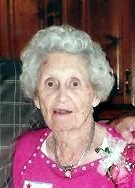
Frances McIntosh Anderson was born on July 30, 1911, the oldest child of Roberta McIntosh Anderson (1887-1989) of Laurinburg, NC, and William Franklin Anderson (1874-1964) of Ninety-Six, SC. She graduated from Lander College in Greenwood, SC, in 1933 and went on to a career as a clerk and bookkeeper in Columbia, SC, and Atlanta, GA, including work for the War Assets Administration. She married William Clifford Arbery (1906-1952) in 1947 and had two children, Rebecca (Becky) and Glenn.
After her husband’s death in 1952, she lived with her parents and worked in Ninety-Six, SC. In 1957, she met and married Hugh W. Mercer Sr. and moved to Forsyth, GA, where she and her children joined Mr. Mercer and his son Hugh Jr. to form a new family. After her father’s death in 1964, she helped take care of her mother, Roberta Anderson, including several years when her mother lived with her. After Mr. Mercer’s death in 1985, she remained in Forsyth, where she was a member of Christ Methodist Church, until 2000, when she moved to Woodstock, GA, to be close to her daughter. She remained in the Woodstock area for the next twelve years, including almost two years with her daughter Becky, until her peaceful death at home on Nov. 22, 2012.
She is survived by members of four generations: two of her siblings, her three children, twelve grandchildren, and 16 great-grandchildren and three more due in 2013.
Her living siblings are William Anderson of Atlanta and Sally A. Pulliam of Columbia, SC.
Her daughter Becky and her husband Tom Dixon live in Woodstock, and their son Steven lives in Marietta.
Her son Glenn Arbery and his wife Virginia, who have seven daughters and one son, split their time between Dallas, TX and Worcester, MA with their daughter Julia. Their daughters Joan and Monica live in Dallas, as does their daughter Lucia, her husband Peter Simek, and their children Eva, Felicity, and Oliver. Their daughter Ruth, her husband Jude Frank, and their daughter Esther live in Herndon, VA. Their daughter Sarah, her husband John Hinkle, and their children Helena and Thomas live in Newmarket, NH. Their daughter Therese, her husband Matt, and their son Dominic live in Norwalk, CT. Their son Will lives in Brooklyn.
Hugh W. Mercer Jr. and his wife Gretchen of Richmond Hill, GA, have two sons and a daughter. Drew and his wife Becky live in Macon, GA with their two daughters , Georgia and Catherine. Brannon and his wife Carrie live in Barnesville, GA with their children Ben, Grace, Camille, and Blake. Ivey and her husband Maj. Scott Virgil live in Richmond Hill, GA, with their children Logan, Laine-Marie, and Luke.
Other family members include many nieces and nephews and two step-children from her first marriage, Mary A. Kinder of Marietta and Cliff Arbery of Atlanta.
A Celebration of Life Service will be held Wednesday, November 28, 2012 at 10:00 am from the Mountain View United Methodist Church in Marietta, Georgia, Rev. Bill Burch officiating. The interment will follow at 3:00 pm at Monroe Hills Memorial Gardens in Forsyth, Georgia. The family will receive friends Tuesday, November 27, 2012 from 6 until 8 pm at the funeral home. Woodstock Funeral Home is in charge of arrangements. 770-926-3107
In lieu of flowers: Memorial gifts in her honor may be sent to one of the following, Mill Springs Academy--Scholarship Fund, 13660 New Providence Road Alpharetta, Georgia 30004, 770-360-1336 -- Mountain View United Methodist Church, Missions or Preschool Progarm, 2300 Jamerson Road Marietta, Georgia 30066 770-928-0050 -- Christ United Methodist Church, 417 North Frontage Road Forsyth, Georgia 31029 478-994-7232
REMARKS BY GLENN ARBERY
I’ve been thinking this week about all the names Mama went by in her 101 years and the relations those names summon up. To Miss Bert and Mr. Frank, who were Mama and Daddy to her all her life, she was just Frances, as she was to work friends like Ione Wheeler or Forsyth friends like Sara Lifsey and Ruth Chapman and to all her new friends in Woodstock at Mountain View Methodist Church. She was here for twelve years—as long as it takes to go all the way through school from first grade to high school graduation, always growing. To her brothers and her sister, she was Sis, so my cousins grew up calling her Aunt Sis, never Aunt Frances. When we were children in Forsyth, Hugh called her Miss Frances, but that changed to MeMa with Hugh and Gretchen’s children and grandchildren. To Stephen Dixon and the Arbery children and grandchildren, she was Nana.
Every one of these names summons up a whole world of relations, and Mama seems to preside over them in some definite, graceful way, but not as the center of attention. She never had the strong impulse to focus a situation, which is not to say that she was passive or shy, just that she was never strongly assertive, never the one in a group to force a conversation in a certain direction or urge her strong opinions on others. She was open and forthcoming, ready for new experience, such as joining the bible group here in Woodstock at 90, but at the same time, there was a silence about her. She was never a gossip, never a storyteller. Our friends who remember meeting her tend to come back to the same words: beautiful, gracious, or beautiful, elegant, generous—a lady in a sense our age seems almost to have forgotten.
Some quality about her has always seemed entirely uncapturable. My comic image of it comes from two or three decades of photographs, most of them preserved in the family albums, in which it proved to be impossible to take a picture of Mama with her eyes open. She’d be doing dishes at the sink after one of the big Thanksgiving or Christmas dinners in Forsyth, and Uncle Jimmy or Uncle Bill would come up behind her, camera in hand, and say, “Sis!” She’d turn around, they’d snap the picture, but the camera would only get her closed eyes and a funny look around her mouth. It got to be a family joke, but the strong impression it left with me was that her actual living appearance could never be represented. Something would hide from the camera in the last split-second, as though her essence could not be seized. Photography did better in her last years, perhaps because she wasn’t always in motion.
But let me say just a word about two of those names and what they summon for me. I became aware of what Sis meant in the 50s or early 60s before Mr. Frank died, when everybody would converge on Ninety-Six, South Carolina, for Thanksgiving at my grandparents’ house. All of the children would be playing at something in that big house where Becky and I had spent five years of our early childhood—Marty and Karen and Linda, Robert and Jay and Buzz and Greg and Stephen—and we’d watch the grownups talking and laughing: Uncle Pete and Aunt Toni, Uncle Tuck and Aunt Martha, Uncle Bill and Aunt Lynn, Uncle Jimmy and Aunt Sally. Mama would take on this new identity as Sis with a whole set of allusions to things that had nothing to do with us as children. These were about growing up with Pete, Tuck, Bill, and Sally in South Carolina in the years after World War I. Mama remembered Miss Bert always giving the boys a hot sweet potato when they came home from school. She always talked about her friends Mott and Frank Anderson (no relation), who lived on the road to Greenwood and whose mother made the best potato chips she ever had. There were stories about her brothers going into the old Revolutionary War tunnel out at Star Fort, about graduating from Lander College in the heart of the Great Depression and working in Columbia for something like $60 a month. There were stories about World War II, Pete and Tuck fighting in the Pacific, her brother Bill severely injured fighting in Europe, her brother-in-law Jimmy Pulliam fighting as the tail gunner in bombing raids over Europe. There were stories about Sis meeting Bill Arbery, marrying him, nursing him through his last year of coronary disease while tending two infant children and my father’s son Cliff from his first marriage, who was a senior in high school.
But in a life of 101 years, these stories add up: her marriage to Hugh Mercer in 1957, our life growing up in Forsyth, Georgia, where she became MeMa a year or two after Hugh and Gretchen’s oldest son Drew was born in 1970. By now she is MeMa to Hugh and Gretchen’s three children and their spouses, and their nine grandchildren. Mama became Nana in the Arbery side of family after Joan was born in 1979. But she was Nana from the time she first visited Irving, Texas, after Joan and Lucia were born and then visited Houston for Ruth, Sarah, and Therese, then New Hampshire for Julia, William, and Monica. The last time she was able to visit us was for Ruth’s wedding in 2009. By then there were already two great-grandchildren from our side, Eva and Felicity, calling her Nana.
By July of 2011, at Mama’s 100th birthday party on a mountain up in Rabun County a few miles from Clayton , there was a great merging of the MeMa branch and the Nana branch. She was surrounded by children, grandchildren, and great-grandchildren—not everybody, but almost everybody, and all of them there for her. The occasion seemed somehow perfectly typical. There she was, honored by all but still somehow seeming to deflect being the center of attention. She wasn’t the kind of person to make a speech, so you remember a sardonic look, a turn of phrase, a gesture, a witty remark spiced with interesting diction and a little satire.
I’ve been thinking this week, too, of the first line of a poem by the 17th century poet Henry Vaughan: “They are all gone into the world of light.” Her mother, her father, two husbands, generations of friends. Now she joins them. Now that her mortal eyes are closed, one of the photographs of her I prize most comes from that last big gathering. My daughter Sarah took it just before nightfall when Mama and I were sitting out on the deck overlooking Lake Burton and the mountains of the Blue Ridge far into the distance, well into North Carolina. She always loved the mountains. We didn’t know Sarah was there, and we weren’t aware that she took the picture. You can just see our faces in half-profile against the last light above the mountains. Mama’s face on the right of the picture is turned slightly toward me, as though I had just said something, and mine is turned a little toward her. She seems to be listening, musing. Her eyes are open on those immense distances—as it says in her favorite hymn, “The silence of eternity,/Interpreted by love.”
Show your support
Add a Memory
Share Obituary
Get Reminders
Services
SHARE OBITUARYSHARE
- GET REMINDERS
v.1.18.0