OBITUARY
Marie Davis
18 October, 1925 – 19 August, 2013
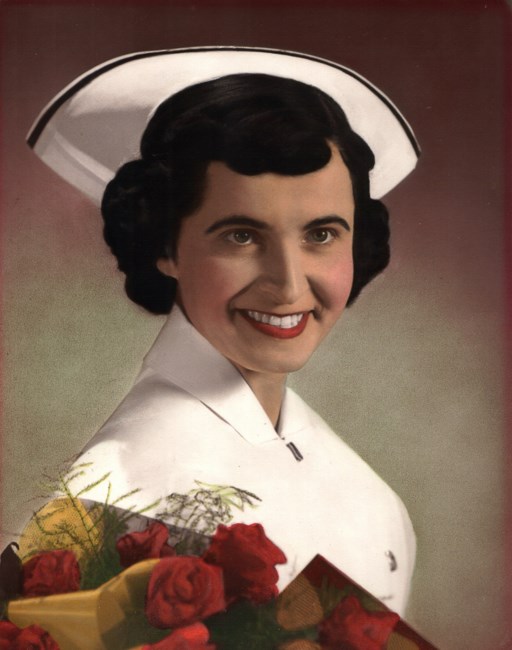
Marie Davis passed away peacefully at the Bethany Care Centre in Calgary, AB on Monday, August 19, 2013 at the age of 87 years. She was born in Hamlin, AB and moved to Vernon, BC in 1943.
Marie studied practical nursing in Vancouver and then worked in a Red Cross Outpost Hospital in McBride, BC. After graduating as Registered Nurse from the Holy Cross School of Nursing in Calgary, Marie worked as a Registered Nurse at the Foothills Hospital for 31 years, most of that time in the Critical Care and Neuro wards. Marie was predeceased by her husband, William (Bill); sisters Doris and Helen and brothers Nicholas, Alex, John, and Dmytro. She is sadly missed by her sons Jeff and John (Coralie); grandsons James and Martin as well as her brothers Steve, Bill, Peter and George. Relatives and friends are invited to a Memorial Service held at FOSTER’S GARDEN CHAPEL, 3220 – 4 Street N.W., Calgary (across from Queen’s Park Cemetery) on Monday, August 26, 2013 at 10:00 a.m. with the Celebrant Bonnie Roddis officiating.
In lieu of flowers, memorial donations may be made directly to Canadian Cancer Society, 200-325 Manning Road N.E. Calgary, AB T2E 2P5 www.cancer.ab.ca. Expressions of sympathy may be forwarded to the family via the website www.fostersgardenchapel.ca.
FOSTER'S GARDEN CHAPEL
FUNERAL HOME AND CREMATORIUM
Telephone: 403-297-0888
Honoured Provider of Dignity Memorial
==============================================================
This excerpt provides remarkable insight into Maries strength of character and determination that emerged from the difficulty of her early years.
Excerpts from: "MY STORY FROM BIRTH TO TWENTY- THREE" by Marie Davis.
We went to a country school some three miles away, walking across the farms to the one road that went by the school.
I was a very small, skinny, child and my two sisters had to carry me on their backs across the worst areas. My sisters were very devoted to me.
I liked school but was a very timid child. If I had to talk in front of the class it was pure torture. I liked playing football and hockey in school but found the boys very rough in their pursuits of winning.
One event when I was thirteen was the most tragic and left indelible marks on me. My five year old little brother who was under my care a lot, died of Diphtheria. I never talk about it but feel I must mention it in a brief form here.
One thing that stays promently in my mind is the disbelief that my brother died. I thought only old people died.
As the following days and months went by, grief and sadness enclosed me.
Next year, I went to a different school in Hamlin, Quiet Nook School. The change of school took me on another road and I made new friends so for that time it felt easier to not think of that loss every day as it had been.
After about two years the family moved to the Okanagan Valley where my dad built a sawmill in the area of the Monashee Mountains, in the Cherryvill area---some distance from Vernon where our home was. It took some time to settle but over time the new school and new friends became my new focus. But I was not free from the sadness and loss of the past. I was a young person carrying a burden. I had no boyfriends but made many friends with girls.
I finished high school. As my option course I took chemistry and found it very exciting and began to wonder if I could do something with it. I still know the atomic weights and numbers of a lot of elements.
While I went to school I worked the night-shifts during the holidays in a laundry, working on two shirt pressers and on a sheet mangle, where you had to fold the sheets with another person in great speed or the hot sheets would pile up. I also worked in a cannery. We had to peel the skins of the hot tomatoes as they came on the conveyer belt and put them in the cans.
On my last summer I worked in my dad’s sawmill cooking for 12 men.
I got up at 4 a.m. to start the wood stove so it is hot enough to cook breakfast. Breakfast, lunch and supper were full meals and I also had to send sandwiches for the men who worked out on the mountainside cutting logs, for the afternoon breaks. In the autumn I was making plans to leave home and start on some career.
During that time I sold my dad’s lumber that he had brought from the mill. I knew the dimensions of the lumber and could calculate the square feet and charge according to a thousand feet of product---various sizes of boards and planks.
After a period of quandary, I made up my mind to be a nurse, but I had a struggle with that because I used to faint at the sight of blood.
When my brothers would cut their hands I would faint, but after someone else stopped the bleeding I would attend to the wound and do a good job of it. The best thing I could do was to be a nurses helper.
I enrolled in the Practical Nursing Course at the Vancouver Vocational School, which I found later was a few notches above a Nursing Assistant. The training took me to various areas in the hospitals---the Vancouver General, St. Paul’s Hospital and the T.B. Sanitarium.
When I finished the course I went to a Red Cross Outpost hospital in North-Central B.C. where I stayed for a year.
The Outpost was where I had to make decisions and manage a variety of patients. I soon found myself getting a lot of responsibilities. I would manage the night-shift alone but there was help upstairs where the other four nurses and I stayed. There I discovered teamwork . When there was an emergency, even the cook was involved---holding the flashlight over an operation in progress when the generator failed and the lights went off.
The nurses looked after the furnace during the night--shovelling coal into the furnace to keep the place warm. The nurses also did their own X-rays.
After one year was ended the Matron insisted that I go into a nursing program in some hospital or I would find myself in an Outpost for the rest of my life. That scared me. One of the nurses there suggested the Holy Cross Hospital in Calgary.
At first I was very discouraged because I had to go back and start the course from 'square one' with the other students who were fresh out of high school.
It was all repetitive to me. What I did was to study beyond the course requirements. This was what I liked and was in the medical library during the spare periods. It was difficult for me to hide my past knowledge when my tests were perfect. I said it was plain luck. I decided not to reveal anything about my past so I could be assimilated into the class. I did not want them to think that I was some kind of a Smart-Alec .
At 23 I found a place where I felt I belonged.
==============================================================================
The following notes are a small sample of the many and varied experiences Marie encountered during her long career in nursing.
They illustrate Maries versatility, humour and ever-present willingness to remain open to all that life would bring.
Excerpts from 'Nursing Notes' by Marie Davis.
1968: My first neuro assignment involved a check on an elderly man with a cranial injury. I was left to do it by myself.
I approached the sleeping man and said “Good morning”, repeating it two more times.
As there was no response so - I go for the eye check.
The pupil size was enough for me!
I immediately rushed out of the room , thinking this demanded an emergency response.
"Suzanne come quick, I think he’s dead “ I said.
Suzanne went around to the other side of the patient and checked his reactive pupil.
He immediately woke up and looked at her.
"He’s deaf and has a glass eye in his left eye socket.” she said.....
Oh so much to learn!!!!
==============================================================
1978: I saw Dr. Shafto taking a patient to the Glaucoma Lab. with an I.V. Pole. I went over to help.
In the lab he asked me to hold the patients head still while he looked in her eyes. I held her head with one hand but she turned away.
Dr. looked up and said: "Use both hands”.
“ Well it’s this I.V" I said... "I have to hang on to it”.
‘Put it on the chair” he said.
“ I can’t because her blood will run into the bag” I replied.
Then I looked at my uniform and saw a button at my neck line. What an inspirational discovery. I solved the problem by hanging the bag off the button.
Dr. Shafto looked up again, smiling and said: ”You should apply for a patent for that dress”!
==============================================================
1984: About 10:00 P.M. there was a call from Emergency that a new patient was soon to arrive .
"What kind of a case is it?” I asked.
Brigid said to me” It was a man who was shot in both sides.”
“ Where was he shot”? I asked.
She said “ He was shot in the head I guess”.
The patient arrived on a stretcher and we did a cursory exam, looking at the head carefully but not seeing any blood or dressings!
Without looking at the papers, Brigid phoned the Emergency and asked: “Who gave that report on the phone? There is nothing wrong with his head! ”
"Do you mean a patient by the name of Mr. Shot on Bothsides?"
Brigid and I broke into laughter, and noted that he was a Native Indian!
==============================================================
1992: The patient had suffered an aneurysm. He pulled one of his I.V.'s out while reaching for a cookie and said "No cookies in sight."
I later found him chewing on a plastic ornament of a bird sitting on a branch. He chewed the top of the birds head!
So..I asked if he liked it?
"It tasted like plastic” he said.
“ It’s a good thing the bird didn’t have feathers on it” I said.
“ Well if it was a duck it would be O.K. because the feathers are greasy” he replied.
I walked out of the room thinking: “ How do I classify this one?"
==============================================================
Show your support
Add a Memory
Share Obituary
Get Reminders
Services
SHARE OBITUARYSHARE
- GET REMINDERS
v.1.18.0