OBITUARY
Satadal Dasgupta
25 September, 1937 – 27 May, 2018
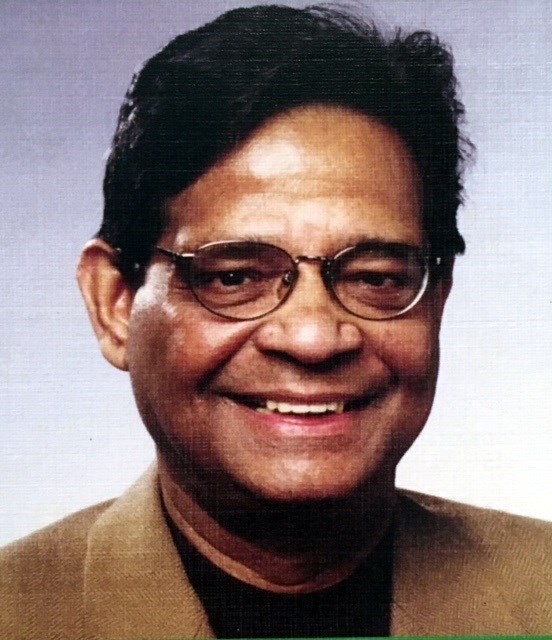
I would like to welcome you here today on behalf of my family. Today is a difficult day for everyone in this room, but we are here to honour and celebrate the life of a wonderful man, my father Satadal Dasgupta. I wanted to give you a sense of his life and what made him the exceptional, kind man whom you all know and love.
Satadal, known to his own family as Gopal, was the fifth born of 7 children. A relative had a dream that he had to be named Gopal after Lord Krishna to have an auspicious life. So that became his nickname. His proper name came some years later, on the advice of his brothers who felt that he was soft and sweet like the petals that the name Satadal represents.
Needless to say, he was a lively child with a great sense of adventure and fun, with his trusty younger brother and companion Biplab. Despite very inadequate soccer skills, they organized a neighbourhood league, with tennis balls. They acquired a bicycle to travel through the chaotic streets of Kolkata to make it to the zoological gardens. At the local library, they were chief contributors to the wall magazine, a bulletin board with poems and stories created by neighbourhood children. As part of the children’s library club, they put on plays and performances, dedicating more hours to these activities than to their schoolwork, to the displeasure of their families. My dad always talked with love and admiration about the dedicated library adult volunteers who gave their time and attention to these young neighbourhood children, not knowing that they were cultivating future writers, politicians, and professors.
Eventually, he started to crack the books. Always a poet and writer, he enrolled in Bengali studies at the University of Kolkata. But my father had a practical as well as a poetic streak and ultimately realized that Bengali studies might not be the best path to a job. Although he had already paid his tuition, he enrolled in a different program, Anthropology, at the Ballygunge Science campus. It was not that he knew what Anthrolopology was; it was just that he thought it might be a good idea. His family had even less of a notion of what this subject was, when they found out what he was doing some months later. They remained skeptical and scolding for some time. No doubt his usual charisma and charm won them over.
He had found the subject that inspired his passions and interests. From Bachelor’s degree to PhD, he was a medal-winning student. He lived with the Bagdi tribes in West Bengal and documented their social structures and ways of life. He studied agrarian reform and the diffusion of innovations. He taught at Kalyani University and worked through the rural extension department of the West Bengali government to modernize and support villagers in West Bengal.
He also fell in love with our mother Krishna. Who wouldn’t? Gorgeous, kind, capable, and adventurous in her own right, she became his life’s companion. They were childhood sweethearts. When my father was offered a coveted Fulbright fellowship in the United States to pursue postdoctoral studies, they opted to elope before his departure, aided by her older brother. They presented themselves before a judge- a woman judge, as they were fond of pointing out- and had a civil ceremony. Years later, they would meet Partha and Ratna Gangopadhayay- who had also eloped with the assistance of the same judge.
My dad found himself in the deep South, in Starkville, Mississippi. Even there, he built his community. He was soon surrounded by a diverse group of graduate students from around the world, who took turns having him edit their theses and papers. He went to Black night clubs with hippy White friends and let people touch his hair as they tried to figure out why his skin was darker though his hair was straight. He saved money with his characteristic discipline and within a year was able to purchase a ticket for our mother to join him in Mississippi. His friends from Kolkata put her on a plane and she had specific instructions not to get out of the plane until the final landing in New York. Twenty-two hours later, they were together again.
They had wonderful years in Mississippi. If dad had friends alone, the numbers swelled exponentially with the arrival of his charming wife. She discovered that she had picked up exceptional cooking skills, mostly by observation. Their small Mississippi apartment soon included a devoted cat and within two years, me, their first baby girl. Mississippi State University invited dad to continue on as an Assistant Professor but the visa requirements meant that he would have to return to India before being able to apply for the appropriate work permit. As their elopement was still fresh, they instead decided to head north to Canada, to take a position at the then new University of Prince Edward Island. They jumped into their Dodge with their four month old baby and their cat. The cat had to be given up to the neighbours within a block. They then drove from Mississippi to PEI with their newborn baby.
You may recognize the man that you knew as my father from my childhood images of him. My dad loved people, in all shapes, sizes, and colours, from all walks of life. He would flash his beautiful warm smile, he would start to chat and banter, telling stories and drawing stories out of them. He would rib and tease. He would argue and debate. He would invite them for dinner. He would pull the young people into the discussion so that old and young were part of the same experience and the same community. He would ask me to sing for his guests and enthusiastically join in. He would take me to his university office so I could see what he did. He would have me sit in on meetings with students and colleagues and help me make his instant coffee. I liked the smell of his books and papers and the look of his neat little writing.
There were parties and parties and more parties. There were pujas in Halifax and Moncton each year, with the Maritime assembly of Hindu Bengalis. As with all things Bengali, there was singing, performance, and eating, with my father in the middle of the fray, emceeing the proceedings, organizing the events, preparing stories and essays for the puja magazine. There was scholarship. My dad authored and edited 9 books and wrote many anthropological papers. He wrote the seminal book on rural Canada. He continued his cultural anthropological studies of Bengal. We would travel to India for summers and sabbatical years where we were able to see my parents’ old friends, their families, their haunts. We saw the Coffee House where he had his college discussions and debates. We saw the places by the banks of the Ganges where he and our mother had their secret meetings. He treated us to delectable street vendor food and the delicious sweets and yogurts on offer in Kolkata.
My dad was an inspiring and supportive teacher. I met his students and colleagues throughout the years, many with stories about how he had helped them make the choices that shaped their lives, how he had imparted his knowledge of anthropology not only with facts and figures but with narratives and anecdotes that became the subject of their own family dinners. My father was an avid gardener. He was constantly planting, designing, weeding, mulching, my mother joining him with a cup of tea or a summons for supper. He loved seeing things grow and develop. He loved beauty.
My dad had big dreams and expectations for his three daughters. In fact, when he was a young man he had read a novel about a man who had three daughters named Umna, Rumna, and Jhumna. He wanted three daughters and he got them. My nickname became Jhumna but my mom refused to name my sisters Umna and Rumna. He wanted us to be strong, to have successful careers, to build loving families, and to listen to him most of the time. He didn’t always get that last wish but the others worked out. He supported us in everything we did.
He was overjoyed when I entered medical school at McGill. The only drawback was that I was far away from PEI. He joined a special university committee that allowed him to travel to Montreal to see me three or four times a year, in addition to my visits home and other visits when he was accompanied by my mom and sisters. He would taste my cooking and try to improve it. He would help me organize my finances. He would replenish my wardrobe. He always trusted me to make good decisions. After a couple of unsuccessful romantic experiences, I started dating my husband Juan in my final months of medical school. My dad loved Juan from the start but when I told him that Juan wanted his chicken dopiaza recipe he said, “He looks good but let’s see how he works out first.”
The next twenty years became the years of weddings and grandchildren. Juan and I married in 1995 on PEI and had our beautiful sons Adario in 1999 and Vikram in 2001. In the years that followed, Mou married Vivek and had Nikhil, Deven, and Navin; Keya married Mark and were blessed with Kiran. My dad reveled in the wedding celebrations, proud father and grandfather that he was. He rightfully regarded these as among the great successes that he and our mother had achieved. The birth of his six grandsons brought him joy, year after year, with our family reunions at our parents’ Braemore home on PEI where we delighted in dad’s garden, mom’s cooking, and shared stories, songs, and love. Another generation of children tasted the joy of the love that my dad and mom always have on offer.
In 2014, the normality that we all took for granted came to an abrupt halt. My dad was admitted to hospital with a severe pneumonia and was intubated for 5 weeks. These were dark days and we were very frightened. We were fortunate then though, because thanks to his years of regular exercise and my mom’s excellent but healthy cooking, he had the reserve to make it back to us. It was a large hit to his health though and as many of you know, he had to slow down a good deal and the man who was always the life of the party had to take a quieter role. And yet, his sheer spirit, wit, and loving nature continued to make him a central figure in all his circles, old and new. In 2016 when he required heart surgery, we insisted that he fully retire and move to one of the cities where one of his daughters lived. He and my mother moved to Halifax, near Mou and also near many wonderful old friends who are here today. Within a year and a half they had not only their community of Bengali friends but also their apartment building community. They were seeing three of their grandchildren almost daily. They spent last summer with me and my family in Montreal where we had celebrations and adventures as we always have had.
We were set to do it again this summer. We were to have a Montreal adventure and then some time in Halifax together with a real family reunion. Dad was looking forward to this. But it was not to be. Instead throughout April and May we went through a living hell, with bleeding into his lungs, a new diagnosis of a rare autoimmune condition, toxic therapies that he needed but were too tough for his body, prolonged intubation. This time my darling dad, a fighter, a man of great spirit, could not make it.
Even in the end, he looked after us. To my sister Mou, he mouthed ‘your Mom’ for reassurances that our mother would be looked after. As he was dying and coming in and out of consciousness, he hung on long enough for Keya and me to return to his bedside. As each of us uttered “Hi Dad” he opened his eyes, looked into ours, and gave us each a smile. When I reminded him again that his oldest grandson had been accepted into medical school at McGill University, he smiled with an even wider smile. He then drifted away from us and for two days we remained by his bedside. In a final quiet moment, with us gathered around him, he took his final breaths.
What is there left to say? For now, it feels like that there are only tears to shed. But my dad would not like that. So we will remember and live the lessons that he taught by example as well as words. He taught us that there is joy in life and that it stems from being together, supporting one another, and letting love flow between us. It comes from working hard with as much enthusiasm as duty, from standing up for your convictions, and taking pleasure in reflection, communication, interaction, and action. It comes from compassion and empathy and forgiveness. I will carry these lessons and his memory in my heart today and everyday.
*************
Delivered by Juan Carlos Chirgwin, son-in-law
How does one speak to the one that is no longer here? I think that it makes sense to speak directly to you, Professor Satadal Dasgupta, because I feel that you are not gone.
So that is precisely what I am going to do. Hi, Bapu. It’s me---Jamai. I always found it so cool that in Bengali different names or titles are given to persons to explain where they fit into the family group. Jamai, Mesho, Mashi, Mesda, Didi and so many other names I do not know. You became Bapu for me after I was told by you know who, “You will call me Ma!” So it made sense that you should be Bapu. Both you and Ma plunged me into this world of late-night food, pujas, books and always the parties. With you there was always something new to learn about South Asian culture. And, of course, you were the anthropology professor, so you were the perfect person to learn from.
First, I want to apologize that I did not make it to your bedside when you were in hospital, but I guess that those were not good moments for you. Because we did not exchange looks or try to communicate one last time, it makes me feel even more strongly that you are present, listening to me now. So while I have you here, let me first tell you that I have one complaint to make to you: Why…why didn’t you write all your stories down? Your bookshelf had all those prize-winning South Asian authors, and you read all those novels. Why didn’t YOU write YOURS down? I told you to start writing short stories, but you never found the time.
So I just have to think of your stories that you told us at the dinner table. Remember when you decided to travel India by train with your friends? I think you took your little brother, too. You wanted to see the country, but, of course, you had no money so you smuggled yourself into the wagons. Then at one train station I imagine the billows of steam from where the ticket inspector tried to grab you as you all ran, only to be caught by another inspector. Then you had to talk yourself out of that one, which I am sure you did well, you were always the talker! How about when you were now grown up and doing your anthropology field work. You had crossed the river and the boat man had warned you to be back before dark because there were tigers in the jungle. But you stayed too long in the village and as you rushed back to the riverside at dusk, you could hear the boat man shouting your name. I don’t know what he would have called you, but I would have cried “Bapu! Bapu! Come back!”
But you are not coming back to this world, and the ferry-man has taken you to another side. Now just these stories remain and the little details of what you spoke. Some are random, like the joke about the Bengali man who is boasting about his new car. The guy asks him, what kind of car is it, and the owner says “Bolbo”. The guy says, OK, so what kind of car is it? Bolbo. The guy gets angry, “Are you finally going to tell me the make of car!” “I am telling you, it’s a Volvo.” I don’t speak Bengali, but if it is at all like Spanish, the “b” and the “v” sound are similar, and also “Bolbo” means “I will tell you.” Just like you Bapu---leave me with a laugh. You also wanted me to try some Bengali phrases on the Bengali speakers I sometimes have as patients in my clinic, but I didn’t dare. “When you listen to their hearts with your stethoscope, say SHA-BANASH!”, which is something like “Oh, my God! That’s all messed up!” That’s another complaint I have for you. I wanted so badly to take you to the corner Tim Horton’s near my Montreal clinic to just sit and chat it up with the locals, who would be from India, Pakistan, Bangladesh and Sri Lanka. And you had your fun, walking into Bangladeshi groceries and announcing Salaam Malaykum! The customers would all look up beaming and ask you if you were from Dhaka, to which you would reply “No, from Kolkata”, making their faces fall. And when Kaberi, and I still lived in northwestern Quebec in the town of Amos, we had warned you that no one spoke English. But you visited us after Adario was born, and when we returned from work you told us how you and Ma had been speaking English all day long to people you met on the street. You literally pulled the English out of the French Canadians’ mouths! Then Keya and Mou joined us in Amos, and we were walking down the single main strip of the town---the Rue Principale. Everyone stopped and stared as the non-white people walked by and the beer drinkers held their drinks half way up until you shouted out “Hello!” to them and they waved and said “Hello!”
All these stories, all those moments are all messed up in my head right now, and they are full of you. There is no punch line to my conversation with you, Bapu, because only you could make it funny. I’ll only say thank you for everything and that one of the best Indian novels was almost written but is now left as an oral tradition in our family. Thank you, Bapu, and I’ll see you around.
************
Celebrating the Life of My Father
Keya Dasgupta
Over the last few days we have been sharing memories about my dad to help us deal with our loss. My father was an accomplished academic and active contributor to his Charlottetown and Halifax communities but what has surfaced for me are memories about who he was as a father. My sisters and I each had unique relationships with our father. As the “baby” of the family, I have been cut some slack over the years. To give you a sense of things, my ability to regularly fly from Toronto to Ottawa by myself has been touted as a great accomplishment by my parents. Where I fell in the birth order meant that I had a more lighthearted relationship with my dad.
I want to share a few stories about who my father was for me.
My father had a great sense of humour. It would be a rare conversation between us that didn’t include laughter. My father found the humour in everyday situations and did not take himself too seriously. When I was a teenager, Mou and I joined my parents for a summer in Kolkata. One day my father suggested that he and I venture to the Air Conditioned Market for a reprieve from the heat and humidity. Upon arriving at the market we were approached by a cooly who was intent on carrying our purchases. Our explanation that we were merely there to window shop and enjoy the air conditioning was met with skepticism. When we noticed that he was following us from shop to shop, instead of becoming irritated and angry we embraced the ridiculousness of the situation - and so began an elaborate cat and mouse game between us and the cooly. We spent the rest of our time at the market hiding behind clothing racks, weaving from one end of the complex to the other, and finally, running to the back of a shop where he followed and then charging out of the market once and for all, laughing into the street.
As a child, my father also knew the irritation I felt during school roll calls when the teachers would inevitably pause before butchering the pronunciation of my name. To comfort me, he told me about how in his classroom, Anglo names were mispronounced. How students would look up in confusion when he inquired about whether Ch-er-eel (Cheryl) or John-aaaah-than (Johnathan) was present.
Throughout my school years, my father was both a mentor and advisor to me. In grade 5, he stepped away from a party he was hosting with my mother to help me with a science project. While I finished writing the report, he sketched the human digestive system for me, ensuring it was good but not so good that it would not pass as a grade schooler’s effort. This support continued into my university years where my poli sci professor correctly noted the “unfair advantage” I had with unfettered access to my father’s mind. My dad was an insightful editor to all of my papers, encouraging clear and simple writing and helping to deepen my understanding of the concepts and ideas raised in my courses.
Most importantly, my father was an observant parent and a great listener. Around him a subtle shift in facial expression or tone of voice would not go unnoticed. As a teenager it was never an option to hide myself away in my bedroom because of a poor mark or bad mood. There would be the inevitable knock on my door with my father checking in about why I was upset and sharing his experiences at a similar age to help me find a way forward. Just talking about what was bothering me and being heard would often make it better. As a six year old, he found me moping around the house one Sunday because I was depressed about the school week to come. He suggested we go for an evening drive which we proceeded to do. We drove along the waterfront, stopping to admire beautiful landscaping and historic properties. We also talked about his work life, my school life and my ideas for my future. This became a frequent ritual which made Sundays more bearable.
My father was one of two people with whom I relished sharing good news – my parent’s collective delight at my accomplishments is like no other. He was also one of the first people I would reach out to in tough times; a reliable confidante and cheerleader whose support helped me through to the other side of life’s challenges. These are some of the memories I will hold close as I enter a period where I can no longer pick up the phone to get his insight, hear his beautiful laugh and feel the comfort of his listening ear.
***********
Dear Dad,
Here we are celebrating your life. I wish that it was under happier circumstances. Maybe at that huge 80th Birthday Party you had hoped we would plan. Believe me, I’m sorry that we didn’t do that for you. I want to take this opportunity to tell you how much I admire you. I admire the way you lived your life passionately, and with little to no regrets. First, there was your passion for your career - almost 50 years as a Social Anthropologist at the University of Prince Edward Island. An Institution that stated in a communication 3 days ago, “the depth and the enduring impact of Dr. Satadal Dasgupta’s career at the University of Prince Edward Island are difficult to match.”
Then, there was your passion for your Community. Actually for creating that Community with your intelligence, charisma, infectious sense of humour, and zest for life. Always the “life of the party.”
And we can’t forget your passion for your garden. How you managed to realize your dream of a backyard garden oasis with painstaking planning, planting, and lots of love.
Finally, there was your passion for your family. Your unwavering love for Mom. You fought long and hard to stay with her until the very end. Your unconditional love for your daughters. I can still hear you saying, “As long as I’m alive, I will take care of you.” I can still feel your many hugs, your many kisses. I can still hear your many ‘I love you’s.
Dad, I also wanted to tell you all the things I learned from you.
You taught me to be a strong, independent woman. I can still hear you saying, “Always be able to provide for yourself.” You were so confident that your daughters could do anything, be anything. You made us believe that we were capable of doing anything, becoming anything (preferably doctors, but a lawyer and a dentist were okay too).
You taught me love and compassion. How many Dads tell their children everyday, everyday, how much they love them. How many Dads are able to hug, kiss and tell their daughter, he loves her despite of, or in spite of the tube down his throat, and the tubes in his arms. How many Dads listen to phone call after phone call from their daughter telling him how much she hates doing her Masters in chemistry. How miserable she is, how she wants to quit, how all she wants to do is come home. I can still hear you saying, “Just finish it. If you quit you will regret it. Just finish it, and then come home for as long as you want.”
And finally you taught me to stand up for myself, for my beliefs, but with integrity and humility.
Dad, I want to end this letter with a few promises to you. I promise, to be strong, and to find a way to accept this great loss. I am forever changed, this wound will never fully heal, but I owe it to you to find a way forward. I promise to live life to its fullest and with no regrets. Simple words, seemingly simple goals. But how many of us actually do this like you did. I’m going to start by signing myself up for a driving refresher course next week.
And finally I promise to take care of Mom. The last thing you communicated to me, the very last thing was “Mom, mom, what about mom.” I promise Dad I will take care of her, we will take care of her. Dad, it’s been an honour and a privilege to have you as a Father. Go in peace. Leave with no worries, no regrets. We, your family, your friends, your legacy will take care of the rest. Someday, we will meet again. You will be waiting with arms open wide, a beautiful smile on your face.
I love you Dad. I will miss you.
Mou
***********
Adario Chirgwin-Dasgupta and Vikram Chirgwin-Dasgupta, two oldest grandsons
Vikram: The sound of the dishes and the smell of our Dida’s food slowly enters the living room. Our Dadu sits on the family room sofa, watching all fifty of his favorite news channels. His tea is set on a coaster on the corner table. Slowly, he dozes off to the murmur of the news anchor’s broadcast.
Adario: Charlottetown was our “summer home,” as Dida liked to put it. The PEI sun would greet us as we rolled over the Confederation bridge. Soon we would arrive at this small paradise at 8 Braemore Avenue, full of the flower garden’s colours, the aromas of cooking, the trickle of the creek in the sloping backyard… and our grandparents’ hugs and smiles.
Vikram: I remember how my Dadu used to let me sit on his lap in the early mornings of our vacations at PEI. I still associate him with the smell of fresh coffee and tea biscuits. He used to read the newspaper every morning and would separate each page until it covered half of the dining room table. My Dadu used to call me chubbu chubbu because of my big baby cheeks. He was a constant source of adventure for me, even when I was that young. I remember how he used to show me their bird Sheta and let me pet her. It fascinated me how he was even able to make a bird love him so much. The first time I saw him take out his dentures, I was shocked to see that my Dadu was missing some teeth. It was like a magic trick. I would tell him “Dadu, you have no teeth!” and he would respond “No look, I still have three.”
Adario: Apart from seeing my grandparents, I came to PEI for the two things PEI does best: beaches and lobster dinner. I don’t know how much Dadu enjoyed being forced to accompany his grandchildren to Cavendish or Brackley beach to sizzle in the seaside sun. But once a summer, my Dida would let him run the kitchen, and then he would prepare a delicious lobster curry. That was always a special evening dinner, and even compared to his Master Chef wife, he was an incredible cook. My Dadu was clearly a man of many talents. As a child, I was incredulous that he was the author of actual books. He was a gardener, one who didn’t settle for the enormous flower lots in the front yard, but instead had immense terraces built out back, on the steep hill, to cultivate all manner of tomatoes and beans. He was a brilliant academic. He was a fierce bargainer.
Vikram: He was a storyteller, whose adventures in India became our childhood legends. He told us once about the time he was writing an anthropology paper in an isolated village, late in the evening. The sun was setting, and he was about to miss the last ferry that would bring him back to the city. As he stepped outside he heard the sounds of tigers from the forests. He realized then that he was in danger. At that moment, the ferryman suddenly appeared, put him on his back, and ran with him to the boat, to safety. That is one of his countless stories that we will never forget.
Adario: Those are the memories from our childhoods, but he does not only have two grandchildren anymore. All six of us have been lucky enough to have known our Dadu. No matter if he is above, around, or within us, his charisma, his dedication to his work, and most importantly his love for his family, friends, and community will forever stay with us and influence what type of young men we will all one day grow up to be.
* * * * * * * * * *
On the 27th of May 2018, Satadal Dasgupta, beloved husband of Krishna and father of Kaberi (Juan Carlos), Mohua (Vivek) and Keya (Mark), passed away. Born in Kolkata, India, Prince Edward Island was his chosen home where he built a life as a devoted professor, passionate researcher, avid gardener and loving family man. Satadal was one of the early professors of the University of Prince Edward Island, joining the Department of Sociology and Anthropology in 1969. During his professorial career, spanning almost 50 years, Satadal contributed immensely to the shaping of his much loved institution. He did this through enthusiastically teaching and mentoring thousands of students, serving as his Department’s indefatigable chair, recruiting faculty, constructing programs, and providing excellent scholarship. His prolific research led to several publications, including 9 books in the field of social anthropology. Satadal treasured his years on the Island. In addition to his academic pursuits, he was actively involved in his Island community as a founding member of the Indo-Canadian Association, chair of the PEI Museum and Heritage Foundation and having an impeccable record of attendance at the Saturday morning Farmer’s Market.
He will be remembered for his ready smile, listening ear, and words of encouragement for friends and family. His kindness, enthusiasm, intelligence and wit will live on through his grandsons Adario, Vikram, Nikhil, Deven, Navin and Kiran.
His life will be celebrated on Saturday, June 2 at 2 p.m. at JA Snow Funeral Home (339 Lacewood Drive, Halifax). A second memorial will be organized in Charlottetown in July.
Show your support
Add a Memory
Share Obituary
Get Reminders
Services
SHARE OBITUARYSHARE
- GET REMINDERS
v.1.18.0