
OBITUARY
John J. Sopka
27 December, 1919 – 20 January, 2014
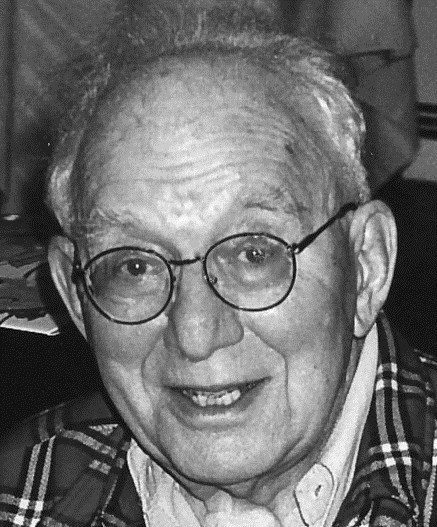
Born and raised in Elizabeth, NJ, Prof. Sopka was the only child of an immigrant couple from Vukovar, Croatia, who had met and married in Elizabeth. His father, John J. Sopka, Sr. worked as a machinist for the Singer Sewing Machine Co. His mother, Mary (Polchert) Sopka suffered repeated extended hospitalizations beginning while John was in grammar school and was largely raised by his maternal grandmother.
Pushed by his father to work hard for a better life, John excelled academically and graduated at the top of his class from Thomas Jefferson High School in 1938 where the faculty urged his application to Harvard. John was awarded a full scholarship to Harvard and subsequently graduated in 1942 with a distinguished degree in Physics, was inducted into the Phi Beta Kappa Society and was admitted to Harvard Graduate School of Arts and Sciences as a Ph. D. candidate in Physics with an award of the prestigious Parker Fellowship.
While an undergraduate, John met Katherine J. Russell, a physics student at Radcliffe College when she had been invited to join an upper-level physics class at Harvard by Prof. John H. Van Vleck who remained a life-long friend following their marriage in 1943.
Continued academic progress was interrupted by World War II, ultimately resulting in the couple’s move to Dayton, Ohio, to work on a crucial but little known part of the Manhattan Project, sited in the top-secret installation at the Bonebrake Theological Seminary. Katherine was precluded from this work, finding herself pregnant with their first child John R. Sopka, now of Groton, MA. The work of the Bonebrake installation was the production of sufficient polonium which, when combined with beryllium, was the neutron source to ignite the plutonium implosion bomb that was dropped on Nagasaki, Japan, on August 9, 1945.
In September, 1945, they returned to Cambridge, MA to complete their graduate degrees at Harvard. Despite the birth of their other two children, Robert J. Sopka, of Catonsville, MD, and Elisabeth M. Sopka, formerly of Marblehead and now of Boston, MA, Katherine completed a Masters degree in Physics while John, having changed his academic area to Mathematics, received his Ph.D. in 1950.
From Cambridge, they moved to Silver Spring, MD, and John joined the Johns Hopkins University Applied Physics Laboratory as a research mathematician. Through friends at the APL he was introduced to rock climbing, soon developing a life-long interest in technical mountain climbing. In addition to summiting numerous peaks in the US and Canadian Rocky Mountains over the next four decades, he also scaled the Matterhorn and other peaks in the European Alps.
In 1954, IBM recruited John to join them in New York City to staff and lead a group of mathematicians to apply operations research techniques to solve previously intractable large business scheduling problems. The family moved to his hometown of Elizabeth, NJ, from which he commuted by train to Manhattan. Based on his success at IBM, he was inviteded to become the Director of Computing for the National Bureau of Standards Laboratory in Boulder, CO, on the front range of the Rocky Mountains. He no longer had to drive thousands of miles annually with his family for the camping and climbing vacations he loved. He then also became an avid skier in the winter. At the Bureau, he championed the switch from the use of business-oriented computers to the more scientifically oriented computers from Control Data Corporation and Seymour Cray, the forerunners of today's highest performance supercomputers.
Once his children’s college educations had been secured, he felt free to pursue the career he really would have preferred as a professor of mathematics, first at the University of Texas in Arlington, TX, and later at Boston College. With his belief in life-long learning, he both engaged in it and strived to pass it along to his children and the students he taught and mentored. His wife Katherine eventually completed work on her own PhD in the History of Science at Harvard while they lived in Framingham, MA, researching the history of quantum physics in the United States from 1920-1935, publishing it and additional works with the American Institute of Physics. In 1980, they both accepted positions at Fort Lewis College in Durango, CO, where they retired and remained in for almost twenty years until declines in their health precipitated their move back to their academic beginnings in the greater Boston area. They settled in Marblehead, MA, in order to be near their daughter, Beth. Her continued care & support enabled them to remain living in their own home until their deaths.
Throughout life, John enjoyed his participation in physical exercise as well as intellectual pursuits. As a child growing up in the Depression era environment of Elizabeth, NJ, he was attracted to the ideals and programs of the Turnverein gymnastics organization. In high school and college, he regularly participated on cross country and track teams, lettering in both sports throughout. Having developed an early enjoyment of tennis with a boyhood friend in Elizabeth, he continued to play regularly until age 78
Katherine died in 2009 from the effects of a massive stroke. John succumbed more gradually to the effects of adult-onset hydrocephalus. They are survived by their three children and four grandchildren, Andrea Shear of New York, Margaret Shear of New York, Edward (Ted) Shear of David, CA, and Christopher Sopka of Groton, MA.
A memorial ceremony will be held at 2:00 pm, Saturday, February 1, 2014, at The Boston Yacht Club, 1 Front Street, Marblehead, MA. In lieu of flowers, the family requests in memoriam donations be made to the Katherine & John Sopka Memorial Fund for Women in Physics, care of the National Grand Bank, 91 Pleasant Street, Marblehead, MA 01945. The American Institute of Physics will be administering the selection of beneficiaries of this fund.
Show your support
Add a Memory
Share Obituary
Get Reminders
Services
SHARE OBITUARYSHARE
- GET REMINDERS
v.1.18.0