OBITUARY
A. Bartlett Hague Jr.
1 October, 1927 – 23 December, 2023
“I never before knew the full value of trees. Under them I breakfast, dine, write, read, and
receive my company.” –Thomas Jefferson
Bart Hague was a lifelong leader in conservation and environmental protection. His life,
relationships, career, retirement, and community work were driven by his dogged dedication to
these causes. He was known to say, “I am not stubborn. I am determined.” One of his
long-time collaborators remarked, “Anyone who has ever argued against Bart regarding an
environmental issue will understand the use of the adjective dogged.”
He resolved to be active late in life and continued to “run” in Waterford, Maine’s annual fall
foliage race until he was 95, to the delight and exasperation of his fellow townspeople as they
expressed concern for his safety. A major snow storm in his 95th year did not deter him from
showing up at the town’s annual meeting to vote on an important clause related to Waterford’s
shoreland zoning ordinance. Until September 2023, his wife, Mary Ann, continued to drive him
almost every weekend to walk with his Rolator around beauty spots near the White Mountains
and behold the peaks he had summited for almost a century. To the last, he told his caregivers
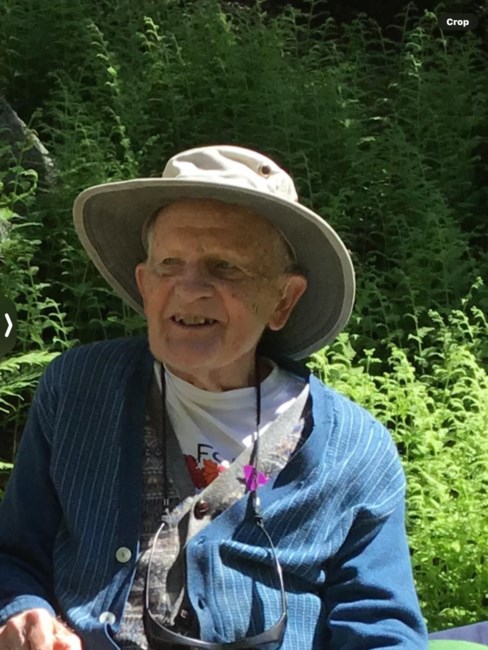
he was a “lifelong hiker.” In his final years, he often sat under a majestic maple tree that had
grown up with him, as he looked out over his favored Mahoosuc Range – especially Goose Eye
and Old Speck Mountains – from his home at the crest of McWain Hill in Waterford, Maine, while
participating fully in the family’s activities.
The seed for Bart’s interest in the environmental field was planted when he visited his Aunt Mary
on McWain Hill in Waterford as a boy in the 1930s. The Maine landscape inspired him; he also
witnessed environmental degradation for the first time when his favorite pine grove was
clear-cut. His strongly held belief that society should protect this and other landscapes fully
formed during his undergraduate and graduate years and guided his career in environmental
protection and his membership in a burgeoning movement.
His public service career in the environmental field spanned over four decades and included
over twenty years as a charter employee in the Environmental Protection Agency (EPA), where
he was a water quality planner on teams to clean up Virginia’s Potomac River, Boston Harbor,
and Maine’s Androscoggin River. He helped plan the National Trails System with the National
Parks Service under Interior Secretary Stewart Udall’s staff. Mitigating environmental impacts of
the highway system focused much of his early career, including during the design of President
Eisenhower’s interstate highway system under special assistant Major General John S. Bragdon
(1955-1961). Although Bart began his career in Washington, DC, in 1967 he moved to the
EPA’s New England office to be closer to his beloved family home in Waterford, which his aunt
had bequeathed to him when he was 16. Always serving in the communities in which he lived,
he was President of the Newton Conservators in Massachusetts while at EPA. After he retired
from EPA in 1996, he dedicated his ensuing decades in retirement to working on environmental
issues in Maine.
Bart believed that environmental and conservation organizations needed to pool their resources
and work together, and he was named President Emeritus of Maine Lakes, having worked with
others to unify several lakes associations. He similarly proposed a regional conservation effort
around the Crooked River and Sebago Lake watershed that would, over a decade later,
manifest as the robust collaborative, Sebago Clean Waters. He was an early voice advocating
for regional collaboration amongst western Maine and eastern New Hampshire area
conservation organizations. He believed that Maine’s greatest future challenges were related to
land use and frequently advocated for sustainable development to maintain the character of
Maine’s rural landscapes, protect large expanses of wilderness, and prevent environmental
degradation.
Bart belonged to a generation of post-Teddy Roosevelt environmentalists who were keenly
aware of the limits of our country’s national resources and believed that this natural beauty was
a legacy that should be protected for posterity. His basic philosophy and approach to
conservation was informed by his honors thesis at Yale, which he wrote on Gifford Pinchot,
Teddy Roosevelt, and the early years of the Conservation Movement. He admired Gifford
Pinchot for his role in expanding the US Forest Service and founding the Yale School of
Forestry; writers such as John McPhee and Peter Matthiessen; his former National Park Service
colleague and writer John Kauffmann, especially his book Flow East; and Secretary of the
Interior Stewart Udall, under whom he served. Like the conservationists who influenced him,
Bart did not oppose development but wanted to ensure that it was sustainable and did not occur
at the expense of the public’s access to their natural environment.
Bart involved himself in mitigation and prevention at the community as well as federal level.
These efforts included several effective campaigns that prevented developments in western
Maine from overwhelming natural resources on McWain Pond and on several spots along the
Crooked River, a Class AAA river that feeds Lake Sebago. He highlighted the need to protect
Portland’s Lake Sebago water supply. He provided data to citizen activists trying to prevent
development at Edes Falls on Crooked River and took on Central Maine Power’s plans for an
expanded new pipeline, reversing and modifying an EPA approval to encourage the project to
run along existing corridors and mitigate its potential effects on the Crooked River. Over the
course of his career, he played an important, and collaborative, role at the federal, state, and
local levels in reducing paper mill pollution into the Androscoggin River.
Bart earned many accolades for his environmental work from organizations he had collaborated
with, and while he valued recognition, the sense of camaraderie he felt with the people he
worked with, and the feeling of being part of a movement, was important to him. He was
nominated for an EPA lifetime service award for his work protecting waters in New England and
across the Nation. He spent decades as a volunteer protecting Maine’s lakes and rivers and
conserving scenic lands and forests in western Maine and was amongst a group of
environmentalists awarded with a Natural Resources Council of Maine (NRCM) Clean Water
Heros award (2022) on the 50th anniversary of the Water Quality Act for his efforts to uphold
water quality. He also was awarded conservator of the year by Maine’s Oxford County Soil and
Water Conservation District (2012); was recognized by the American Forest Foundation’s
Center for Conservation Solutions (2009) for his outstanding efforts to conserve and restore
water quality and wildlife while practicing sustainable forestry; and was awarded an Outstanding
Lake Stewardship Award (2006) for his work as a volunteer for Maine’s lake monitoring
program. Bart was declared environmental activist of the year in 1999 by the Natural
Resources Council of Maine in recognition of his years of dedication and commitment to
protection of Maine’s watersheds as both a public servant and citizen advocate, including
protection of the Crooked River, clean up of the Androscoggin River, and advocating for
protections for other rivers from destruction by power corridors.
Bart was particularly proud of his work in Waterford, including his work on two Waterford
conservation planning and implementation committees. Bart served on the board of the Western
Foothills Land Trust for 8 years. Bart and Mary Ann placed 475 acres under conservation
easement, including on McWain Hill, the former Camp Waganaki and a cove on McWain Pond,
and at least a mile on both banks of the Crooked River, to protect the viewscape, landlocked
salmon habitat, and water quality.
Bart earned a BA from Yale University and an MS in Conservation from the Michigan School of
Natural Resources and an MA in Social Science from the University of Michigan. He was the
son of Arthur Bartlett Hague, Sr, a piano professor at the Yale School of Music and concert
pianist, and Marjory Abbott Hague, a watercolorist of landscapes, and they passed to their son
an appreciation of classical music and nature painting. He was most at peace hiking in the
White Mountains, swimming in McWain Pond, practicing sustainable forestry and organic
gardening at home, and canoeing Maine’s lakes and rivers. He witnessed the Androscoggin
River’s transformation from sludge to clear water in his paddles down river.
Bart is survived by his wife and intellectual partner of 61 years, Mary Ann Conner Hague (nee
Whitehead) and three children: his son Art Hague and daughter-in-law Shivaun Pryor; daughter
Beth Hague and son-in-law Libo Liu; and daughter Mary Hague Yearl; and by three
grandchildren: Joe Yearl, Athena Yearl, and Nathaniel Liu.
No public service is planned. In lieu of flowers, Bart and his family request donations be made to the Natural Resources Council of Maine, Maine Lakes, or the American Friends Service Committee.
Show your support
Add a Memory
Share Obituary
Get Reminders
Services
SHARE OBITUARYSHARE
- GET REMINDERS
v.1.18.0