
OBITUARY
Reverend Robert Bob Clarke Brock
16 August, 1931 – 20 June, 2011
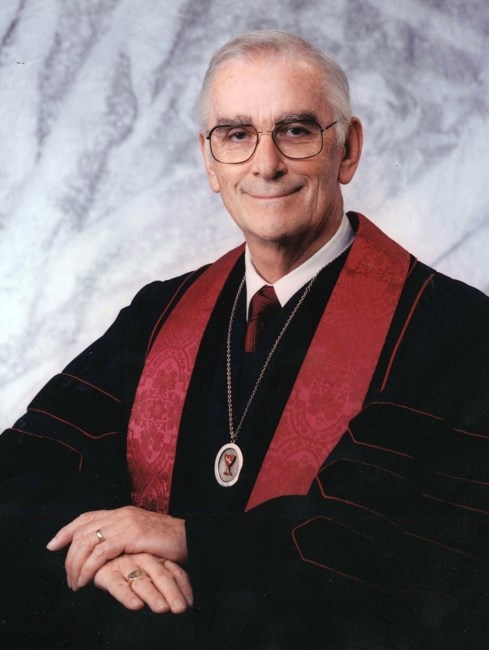
August 16, 1931 - June 20, 2011
Bob Brock, retired Regional Minister for the Northwest Regional Christian Church (Disciples of Christ) died under the loving care of his family and staff at Providence Mt. St. Vincent in West Seattle.
He was the son of Edgar and Echo Brock of Salem, Oregon and married for 60 years to his loving and devoted wife, Berlena Dougherty of Baker, Oregon. He’s survived by four children, Beverly (Paul) Fletcher, Stephen Brock, Thomas (Maryse) Brock, Timothy (Cecilia) Brock, and six grandchildren: Brian and Katy Anderson, Parker Brock, Hannah Madans, and Angelique and Aaron Brock. A sister, Florence Wolfe, resides in Sun City, California.
Bob served churches in Oregon, Idaho, Indiana and Ohio before being called to First Christian Church on Broadway in Seattle in 1972. Beginning in 1979, he served 17 years as Regional Minister to Disciple churches in Washington, Northern Idaho and Alaska until his retirement in 1996. In addition, Bob was active in the ecumenical movement and a witness for peace and social justice throughout his ministry.
Family members held a private graveside service at Forest Lawn in West Seattle on June 28, 2011. A public memorial celebrating Bob’s life will take place August 20, 2011 at 12 noon at All Pilgrims Christian Church, 500 Broadway E., Seattle, with a reception following. Remembrances may be made to the Robert Brock Scholarship Fund at Northwest Christian University, 828 E. 11th Ave., Eugene, Oregon 97401 or to All Pilgrims Christian Church, 509 10th Ave. E., Seattle, Washington 98102 in memory of Robert Brock.
Please sign the family’s guestbook at www.forestlawn-seattle.com
A detailed account of Bob's life follows:
Salem
Robert Clarke Brock first greeted the world on August 16, 1931 in the back bedroom of his mother and father’s home at 845 Gaines Street in Salem, Oregon. The Brock family home was a simple, two-bedroom house with a large front porch on a quiet street not far from the State Capitol building. In fact, one of Bob’s earliest memories was watching the fiery collapse of the Capitol dome when the State Capitol was destroyed by fire in 1935.
Bob’s mother, Echo, was the oldest of seven sisters. As the first boy in a long line of girls, Bob’s arrival was heralded with much fanfare and toasted with home-made root beer by his Grandmother and Grandfather Kruger, his many aunts, his sister Florence, and other family members. All agreed the newborn Bob was utterly adorable, so a decision was reached to enter him into a baby contest sponsored by a local photography studio. Much to everyone’s surprise, Baby Bobby won first prize. Bob’s Aunt Doris, who was ten years old at the time, would later recall: “We never thought he would win, but he showed us that he was the cutest and healthiest baby that year in the city of Salem, Oregon. We all walked around Salem for quite some time, holding our chests with great pride.”
Bob’s father, Edgar, was a gifted woodworker and furniture restorer who ran his own furniture refinishing business for many years. He also worked as a painter in the naval shipyards in Portland during World War II. In addition to maintaining the household, Echo worked outside the home as a practical nurse, caring for the sick and elderly. Generous and engaging by nature, she was sometimes known to bring hungry strangers home after work to share the family’s simple supper. Both Edgar and Echo were deeply committed Christians active in the Court Street Christian Church, a community of faith that would play a huge role in Bob’s formative and early adult years.
Like many children of the Depression, both Florence and Bob were expected to be largely self-reliant while mother and father worked. Climbing the cherry tree in the front yard, playing on the playground of Grant Elementary School at the end of the block, and walking to grandmother’s house all were favorite childhood pastimes. Because big sister Florence was 18 months older, she was often placed “in charge” of her younger brother – although, naturally, that was not always the way Bob remembered it. In later years, he liked to claim that Florence was always the one getting HIM in trouble. However, it’s difficult to see how Florence could be blamed for Bob’s most memorable childhood injury: the time he threw the lard pail he used to pick cherries high into the air, only to have it strike his head with a horrifying clang on its way back to earth, leaving a bloody gash. It’s anyone’s guess who was “in charge” in the immediate aftermath of the injury, as both Bob and Florence ran to Grandma Kruger’s house for sympathy and first aid.
Both Bob and Florence enjoyed spending time at the Krugers’, which often served as a home away from home for the growing siblings. Bob fondly remembered playing there and being doted upon by aunts who were close enough in age to feel more like sisters than anything else. He developed a lifelong love of mashed potatoes and gravy at large family dinners at Grandma Kruger’s table, surrounded by adoring aunts and, eventually, uncles and cousins, too. In summers, the family would take wonderful day trips to the Oregon coast and other excursions mixing Krugers, Brocks and their extended family of friends from Court Street Church.
Like most boys his age, Bob liked riding bikes, shooting marbles, and playing baseball, basketball, and other outdoor games. On rainy days, Bob, Florence and friends might settle in for a round of Monopoly, Pit or Carrom, or work on a jigsaw puzzle together. Favorite boyhood stories included Hardy Boys mysteries, Treasure Island, and Huckleberry Finn. Bob’s lifelong passion for photography also began in childhood, as he learned to develop the photos he snapped in a dark room he’d built himself. Bob also maintained and grew a large paper route, delivering papers each day and selling subscriptions door to door. In addition, he played baritone in the school band, basketball on his church team, and was very active in scouting, earning many merit badges and climbing Mt. Rainer, Mt. Adams, and other Northwest peaks.
Tragically, in 1946, Bob and Florence’s lives changed forever when their mother Echo died unexpectedly after a brief illness. Looking back many years later, Bob would acknowledge that the shock and grief of the sudden loss had left its mark, as he reflected on the resolution he’d made as a youth of 14 to “always be prepared for the worst.” Compounding the grief were difficult changes in family dynamics. Always a quiet soul, Edgar seemed even more reserved after the loss of his outgoing wife. At the same time, newly thrust into the role of “woman of the house,” Florence’s responsibilities expanded dramatically – a change that required her to grow up quickly, and complicated her relationship with younger brother Bob. All told, it was a difficult and painful time for everyone in the family.
As his teen years progressed, Bob became more and more active in Christian youth fellowship and other church activities. Very early on, he began to feel, with increasing conviction, a call to Christian service. Attending a summer youth camp at age 14, Bob made a decision to dedicate his life to Christ – and, soon afterwards, a commitment to prepare for Christian ministry. Little did he know that, at the same time, a certain farmer’s daughter in eastern Oregon had independently arrived at the same decision and chosen a similar life path.
Baker
In the summer following Bob’s sophomore year in high school, these young, dedicated Christians would meet at a family farm outside Baker, Oregon. The farmer’s daughter in question, Berlena Dougherty, later described the fateful encounter as follows:
“One summer morning in 1947, I was preparing a banana cream pie for our hired men, who would be eating ‘dinner’ at noon before returning to help my father in the hay field. A young man by the name of Bob Brock of Salem, Oregon, who was looking for summer work, was brought out to the farm by our pastor, Frank Zook.
“As he sat in the corner of our kitchen, waiting to meet my dad, he watched me intently while I was separating the egg yolks from the egg whites. I became flustered under his gaze, and the yolks kept going into the whites.
“From this first encounter, our relationship began to develop as we worked together in the hay fields, sang hymns while I played the piano, talked over our country, party-line phones when he was working on other farms in our community, and going to the same church. We discovered we had both dedicated our lives to ‘full-time Christian service’ in youth camps the summer before – he in western Oregon and I in eastern Oregon.
“When he returned to Salem at the end of summer, we corresponded by letters quite intently until the following spring. Later, he called to see if he could return to work in the fields, which he did in the summer of 1948. When fall arrived, he decided to remain in Baker to finish his senior year, living with our new pastors, Helen and Joe Jewett.”
Bob arrived in style for his second summer as a hired hand on the Dougherty farm – behind the wheel of his beloved 1929 Model A Ford. Bob loved his first car and the mobility it provided, both between the Dougherty farm and town and, increasingly, between his two, far-flung homes: one in eastern and the other in western Oregon. Many harrowing tales are still recounted in Brock family lore about treacherous, late-night journeys on “Cabbage Hill” – the notoriously steep, hairpin-laced stretch of old highway climbing through the Blue Mountains an hour and a half west of Baker.
Fortunately for his offspring, Bob did survive to reproduce.
Having a car also made it much easier to visit the local A&W and drive-in movie theater during Bob’s senior year in Baker. Among other extracurricular activities, Bob sang with eight other Baker High School seniors in a choral group immortalized as the Nine ‘49ers. He was also active in the high school Speech Club, traveling to speech tournaments around the region to deliver extemporaneous addresses. In addition to maintaining part-time jobs at local grocery stores, Bob was deeply involved in local Youth for Christ initiatives sponsored by the Billy Graham Evangelistic Association.
Eugene
After graduating from Baker High in 1949, both Bob and Berlena decided to attend Northwest Christian College (NCC; now Northwest Christian University) in Eugene, Oregon. To prove to Berlena’s mother that her college choice had nothing to do with Bob, the high school sweethearts agreed to break up once they arrived in Eugene and solemnly pledged to begin dating others. Each went on precisely one date with a new suitor before becoming reacquainted with reality and giving the idea up for good.
In their first two years at NCC, both Bob and Berlena lived in student housing. One delicious campus tradition was to buy multiple of loaves of piping hot bread – available fresh from the oven at the bakery down the street from campus – to take back to the dorms and enjoy late at night, marinated in melting butter and jam. However, a strict 10 pm curfew was enforced for female undergraduates in student housing, making late night bread runs problematic. Fortunately, NCC’s male undergrads, who had no curfew, were sympathetic. They contrived to deliver hot bread to the fairer sex on upper floors of the girls’ dorms via a rope and basket – often serenading the girls for good measure.
Berlena was, naturally, powerless to resist such displays of ardor and ultimately accepted Bob’s proposal of marriage. The engagement ring was hidden in the cookie jar at the home of Bob’s sister Florence and her husband Dean Wolfe, who were also students at NCC. Berlena was delighted to find it when Bob asked her to bring him a cookie (the first of many such requests). Dean, in addition to being a brother-in-law, was a good friend of Bob’s from high school and wrote a beautiful poem for the couple’s wedding invitation.
The wedding date was strategically set for August 19, 1951 – three days after Bob’s 20th birthday – so that the bride and groom would be exactly the same age when the wedding announcement appeared in the local newspaper. Unfortunately, when the announcement was published, the paper dutifully reported that Berlena was age 20 – and Bob an old coot of 28.
Married life was wonderful – and very hard. In addition to keeping up with their studies, both Bob and Berlena worked to make ends meet. Bob scrubbed floors at night for local retail establishments, and Berlena cleaned houses during the day. On weekends, the couple traveled 100-200 miles to serve student churches in Scotts Mills and, later, Scio, leading morning and evening services each Sunday. On the way home, the young newlyweds often stopped in Salem to visit Edgar and his second wife, Jessie, feasting on spam sandwiches and hot chocolate.
To make things a bit easier, Court Street Christian Church offered Bob a scholarship to cover the cost of tuition, as well as a $500 loan to help the young couple purchase their first home. Soon Bob and Berlena were the proud owners of a lovely two-bedroom house at 421-1/2 Fourth Street in Eugene’s sister city of Springfield, Oregon – just four or five miles from the NCC campus. The monthly mortgage payment of $33 sounds like Monopoly money in today’s dollars, but at the time represented a significant proportion of the family budget. The going rate for student pastors, for example, was $10/week, and was expected to include the services of an itinerant pianist and Sunday School superintendent (Berlena), pastoral calls, attendance at church committee and board meetings, fellowship dinners, and other events, as well as the cost of gasoline and other travel expenses to and from Eugene.
Boise
Bob and Berlena graduated from NCC in 1954 – Bob with a Bachelors Degree in Theology and Berlena with a Bachelors in Christian Education. Not long afterwards, Bob was invited to serve First Christian Church of Boise, Idaho under the leadership of Senior Pastor Hartsell Cobb. Bob accepted, and he and Berlena soon said their goodbyes to friends and loved ones in Oregon and set out for Idaho. A blond cocker spaniel named Sparky, given to the couple just prior to graduation, also made the trip.
From 1954 to 1957, Bob served as Associate Pastor of Boise’s First Christian Church. Bob led the youth ministry for the congregation, helped organize and staff regional youth conferences and other events, and spearheaded an evangelism campaign that netted over 200 new members for the Boise church.
The couple spent their third anniversary on the road, traveling with four Boise youth to a conference in Nashville, Tennessee. Berlena, thinking she must have the flu, could keep nothing down but crackers. Somewhere outside Laramie, Wyoming, in the glare of the morning sun, Bob failed to notice that the truck ahead of him had stopped. Slamming into the truck at top speed unleashed a Niagara of mayonnaise jars. Broken glass and gobs of white littered the car hood and road. But there were no other injuries. The Boise youth waited for what seemed like an eternity for road assistance to appear. Antelope sauntered by, indifferently. Eventually a tow truck did arrive, enabling Bob and Berlena to celebrate their anniversary at a Laramie drive-in later that night.
On April 14, 1955, Bob and Berlena’s first-born, Beverly Claudine, arrived.
Elnora
In the summer of 1957, the young family of three would undertake a 2,000 mile move away from family and friends to begin a new ministry in heart of the Midwest. In the fall, Bob began his seminary training at Butler University and Christian Theological Seminary (CTS) in Indianapolis, Indiana. Like other CTS students, Bob was also invited to serve a small church in a more remote community. Elnora, Indiana was (and still is) a tiny farming community surrounded by corn and soybean fields in the southwest corner of state. It lies closer to Kentucky than to Indianapolis, and the unique vocabulary and gentle southern drawl favored by its inhabitants would ultimately prove infectious for the transplanted Northwesterners.
In addition to warm, welcoming families, Christian fellowship, and family-style dinners featuring the most amazing sweet corn, green beans, and watermelon on earth, Elnora Christian Church offered a fine old parsonage with transom windows across the street from the church. Berlena, Bev and Bob soon settled in. It did not take long to make life-long friends in the close-knit rural community. The Brocks were taken in and treated like honorary family – which certainly helped take some of the sting out of being so far from home. Occasionally the Brocks would also climb in the family Ford and drive many miles for extended holiday visits with other student families posted far from home, including the Pifers, the Hostetlers, and the Wolfes.
Although Bob drove over 200 miles to Indianapolis and back for classes each week, he remained deeply engaged in the day-to-day life of the church and the community it served. Under his leadership, the church launched a capital campaign to build a new building adequate to meet the congregation’s needs and goals for the future. Bob soon discovered that the largest obstacle to building a new Disciple church in Elnora was the necessity of tearing the old one down. One church member was particularly attached to the existing church’s outhouse, as it had been built by her father and others as a Civilian Conservation Corps (CCC) project during the New Deal.
In the meantime, the Brock family continued to grow. Stephen Michael arrived on April 13, 1958. Anticipating his arrival, Berlena had made arrangements for Bev to stay with good friends Marie and Paul Nugent at the onset of labor. At the appointed hour, the plan was executed to near-perfection. Bev was dropped off at the Nugent’s farm, and Bob and Berlena immediately high-tailed the 20 miles to the hospital in the Daviess County seat. It was not until bedtime that Bev opened her suitcase and found that her distracted mother had packed nothing for her but a pillow.
Having a newborn in the house certainly did not make completion of Bob’s master’s thesis any easier. The thesis explored the historical relationship between Disciple and independent churches in Indiana. The topic interested Bob greatly. But the sleep-deprived new father, husband, graduate student, pastor and long-distance commuter found the going extremely rough with nothing but the wee hours available for writing and research. Every hard-won sentence was a victory of sorts. Under the circumstances, his instructions to Berlena were somewhat understandable: in the event of a fire, get the thesis out first. Then go back for the kids.
Ironically, not long afterwards, the old Elnora church actually did catch fire. Fortunately, Bob was able to retrieve his thesis from the church office in time. The church’s roof did not fare as well, but was soon replaced. Notwithstanding the congregation’s investment in emergency repairs, and despite some ongoing internal dissent, the old church building was eventually razed to make way for a new structure. Ground would be broken for the new Elnora church building in 1961.
In the meantime, Thomas Edgar joined the Brock family on June 12, 1960 – the date of Bob’s CTS commencement. Bob’s father Edgar and step-mother Jessie had arrived earlier in the week to attend the graduation ceremony. Ultimately they were able to watch Bob being awarded two Master’s degrees that day: one in Divinity and the other in Theology. Mom and Tom sent their regrets but were unable to attend. But the brand new baby boy delighted everyone who met him that day – perhaps big sister Bev, now age 5, most of all.
Columbus
In the fall of 1960, Bob enrolled at Indiana University in Bloomington, a mere 45 miles northeast of Elnora, to begin working toward a Doctorate in Church History. The new commute to school was much shorter than the old. However, in 1962, Bob’s primary professor and mentor left Indiana University to assume a new post at Ohio State in Columbus, Ohio.
Soon afterwards, when the Regional Minister of Ohio began recruiting to fill a vacancy at the Benfield Avenue Christian Church in Columbus, Bob and Berlena were faced with a choice. After discussing the options, they reluctantly agreed to pull up stakes. It was difficult leaving good friends in Elnora, but Bob looked forward to the new challenges presented by an urban church.
The family of five moved to Columbus in 1962, and a fourth and final Brock child joined them there on June 10, 1963. Timothy Allen was a Christmas-in-June miracle and the very best present the Brock kids had ever been given by their parents. Bev, Steve and Tom were practically beside themselves with anticipation, riding in the family Ford to meet their brand new little brother for the very first time. Each had big plans for the new playmate. And each took turns carefully holding the precious newborn and being careful not to squeeze too hard out of pure love and excitement. It was clear from the moment they laid eyes on Baby Tim that, happy as they were now, life could only get better and better for the Brock family. Better and better forever and ever.
Cincinnati
In 1964, Bob was called to serve a new congregation in a fast-growing community in suburban Cincinnati, Ohio. The Anderson Hills Christian Church was looking for a young, dynamic pastor with a strong background in evangelism and church development. The congregation was holding services in the local high school auditorium when the Brocks first arrived. But soon afterwards, ground was broken for a new church building on a mostly wooded, ten-parcel fronting Clough Pike. The graceful old parsonage next door to the construction site became home for the Brock family for the next eight years. The house’s white stucco exterior was enhanced by beautiful gardens and stately old trees. The Brock boys, in particular, would grow to love the huge lawn in front of the church for ball-playing, as well as the seemingly endless tract of forest behind the church – perfect for wilderness explorations and other incredible adventures. The Brocks would make life-long friends and treasured memories with the gracious and supportive families attending the Anderson Hills Church.
In those days, Anderson Hills Township was growing so rapidly that the local school district was forced to open a new elementary school every other year to keep up with the demand for primary classrooms. With all of her own kids finally in school, and elementary school teachers at a premium, Berlena began a new career as a kindergarten teacher, making use of her Christian Education degree and fifth-year classes in Early Childhood Education at the University of Cincinnati. Berlena found she truly enjoyed teaching, first at Newtown Elementary and later at Summit Elementary – the same primary school the Brock kids attended.
Bob continued commuting to Ohio State when the family first moved to Cincinnati. As he neared completion of his doctoral coursework, however, he realized that the ongoing travel and late night studies were taking a toll. Reluctantly, he came to the conclusion that investing the time and energy needed to complete a doctoral thesis would leave little for his family and growing congregation. Not wanting to impose this burden, Bob resigned himself to wrapping up his formal studies in church history with a PhD ABT (All But Thesis).
It was a difficult decision. But his congregation and community needed him. As in the rest of the country, the late 1960s were turbulent times in Ohio. Bob’s vision of Christian ministry also evolved with the times, as he developed powerful new leadership skills utilizing active listening, group facilitation, consensus-building, mediation and other forms of active peacemaking. In addition, Bob was a gifted teacher and speaker who excelled at thinking on his feet, often finding just the right words to put differences in perspective and articulate the essential unity underlying individuals or factions with conflicting points of view. These gifts were highly valued by committed Christians seeking to apply their faith in confusing and difficult times, both at Anderson Hills and in the wider community.
In addition to being the pastor of a vital, growing congregation, Bob worked with other Disciples in the Ohio Region to support a vision of the church as a catalyst for outreach, inclusion, and Christian unity. He became a leader in the local ecumenical movement, investing significant time and energy in the bridge-building efforts of Southeast Ecumenical Ministries to unite people of faith and conscience from a variety of faith traditions. And he became an activist and advocate for non-violent change in local social justice and civil rights causes, especially in the aftermath of the assassination of Rev. Martin Luther King, Jr., when he became involved in city-wide efforts to build closer ties between predominantly black churches in Cincinnati’s central city and predominantly white churches in its suburbs.
Even without the demands imposed by graduate school, Bob somehow managed to fill every hour. But it was not ALL work and no play. Every August, Bob would take a much-needed vacation, and the family of six would pile into the family Ford for a long-distance road trip. Every other year, the trip was a four-day, 2,000 mile excursion back to Oregon to visit grandparents, other relatives and family friends on the west coast. Eventually, Bob bought and extensively refurbished a cozy blue tent trailer to tow behind the Ford, and the family camped all the way to the Oregon coast and back. Some of the happiest and most highly-prized Brock family memories were endured on those cross-country odysseys.
In 1969, the family trek west coincided with the Disciples General Assembly in Seattle. After spending a few days in Salem, Bob and Berlena left the kids in the care of their grandparents and great aunts and traveled north for the Assembly. Bob and Berlena fell in love with Seattle at first sight, and privately began contemplating the possibility of a return to the Pacific Northwest.
Seattle
When an opportunity emerged at First Christian Church in Seattle in 1972, Bob and Berlena were ready to make the move. The joy of returning home to the Northwest was tempered by the difficulty of saying goodbye to the many friends and surrogate family members the Brocks had gained after 15 years in the Midwest. The transition was especially painful for daughter Bev, who was all set to begin her senior year at Anderson High and had just been elected Co-President of the Ohio Christian Youth Fellowship. Saddest of all, Bob’s father Edgar became seriously ill in the spring of 1972 and ultimately passed away a few short weeks before the family’s scheduled move. For Bob, the loss was especially poignant, knowing that he and his family would soon be living a mere half-day’s drive away.
The warm and friendly folks at Seattle’s First Christian must have understood the emotional complexities of the move and began welcoming the Brocks to Seattle even before they arrived. A letter-writing campaign was launched to express the congregation’s enthusiasm and excitement about its new minister and family. Hershey Bars and other thoughtful gifts followed, along with postcards and brochures extolling the various civic virtues and attractions of the city. Among other generous offers made to ease the transition, Clark and Evalea Beck invited the ragtag Brocks, sight unseen, to stay in their lovely home bordering Lincoln Park when they first arrived in town. The Becks, whose sons Dave and Dan were exactly the same age as Tom and Tim, would ultimately become Bob and Berlena’s nearest First Church neighbors, trusted friends and confidants, and compatriots in international travel and other hijinks.
After a day or so of bitter tears, the long drive from Cincinnati to Seattle began to seem much like other family trips Out West – until the family Ford began climbing the slopes of the Cascade range on the final day of the trip. A quick check of the map at the summit of Snoqualmie Pass confirmed that these magnificent, snow-capped peaks were indeed only an hour or so from Seattle – or virtually in the Brock family’s new backyard. Clearly the family was not in Kansas (or Ohio or Indiana) any more. Other amazements in that final hour of the drive included unfathomably tall trees in endless evergreen forests; fast-running, crystal-clear rivers, streams, and waterfalls – so different from the muddy, slow-moving waters of the Midwest; a floating bridge; the stunning contrast of bright white sails against the midnight blue of Lake Washington; grown-ups riding bikes; the first, distant glimpses of the Space Needle and downtown skyscrapers; the scent and sensation of cool maritime air; huge cranes and container ships in the international harbor; enormous, ocean-going ferries plying the waters of Puget Sound; the imposing edifice of Mt. Rainier; the jagged outline of the Olympic range on the western horizon; and the growing realization that the family’s newly adopted home was probably the most exotic and wonderful place they’d ever been. The Brock boys even spotted a pair of golden arches not far from the Beck’s – a reassuringly familiar sight in this strange new paradise.
First Christian Church was a congregation with a rich history meeting in a grand old building on Capitol Hill, close to the geographic center of Seattle. By the 1970s, however, the congregation drew most of its membership from outlying areas of the city. In the meantime, the church’s surrounding neighborhood had become a magnet for Seattle’s dynamic youth, minority, arts, and alternative cultures. One of the congregation’s primary challenges was, in essence, bridging the gap between Sundays and the rest of the week – and finding new ways to be of service to its changing community.
Bob began by facilitating all-church and church leadership retreats to help the congregation envision and map its future. New organizational structures were created and resources allocated to support the church’s mission and priorities. Over the years, the church would open its doors to meet a wide range of community needs, including outreach programs and study groups for students at Seattle Central Community College (located immediately across the street from the church); new investments in young adult and youth programming; a community food bank and emergency fund serving individuals and families in crisis; an external elevator installed next the church’s front steps to ensure access for individuals with physical challenges; conversion of the church’s fellowship hall to provide daycare services for student parents; sponsorship of AA and NA meetings; community concerts, sing-alongs and other musical events; and sharing space with a new Christian fellowship holding worship services exclusively in Korean.
Among other affiliations, Bob would also become active in CHOICE, an interdenominational coalition of Capitol Hill churches, the Church Council of Greater Seattle, and United Ministries, a combined ministry of Disciple, United Church of Christ, and Church of the Brethren congregations in Washington State.
Rather than a parsonage, the Seattle church provided a loan allowing Bob and Berlena to purchase their own home. It was the first home the couple had purchased since their student days at NCC. And it cost about ten times as much – a whopping $35,000 for a four bedroom split-level with a large yard and views of Puget Sound and the Olympic Mountains. It seemed an outrageous sum at the time, but the house would serve the family well, providing the focal point of Brock family life for nearly 40 years (and counting).
All of the Brock kids would grow up there and eventually produce offspring of their own. Bev would graduate from the School of Nursing at the University of Washington and go on to work, first, as an oncology nurse and, later, a hospice provider. Her son Brian was born in 1983, and daughter Katy in 1985. Stephen would attend The Evergreen State College and work as a technical writer and editor before returning to school and entering the helping professions. His daughter, Hannah, was born in 2000. Tom would graduate with a degree in Communications from the University of Washington and go on to work in television news, first as a reporter and then a producer. His daughter Angelique was also born in 2000 and son Aaron in 2007. Tim was a gifted artist and musician who would go on to become a composer and conductor collaborating with world-class orchestras all over the globe. His son Parker was born in 1997.
Berlena, meanwhile, started an entirely new ministry after arriving in Seattle. In the fall of 1972, she began working with the elderly as an Activity Director at the Kenney Presbyterian Home, just down the hill from the Brock household. Her initial impression of the job was that it was much like teaching kindergarten, except that she wouldn’t have to run as fast. Being an Activity Director was an excellent fit with Berlena’s sunny disposition and creativity, and she would go on to work at the Kenny for the next 24 years. In fact, her ongoing involvement with Friend-to-Friend, a volunteer organization supporting community connections for elders in institutional care, would keep Berlena busy well into her retirement years.
Washington, Northern Idaho and Alaska
In 1979, Bob also began a new ministry when he accepted the position of Regional Minister for Disciple churches in Washington, northern Idaho and Alaska. As with Berlena, the new role was a great match with Bob’s interests and abilities, and he quickly grew to love the job. He would go on to serve as Northwest Regional Minister for the next 17 years.
As a pastor to other pastors in the Northwest Region, on-call consultant to Disciple congregations in times of transition or turmoil, and planner/facilitator for Regional conferences, boards, committees, workgroups and retreats, Bob traveled the Region extensively. At the same time, representing the Northwest Region in the national life of the church required frequent travel to Disciple headquarters in Indianapolis and other cities. As a result, Bob was typically away from home for over 100 nights per year – a change which required some adjustment for both Bob and Berlena.
During his tenure as Northwest Regional Minister, Bob became well-known for his strengths in conflict management. In crisis situations, he often began by facilitating listening conferences designed to help divided congregations communicate more openly, honestly and directly with one another. Active listening by all participants, particularly to opposing points of view, often led to increased mutual understanding – if not always to greater mutual appreciation. As communication improved, however, it would often become easier to identify areas of agreement, as well as continuing differences requiring additional dialogue to resolve.
Bob used similar methods to assist congregations searching for new pastors: active listening to encourage frank and open discussion of the congregation’s wants and needs, with subsequent conversations structured to help refine these objectives and build a consensus on the church’s primary values and goals. By the end of the process, the congregation would have a clear sense of mission and direction, and the search team a clear mandate, and specific criteria, to identify potential candidates. The search process Bob developed in the Northwest Region was ultimately recognized as a best practice by the national church, and is still the method employed for pastoral searches by Disciple congregations throughout the country.
Even when he was home, Bob stayed busy. Besides his Regional responsibilities, Bob maintained active roles in Seattle-based ecumenical organizations like the Washington Association of Churches and the Northwest Council of Bishops, working closely with other denominational leaders to promote social justice, equality, unity and peace. With the Northwest Bishops, Bob was particularly active in efforts to ensure recognition of Native American treaty rights, and to redirect federal spending for costly new weapons systems like the Trident nuclear submarine. In addition, Bob traveled with other church leaders and mission supporters to regions in conflict and need around the world, advocating for peace and reconciliation and supporting the work of sister churches in Nicaragua, South Africa, Zaire, Argentina, Paraguay, Korea and other countries.
In recognition of his leadership and lifelong service to the church, Bob was awarded an honorary Doctorate from Northwest Christian College in 1994.
Retirement & Beyond
In 1996, Bob and Berlena both “retired,” but not much, and not for long. Soon afterward, Bob was asked to teach a class in Church Polity to seminary students at Seattle University. Then in 1998, at the request of the Disciple church’s Division of Homeland Ministries (DHM), Bob and Berlena agreed to move to White Swan, on the Yakama Indian Reservation in eastern Washington, to serve a two-year interim ministry at the Yakama Christian Mission. The mission, originally founded in the 1920s, had been through many changes in the intervening years. Bob’s sister Florence and step-brother Dean had also served there in the 1950s. Nearly fifty years later, however, Bob’s primary charge was to assess the current strengths and challenges of the ministry and help DHM decide whether to continue the national church’s support for the mission.
In addition to holding Sunday services at the Log Cabin Church, teaching youth Bible classes, and leading church fellowship and other events, Bob and Berlena began building relationships and reaching out to the local community. Besides handling all the day-to-day administrative and maintenance tasks for the mission, they also planned and hosted workgroups for special projects utilizing volunteers from other Disciple congregations in the Region – including building projects co-sponsored by Habitat for Humanity. In addition, Bob developed a new, inter-regional advisory board to broaden support for the Yakama Mission, with representatives from Oregon, California, southern Idaho and Montana, in addition to the Northwest Region. Ultimately, with the input and hard work contributed by Bob and Berlena, a sustainable plan for the mission was developed. DHM pledged its continuing support, and a search was launched for a permanent pastoral team to replace Bob and Berlena and continue the work of the mission.
Not quite ready to slow down, even after their second “retirement,” Bob and Berlena would go on to serve two more interim ministries in the new millennium: one from 2000-2002 at Northwest Christian Church in Seattle, where Bob and Berlena celebrated their 50th Wedding Anniversary in August 2001, and the other in 2004 at First Christian Church in Billings, Montana.
It was in Billings that Berlena first noticed that Bob sometimes struggled with tasks in ways that were uncharacteristic for him. On the couple’s return to Seattle, these momentary bouts of confusion started becoming more frequent. Bob’s short-term memory also became increasingly unreliable. Initial tests were inconclusive. But new symptoms continued to appear. By the time Bob and Berlena traveled to Bologna, Italy to visit Tim in the summer of 2005, Bob’s difficulty remaining oriented in unfamiliar surroundings made it clear that something was seriously amiss.
Bob was diagnosed with Alzheimers-related dementia later that year. As his condition deteriorated, the family rallied around. Berlena made major adjustments, learned new skills and took on new responsibilities to provide the supervision, reassurance and assistance that Bob needed more and more. As Bob struggled with more and more routine tasks of daily living, Berlena was available around the clock to provide the patience and loving care he needed. In addition, Bev, her husband Paul, Tom and his wife Maryse provided critical day-to-day support, allowing Berlena to care for Bob at home for many years.
A series of collapses in 2010 left Bob in a fragile, weakened state and made continuing in-home care impossible. In December, everyone in the family made it back to Seattle for a final Brock family Christmas with Bob at home. On January 8, 2011, accompanied by his wife, children and grandchildren, Bob transitioned to 24-hour nursing care at Providence Mt. St. Vincent, a short drive from the Brock family home. Berlena visited every day and soon became a favorite of staff, other residents and their families. Other members of the family were always greeted warmly, too – especially the family’s in-house “consulting nurse,” Bev, and Bob’s grandchildren: Brian, Katy, Parker, Hannah, Angelique and Aaron.
Bob adjusted well to being at The Mount and received exceptional care. But his physical strength continued to ebb. In June 2011, he entered hospice care and, a few weeks later, contracted pneumonia. During a four-day vigil over Father’s Day weekend, family, friends and loved ones gathered at Bob’s bedside to sing hymns, read scriptures, share memories, and offer love and support to Bob and one another. Surrounded by loved ones, Bob passed away on June 20, 2011 in the arms of his loving and devoted wife.
He is loved and missed by all who knew him.
Show your support
Add a Memory
Share Obituary
Get Reminders
Services
SHARE OBITUARYSHARE
- GET REMINDERS
v.1.18.0